Essential Air Fryer Accessories Worth Buying
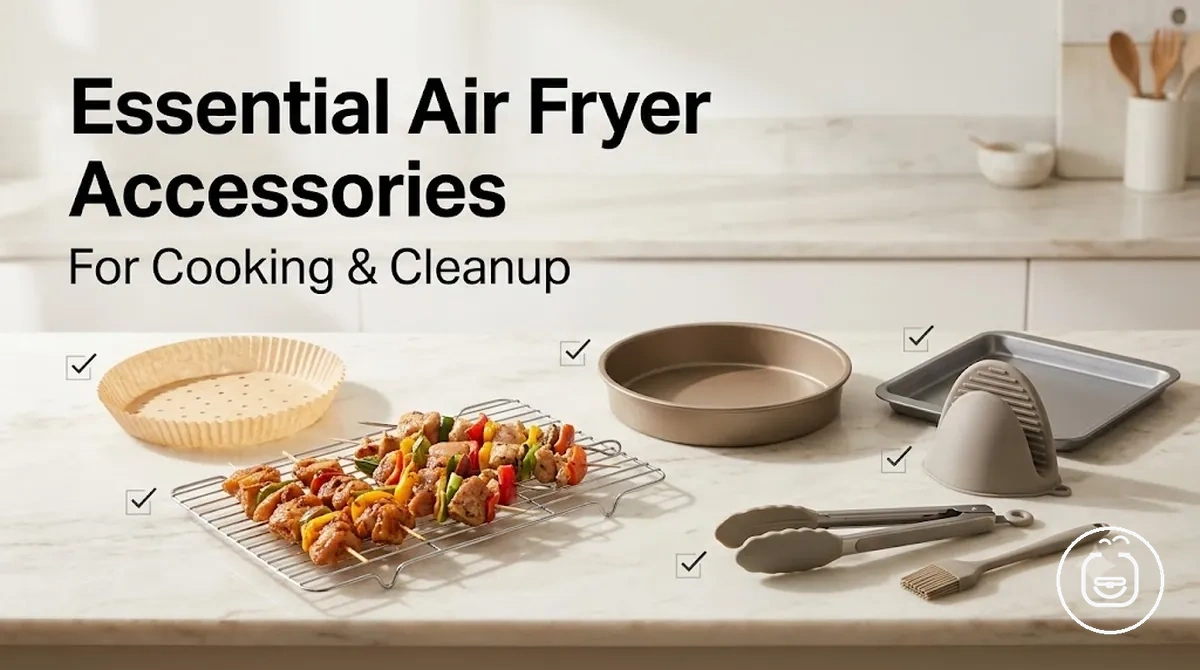
Essential air fryer accessories are cooking tools used frequently enough to improve everyday cooking outcomes such as cleanup, handling, fit, and airflow inside the basket. They are defined by repeated practical use in real cooking conditions, where they reduce friction in preparation and post-cooking cleanup while supporting safe airflow.
These essential accessories are typically identified through how they support everyday cooking tasks rather than how many items are available in a set. The selection depends on recurring needs like cleanup effort, safe handling of hot food, correct fit inside the basket, and maintaining airflow for consistent cooking results. Common accessory groups include liners for cleanup control, racks for spacing and airflow, tongs for handling, and oil sprayers for controlled coating, each serving different functional conditions rather than universal requirements.
When evaluating these essential accessories, the focus shifts to the problems they solve during use. Sticky residue or frequent cleanup challenges may point toward liners, while limited cooking space or uneven exposure may highlight racks. Handling safety during hot cooking may require tongs, and coating control for crisping may benefit from an oil sprayer. Each accessory group is judged by its condition of use, expected limitation, and impact on airflow and basket performance rather than general popularity.
In practical terms, essential accessories usually cluster around a few repeated scenarios in everyday cooking. If cleanup is a constant issue, liners become more relevant. If airflow and spacing affect results, racks gain importance. If handling or coating control is needed, tongs and oil sprayers become more useful. These priorities vary by cooking habits and basket size, so fit and airflow conditions still need careful checking before choosing any accessory.
Essential accessories can be summarized by their most consistent use-value in daily cooking rather than by completeness of a set.
- Liners support cleanup by reducing direct basket contact, especially with sticky foods.
- Racks improve airflow and spacing when cooking multiple items or thicker portions.
- Tongs improve handling safety when moving hot food inside the basket.
- Oil sprayers help control coating for more even surface cooking.
- Fit and airflow considerations determine whether any accessory improves or restricts performance.
What Makes an Air Fryer Accessory Essential
An essential air fryer accessory is a high-use tool that earns priority when it is used repeatedly, solves a recurring cooking or cleanup problem, and maintains safe basket fit while supporting airflow. Its value is not defined by how often it appears in sets but by how consistently it improves everyday cooking conditions. The core criteria include repeated use, cleanup value, airflow behavior, heat-safe material, basket fit, scratch prevention, and storage burden.
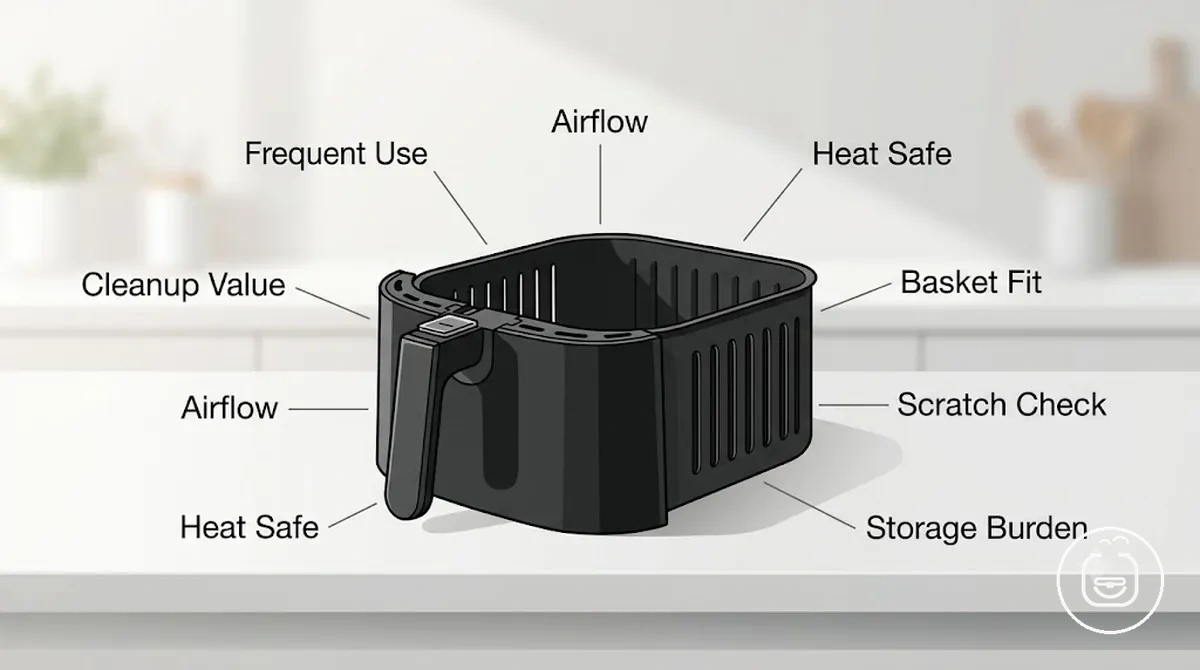
What makes an accessory essential depends on whether it solves a repeated cooking or cleanup need rather than a one-time convenience. When an item consistently reduces cleanup effort, improves handling safety, or supports stable airflow during cooking, it gains higher practical value. Frequency of use becomes important because rarely used items do not meaningfully impact everyday cooking outcomes. These conditions must also align with safe basket fit and material suitability for heat exposure, otherwise the accessory becomes unreliable in routine use.
The criteria below help verify whether an accessory qualifies as essential air fryer accessories in everyday cooking and cleanup situations.
- Frequency of use determines whether the accessory meaningfully impacts everyday cooking rather than occasional use.
- Cleanup value reflects how much it reduces residue, washing effort, or basket maintenance after cooking.
- Airflow impact checks whether heat circulation remains stable or becomes restricted during use.
- Heat-safe material ensures the accessory can withstand cooking conditions without deformation or risk.
- Basket fit evaluates clearance and placement inside the basket to avoid blocking cooking space.
- Scratch prevention reduces wear on non-stick surfaces during repeated handling and use.
- Storage burden considers whether the accessory adds unnecessary clutter or remains practical to store.
When these criteria are applied, the difference between essential and non-essential items becomes clearer under real cooking conditions. Fit and material behavior matter most because they directly influence safety and airflow performance. You can explore how these criteria connect across different tools in the air fryer accessories guide.
Not every useful item becomes essential, even if it appears popular or included in sets. Some accessories remain optional because they are used infrequently or add storage burden without improving everyday cooking. This distinction helps separate essential air fryer accessories from merely useful or unnecessary add-ons.
Essential Accessories to Prioritize First
Essential Accessories to Prioritize First depend mainly on how often each accessory supports everyday use in cleanup, space management, handling, and cooking control. Accessories that solve repeated cooking needs usually come first because they create immediate practical benefit in daily routines. The shortlist below groups accessory types by their primary job in the cooking process.
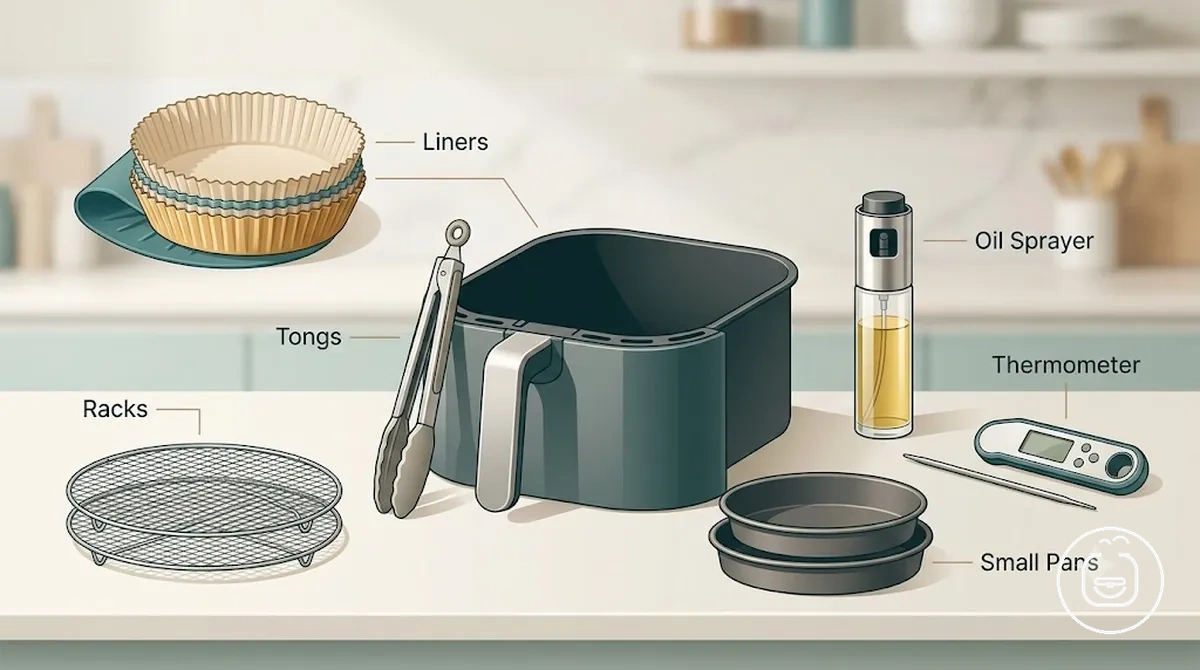
This grouping helps separate accessories by the problems they solve in real use conditions, such as sticky cleanup, limited basket space, or handling hot food safely.
- Liners reduce cleanup effort when cooking sticky or oily foods where residue builds up in the basket.
- Racks improve cooking space and airflow when preparing layered or multi-item meals in a limited basket.
- Tongs support safe handling when turning or removing hot food during or after cooking.
- Oil sprayers improve surface coating control when even crisping is needed with minimal oil use.
- Thermometers help verify doneness when cooking thicker proteins where internal temperature matters.
- Small pans or ramekins allow structured cooking for liquids, baked items, or portioned recipes inside the basket.
Liners and racks often become the first priority because they address high-frequency needs around cleanup and cooking space, especially in everyday use. Tongs and oil sprayers typically follow as they improve handling and control during active cooking.
Thermometers and small pans depend more on cooking style and are usually relevant when recipes require precision or expanded preparation methods. For readers starting with a minimal setup, these beginner accessory choices can help decide what to add first without overloading storage or use complexity.
Liners for easier cleanup and fewer stuck-on messes
Air fryer liners are most useful when cleanup friction is high, especially with sticky foods, sauces, or soft items that cling to the basket. They reduce direct basket contact, which helps limit residue buildup after cooking. In these conditions, liners become a practical way to simplify post-cooking cleanup when grease and food particles are difficult to remove.
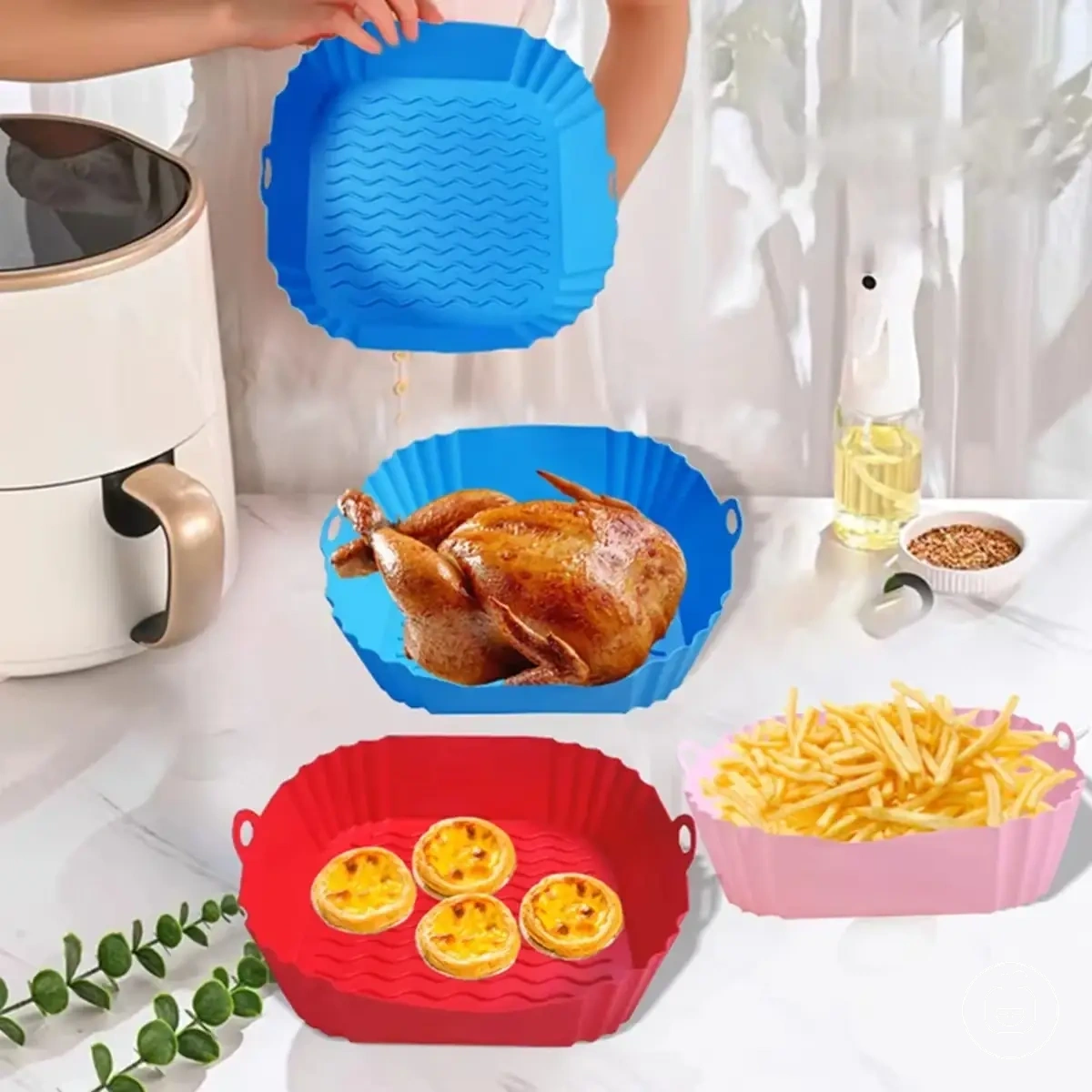
- Silicone liners work as reusable liners that reduce basket contact and require washing after use, depending on fit and heat conditions.
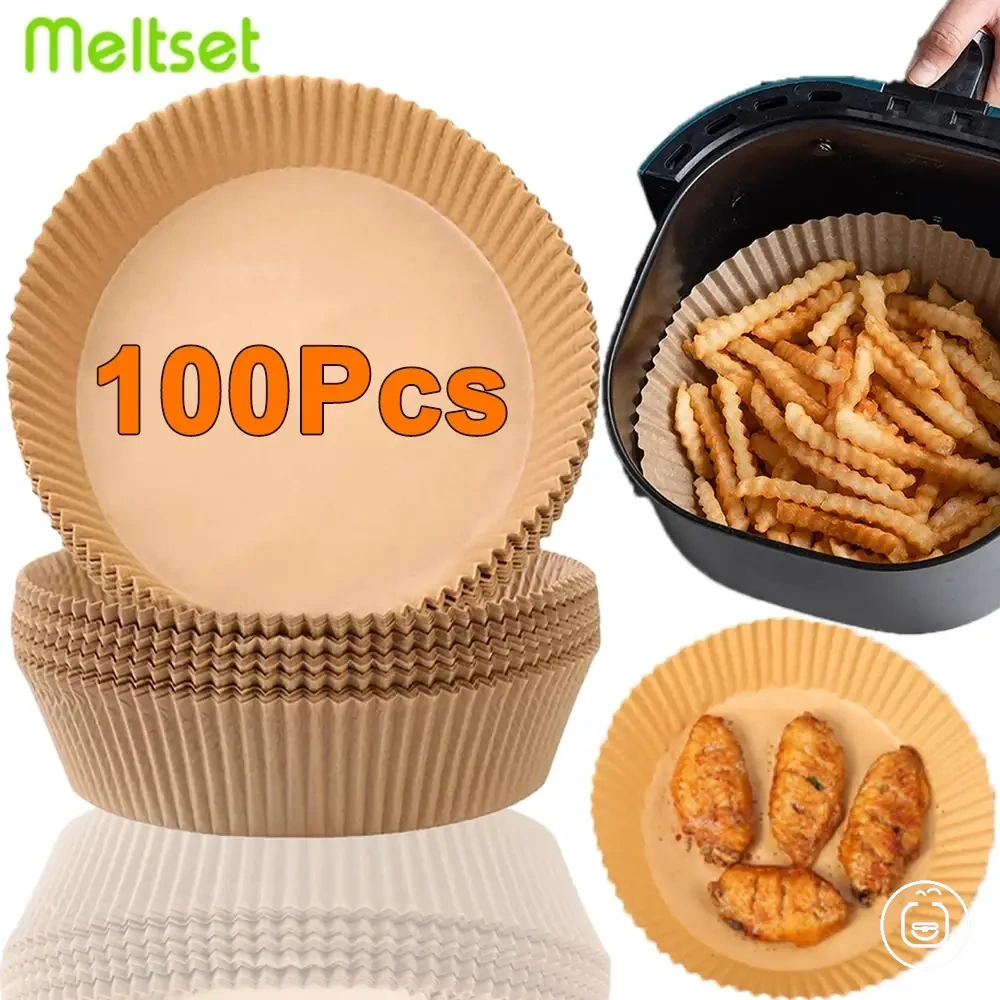
- Paper liners act as disposable liners that help manage grease and sticky residues during single-use cooking sessions.
- Perforated liners support airflow by allowing heat circulation while still reducing direct food contact with the basket.
- Bare basket use provides maximum airflow and browning when food is dry or naturally non-sticky.
These air fryer liners vary in how they interact with cleanup and cooking conditions, especially depending on grease level and food texture. Silicone liners typically support repeated use but depend on proper basket fit for stable performance. Paper and perforated liners may suit lighter cleanup needs, but airflow and food weight can influence how well they perform in different cooking setups.
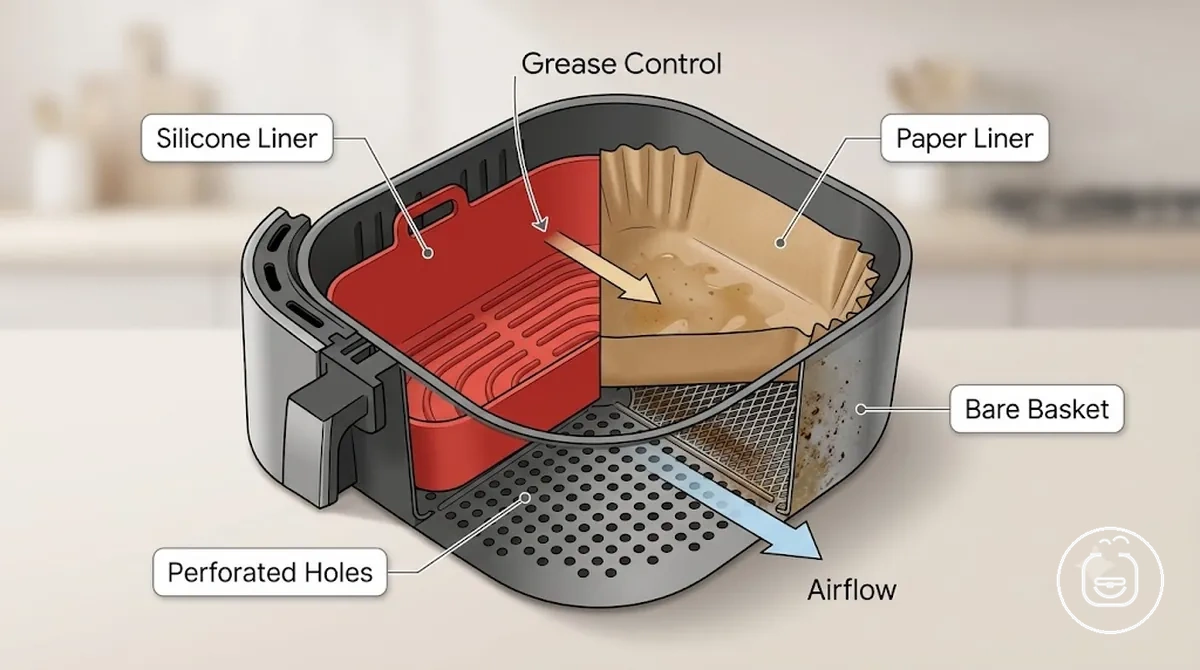
Air fryer liners are not required for every cooking situation, especially when crisping performance and airflow are priorities. In many cases, skipping liners allows better browning and more direct heat exposure. A bare basket is often more suitable when cooking dry foods or when maximum airflow is needed for texture development.
Racks for extra space and better browning
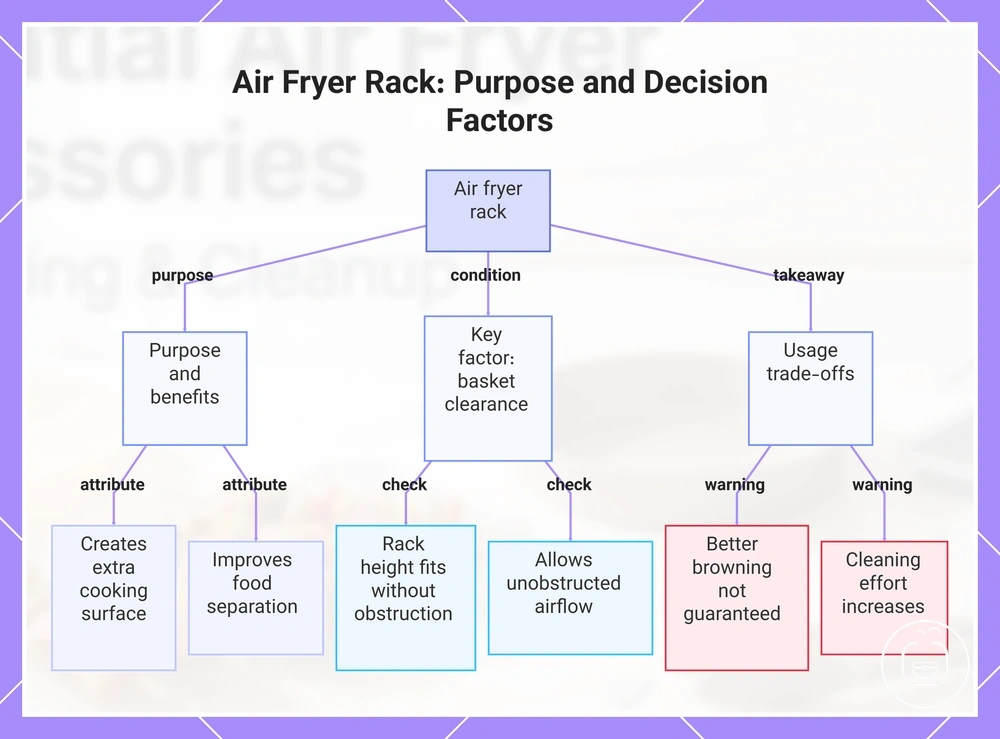
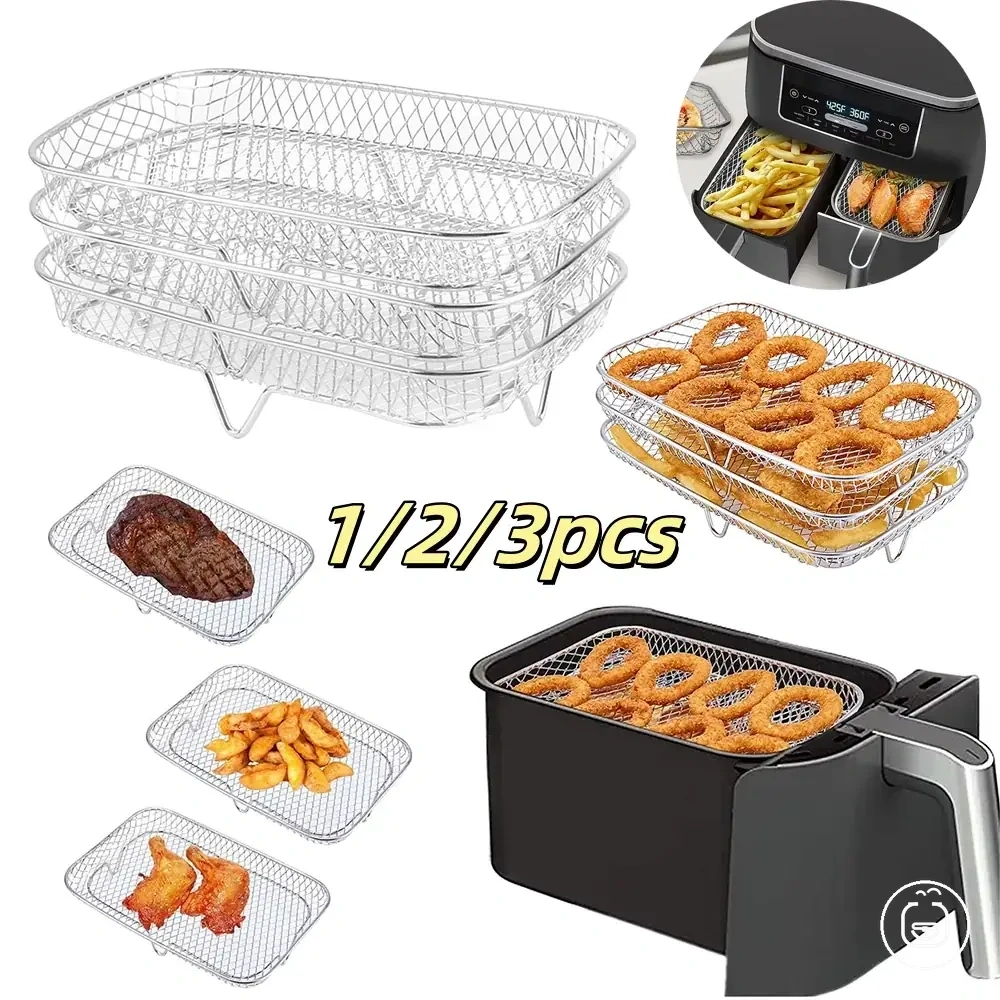
An air fryer rack is a stacking or elevating component used to create extra space inside the basket and improve food separation during cooking. It becomes relevant when the cooking setup needs more usable cooking surface or when airflow must reach multiple food layers. The key decision factor is basket clearance, since rack height must fit without blocking circulation or pressing food against the top space.
- Rack height determines how much vertical space is added and whether it fits within the basket without obstruction.
- Basket clearance affects whether stacked food layers can cook without compression or restricted movement.
- Food thickness influences whether elevated placement still allows even exposure to heat and airflow.
- Turning requirements matter when food such as wings or vegetables needs repositioning during cooking.
- Cleaning becomes more demanding as additional surfaces may collect grease and residue.
Racks are typically used when cooking needs shift toward separation between batches or layered cooking, such as wings, vegetables, or skewers. In these cases, the air fryer rack increases extra space and allows better organization inside the basket. Airflow around food layers can improve circulation depending on how much open space remains between stacked items, but this is strongly influenced by rack height and food thickness.
Better browning is not guaranteed in all situations because results depend on basket clearance and airflow conditions rather than the rack alone. In smaller baskets or tightly stacked setups, reduced circulation can limit heat exposure and affect consistency. Cleaning effort may also increase due to additional surfaces, so the decision to use a rack depends on balancing extra space against airflow limits and maintenance tradeoffs.
This chart shows the purpose of an air fryer rack, the key clearance factor for using one, and the trade-offs to consider.
Tongs, oil sprayers, and thermometers for daily control
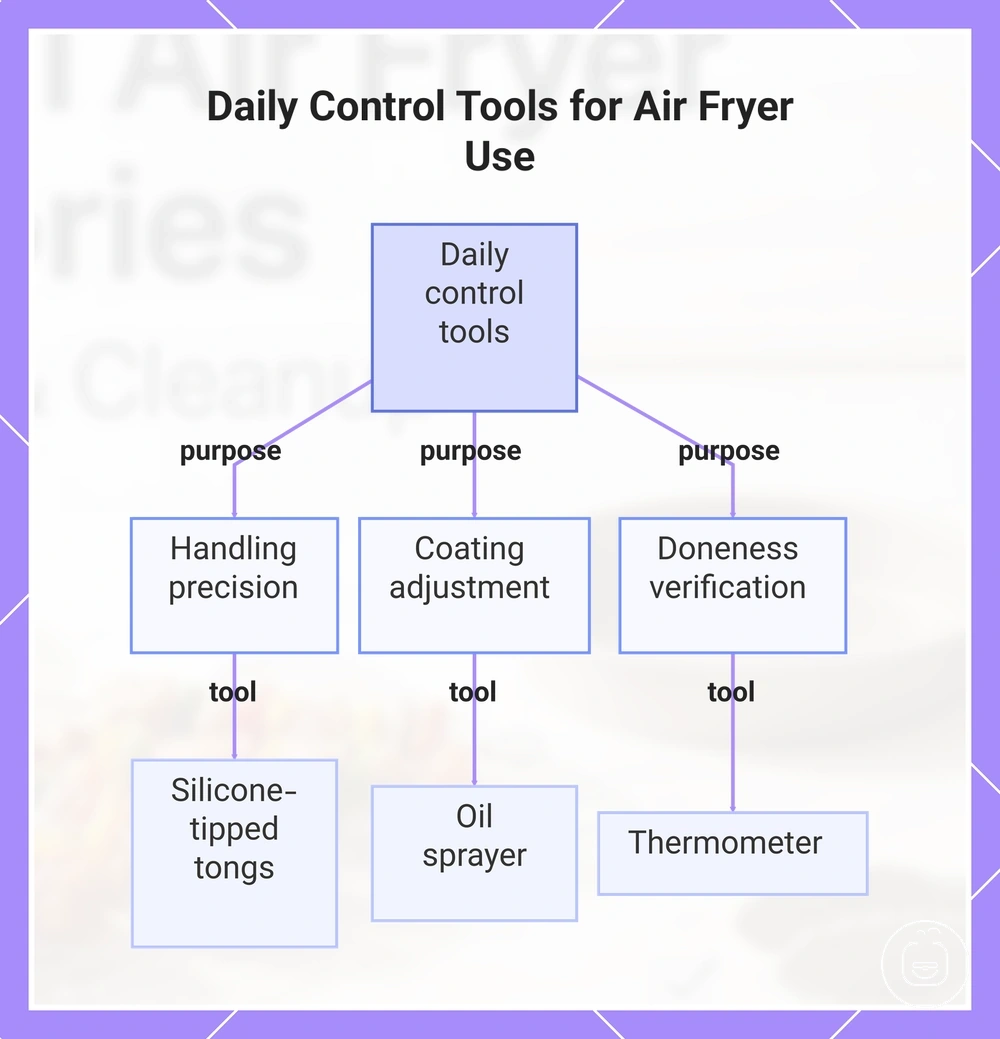
Daily control tools in air fryer use focus on handling, coating, and doneness control during routine cooking. These tools reduce handling risk, help manage surface coating, and support checking internal doneness when needed. Their role is situational and depends on the specific control challenge during cooking.
- Silicone-tipped tongs support nonstick-safe handling and turning, reducing direct contact that may affect basket surfaces during movement.
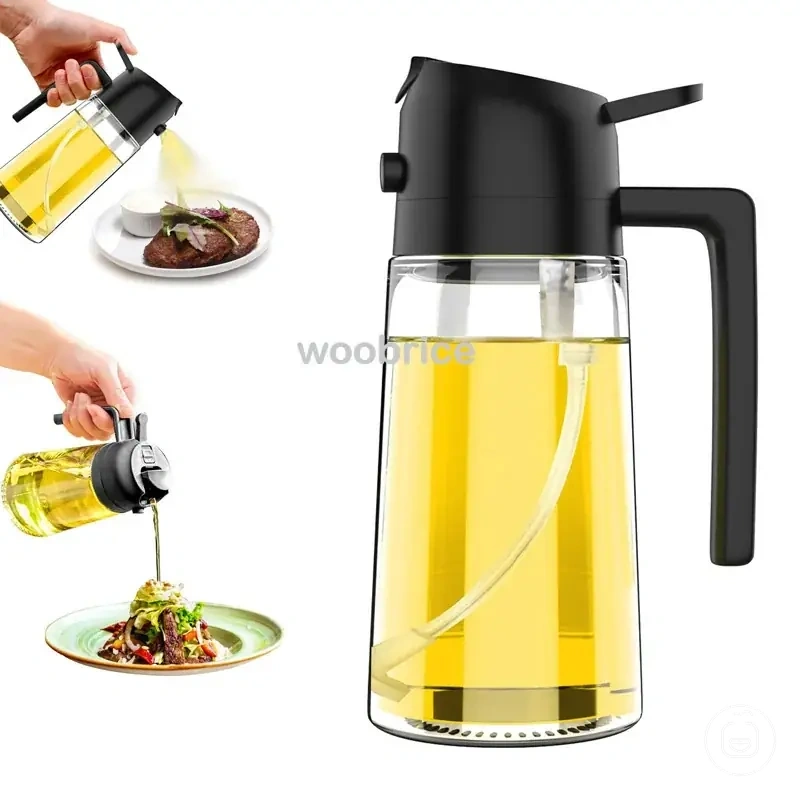
- Oil sprayer or oil mister helps apply light coating for more even surface coverage under different cooking conditions without heavy grease buildup.
- Thermometer supports internal doneness checks, especially for thicker foods where visual cues may not be reliable.
These control tools are used based on need rather than as mandatory equipment for every cooking session. Their usefulness depends on whether handling precision, coating adjustment, or doneness verification is required in that specific situation.
They do not replace cooking judgment or guarantee results on their own. Instead, they support safer handling, more controlled coating, and better-informed doneness decisions when used appropriately alongside normal cooking observation.
This chart shows daily control tools for air fryers: tongs for handling, oil sprayer for coating, thermometer for doneness, used based on need.
Small pans and ramekins for recipes that need a vessel
Small pans and ramekins depend on whether a recipe requires a contained vessel instead of direct placement in the air fryer basket or on a rack. This becomes necessary when the food cannot hold its structure on its own, such as liquids, batters, or delicate portions that need support during cooking. The deciding factor is whether containment is required for the recipe condition rather than general accessory use.
When using a small pans or ramekins, selection depends on fit, heat-safe material, and how the vessel behaves inside the basket during cooking. Small pans and ramekins must match the available basket space so airflow clearance is not blocked. Side height affects how well the recipe vessel holds its contents, especially for mixtures that expand or soften during cooking.
- Fit ensures the baking pan, small pans, or ramekins sit properly inside the basket without restricting movement.
- Heat-safe material determines whether the recipe vessel can handle air fryer conditions without deformation risk.
- Side height affects containment for liquids or batters and influences cooking stability.
- Portion size determines how much food can be prepared in a single ramekin or small dish.
- Airflow clearance ensures heat can circulate around the vessel for stable cooking conditions.
Small pans and ramekins should be treated as conditional accessories because their use depends on specific recipe needs rather than general cooking routines. Oven-safe labeling does not automatically guarantee identical performance in every air fryer setup, since basket geometry and airflow conditions may vary. These vessels are typically used only when a recipe vessel is required, making them occasional-use tools rather than universal essentials.
When a Liner, Rack, or Bare Basket Makes Sense
Direct usage choice depends on cooking goal: a liner prioritizes cleanup and grease control, a rack prioritizes airflow and added space, and a bare basket prioritizes direct contact for stronger crisping surface and browning. Each option supports a different cooking condition rather than a universal setup, and the decision usually follows what outcome matters most in that session. The three-option frame is best understood through cooking behavior rather than preference.
The comparison becomes clearer when evaluated by cooking behavior rather than preference. Food type, mess level, airflow exposure, browning need, grease control, turning access, and cleanup effort determine which setup fits best in a given situation. These factors often highlight a tradeoff between cleanup efficiency and browning intensity.
| Option | Main advantage | Trade-off | Best use case |
|---|---|---|---|
| Liner | Improves cleanup and grease control | Can slightly reduce direct airflow exposure | Sticky or high-residue foods |
| Rack | Improves airflow and space separation | May increase cleaning effort | Layered or multi-item cooking |
| Bare basket | Direct crisping surface and stronger browning | Higher cleanup effort | Dry foods needing direct heat contact |
| Liner + Rack | Balanced structure with controlled cleanup | Depends heavily on fit and airflow space | When layering is needed with controlled mess |
It is a misconception that one setup is universally optimal across all cooking conditions; liner, rack, and bare basket each serve different outcomes depending on airflow and cleanup priorities. Understanding these differences helps clarify whether liners are essential in specific cooking situations.
Accessories That Are Useful but Not Essential for Every User
Useful accessories that are not essential for every user depend on cooking habits and basket constraints. Their value changes based on how often specific cooking situations occur and whether the air fryer setup supports those conditions efficiently. These are optional accessories that add convenience in certain scenarios but are not required for everyday cooking performance.
Skewers, specialty trays, basting brushes, muffin cups, mats, and larger kits become relevant only in specific use cases. Frequent grilling may justify skewers, while baking-focused use may involve muffin cups or specialty trays. Batch cooking or structured meal preparation may rely on mats or larger kits depending on storage space and how often those cooking patterns appear.
| Accessory type | When it helps | Why it may stay optional |
|---|---|---|
| Skewers | Frequent grilling or skewered cooking | Limited use outside grilling situations |
| Specialty trays | Baking or structured cooking tasks | May not match all basket sizes or routines |
| Basting brushes | Applying coatings during cooking | Not needed for dry or low-coating recipes |
| Muffin cups | Portion-based baking or snacks | Only useful for specific baked recipes |
| Mats | Batch cooking or surface protection | Can affect airflow depending on setup |
| Larger kits | Multi-purpose cooking setups | Often include unused items that increase storage load |
Optional accessories may still remain unused even when included in larger kits because their value depends on actual cooking frequency. Larger kits especially can introduce storage burden if most components are not aligned with regular use cases. Storage space and repeated cooking need are the main factors for deciding whether these accessories are truly necessary.
How to Choose Essentials Without Overbuying
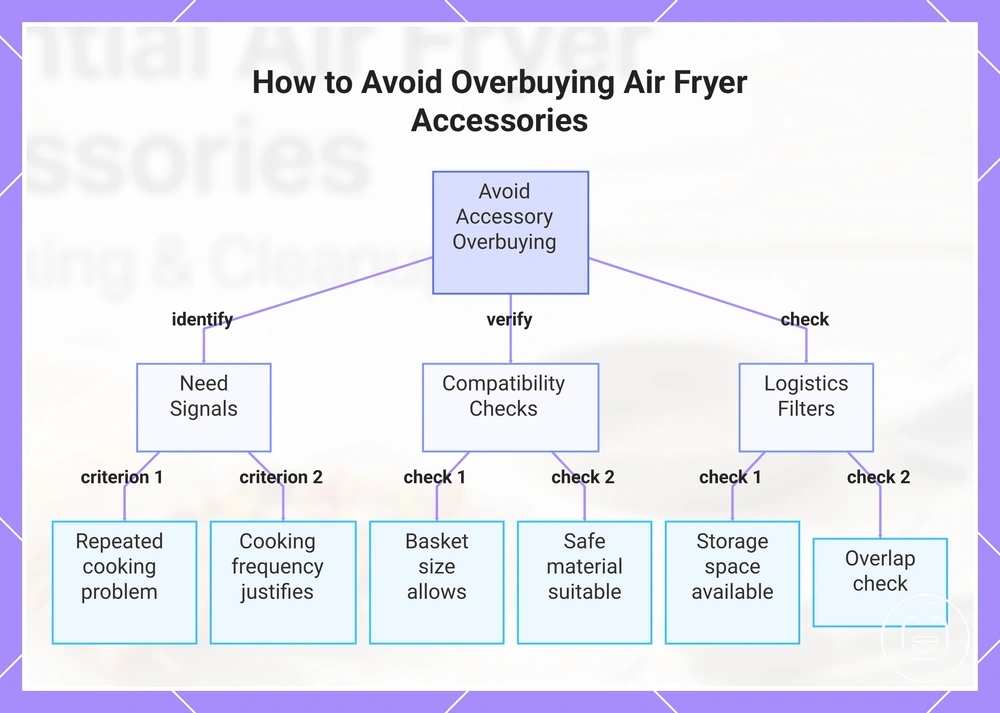
Choosing essentials without overbuying depends on identifying repeated cooking problems first and then filtering any accessory against that need. Overbuying usually happens when items are selected before the actual use case is clear, leading to unused tools and unnecessary storage pressure. The decision process should always start from repeated cooking problems and only then move toward selecting air fryer accessories that directly solve them.
The checklist below helps filter accessories before purchase and reduces decisions driven by bundles or assumptions.
- Repeated cooking problem is clearly identified (such as cleanup pain or turning difficulty)
- Cooking frequency justifies regular or repeated use
- Recipe type actually requires the accessory support
- Basket size allows safe placement and airflow
- Safe material is suitable for air fryer heat conditions
- Storage space is available without creating clutter
- Overlap check confirms one tool does not already solve the need
- Decision separates first purchase from future upgrade needs
Cooking frequency and repeated cooking problems are the strongest signals because they show whether an accessory will be used consistently or only occasionally. Cleanup pain and recipe type often define priority, while basket size and safe material determine whether the tool can function correctly in practice. Storage space also acts as a limiting factor since even useful tools lose value if they cannot be stored efficiently. In many cases, a single multi-purpose accessory can cover multiple needs and reduce unnecessary additions.
The goal is not to eliminate useful tools but to delay unnecessary ones until the actual cooking pattern is clear. First purchase decisions should always focus on repeated needs, while other items can be treated as upgrades once usage becomes more predictable. This approach reduces overbuying while still allowing gradual expansion when a clear and consistent need appears.
This chart outlines the essential checks to select only useful air fryer accessories by starting from your cooking needs and practical constraints.
Match the accessory to your most frequent cooking problem
Cooking problem matching translates a recurring cooking problem into a single accessory choice by linking the dominant pain point to the most relevant accessory choice. This method prioritizes one clear match per cooking problem instead of broad multi-item selection, which helps keep decisions focused on the actual accessory choice needed for that situation.
Sticky messes, limited space, uneven browning, awkward turning, dry coating, doneness uncertainty, and recipe containment represent common cooking problem patterns. Each cooking problem relates to a specific condition such as cleanup behavior, airflow limits, handling difficulty, coating control, or internal doneness checks. The correct accessory match depends on which condition dominates the cooking situation rather than the general category of the accessory.
| Problem | Likely accessory | Condition to check | Decision effect |
|---|---|---|---|
| Sticky messes | Liner | Grease level and residue intensity | Reduced cleanup when buildup is frequent |
| Limited space | Rack | Basket clearance and airflow gaps | Improved layering when height allows |
| Uneven browning | Rack or repositioning tool | Air circulation pattern and food spacing | More balanced exposure when airflow is uneven |
| Awkward turning | Tongs | Nonstick sensitivity and food size | Safer handling during flipping or movement |
| Dry coating | Oil sprayer | Surface dryness and coating requirement | More even coating when light oiling is needed |
| Doneness uncertainty | Thermometer | Food thickness and internal heat reach | More reliable internal checks for thicker food |
| Recipe containment | Small pans or ramekins | Liquid or batter stability requirement | Stable structure when containment is required |
Each cooking problem should be evaluated through its dominant condition before selecting an accessory, since airflow, basket size, and food type can change the outcome of the match. This structured mapping supports clearer decision-making through choose by cooking need as a criteria-based selection step.
Choose individual pieces before buying a full accessory set
Choosing between individual accessories and a full accessory set depends on cost-value alignment with repeated needs. When only one or two high-use tools are needed, individual accessories usually provide more practical control over fit and usage compared to a bundle. This approach reduces unnecessary additions when the one-or-two-tools condition applies.
A bundle becomes more relevant when cooking routines require several tools that overlap in actual use. In those cases, an accessory set may align with repeated needs, but only when included items are actively used and not redundant. Otherwise, duplicate items, unused pieces, material quality variation, and storage burden can reduce practical value.
- Use count: whether each item matches repeated needs or occasional use
- Duplicate items: whether the bundle repeats tools already owned or unnecessary
- Fit: whether items match basket size and practical handling conditions
- Storage burden: whether the set adds unnecessary storage load
- Material quality: whether included tools meet expected durability needs
- Overlap: whether the set duplicates already prioritized accessories
Many assume accessory sets are automatically better value, but this depends on how closely the included tools match real cooking behavior. In practice, individual accessories often reduce fit risk and avoid unused pieces when needs are limited. This is the key difference when comparing sets or individual accessories.
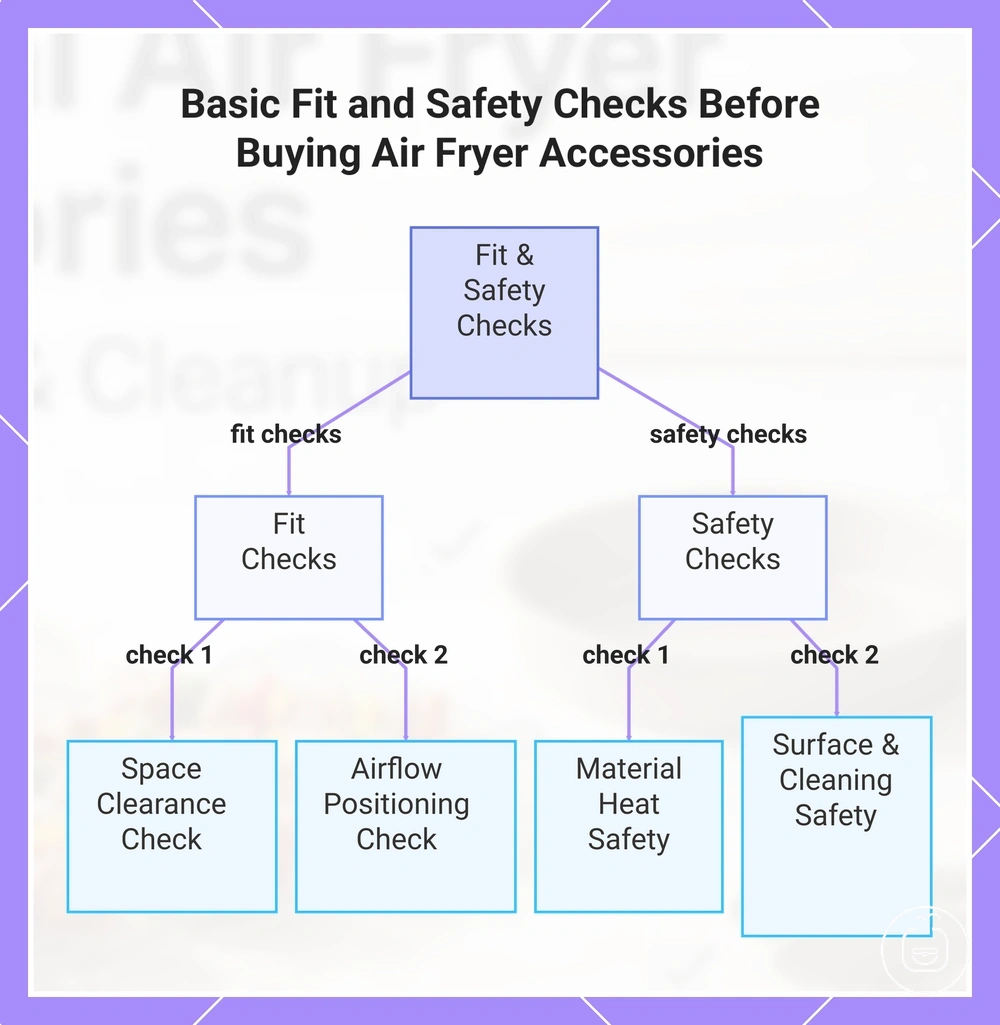
Basic Fit and Safety Checks Before Buying
Basic Fit and Safety Checks Before Buying focus on fit checks and safety checks that confirm whether an accessory can be used safely with an air fryer before purchase. These checks help reduce mismatch between accessory design and appliance constraints such as space, heat exposure, and handling limits. The goal is to verify compatibility and safe usability before comparing offers.
Different air fryer models vary in basket size, basket shape, and internal clearance, which directly affects how accessories sit and perform during use. Handle clearance can limit movement when lifting or removing items, while rack height and liner position can influence airflow stability inside the basket. These variations mean model and basket qualification must be checked before assuming usability.
Material and safety conditions also influence whether an accessory is suitable for repeated cooking use. Heat rating, food-safe material, nonstick-safe contact, and cleaning method all affect durability and safe handling over time. A checklist before comparing options helps structure these verification points before a purchase decision.
- Basket size: whether the accessory fits without blocking usable cooking space
- Basket shape: whether interior design affects placement stability
- Handle clearance: whether movement or closure is obstructed during use
- Rack height: whether vertical space remains sufficient for safe airflow
- Liner position: whether airflow is maintained without obstruction
- Heat rating: whether material can withstand operating temperatures
- Food-safe material: whether direct contact is safe for cooking use
- Nonstick-safe contact: whether surfaces avoid damaging coating layers
- Cleaning method: whether maintenance is practical and safe for reuse
Many compatibility issues only become visible during real use conditions rather than at the selection stage. Fit checks and safety checks help reduce this uncertainty by aligning accessory choice with actual physical and material constraints.
The products below are useful examples for comparing available options. Before buying, check that the compatibility criteria, key features, and product details match your needs.
This chart shows the key fit and safety checks to perform before buying an air fryer accessory to ensure compatibility and safe usability.
Basket size, shape, and airflow clearance
Basket size, basket shape, and airflow clearance determine whether an accessory can function properly inside an air fryer without blocking air movement. These fit checks define how the accessory sits in the cooking chamber and how air circulates around it during use. In most cases, airflow clearance is the deciding condition for safe and stable operation.
In different air fryer designs, round basket and square basket layouts change how accessories align with available space. Depth influences how far an accessory can sit without entering restricted heat zones, while rack height and food height affect vertical spacing inside the basket. Liner overhang and available space around the accessory also influence whether airflow remains consistent. Basket dimensions cannot be judged only by nominal capacity because internal shape and usable space may vary.
Fit issues typically appear when accessories reduce circulation or exceed internal clearance limits during real cooking conditions. A dual-basket setup can introduce separate airflow zones, but each still depends on maintaining adequate clearance for stable performance. Safe fit depends on verifying that basket size, basket shape, and airflow clearance remain within usable limits during actual use conditions.
Heat-safe materials and nonstick-safe handling
Heat-safe materials and nonstick-safe handling define whether an accessory can be used safely under air fryer conditions and how it interacts with coated surfaces. These material checks act as purchase-level safety filters because heat exposure, food contact, and cleaning behavior directly influence durability and risk during repeated use. Manufacturer temperature guidance should always be used as the primary reference for confirming suitability.
Food-grade silicone, stainless steel, and parchment are commonly used heat-safe materials, but their suitability depends on their heat rating limits and how they are applied in the basket. Silicone-tipped tools support nonstick-safe handling by reducing direct surface contact, while nonstick coatings require careful use to avoid scratches during turning or removal. Dishwasher claims vary by product type and should be considered only alongside temperature guidance and material limits.
Nonstick-safe handling becomes critical when repeated scraping, metal contact, or worn surfaces increase the risk of coating damage over time. Silicone-tipped tools may reduce abrasion risk, while stainless steel tools typically require more controlled handling depending on surface sensitivity. Questionable materials or visibly damaged coating should be treated cautiously rather than assumed safe for continued use.
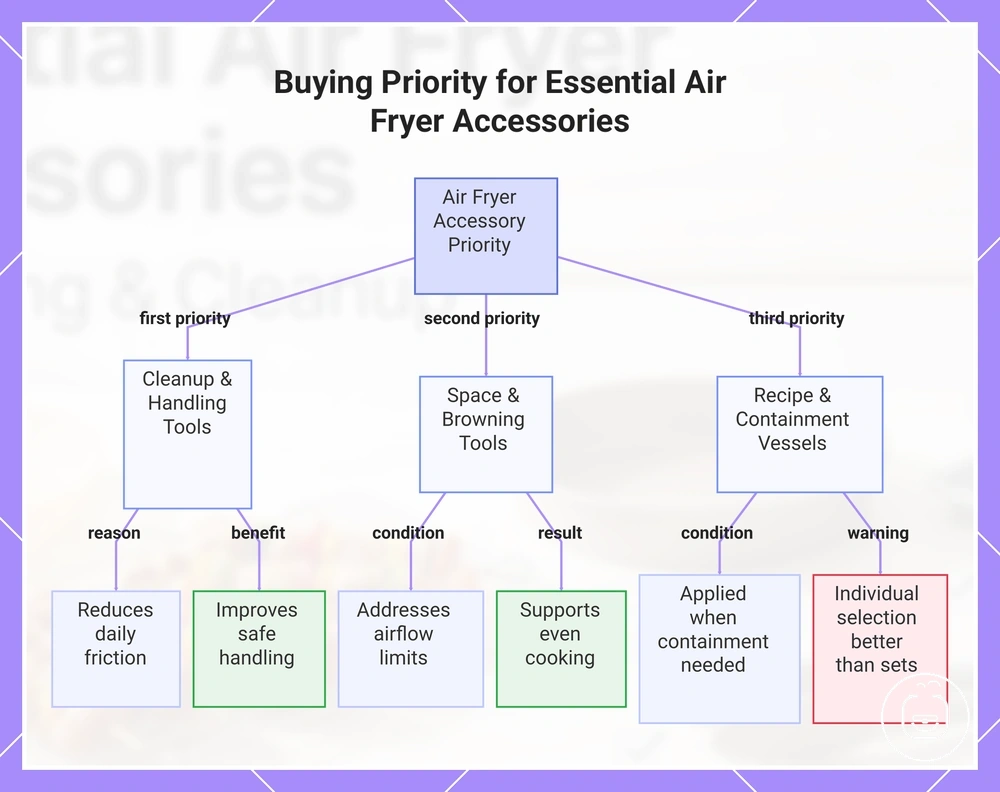
Buying Priority for Essential Air Fryer Accessories
Buying Priority for Essential Air Fryer Accessories depends on need, fit, safety, and frequency of use, and it helps structure the decision around the most unresolved cooking or cleanup requirement. The goal is to avoid random selection and instead follow a clear buying order based on real usage conditions.
Cleanup and handling tools come first when residue buildup or frequent turning creates daily friction during cooking. These essential air fryer accessories directly affect routine usability by reducing effort during cleanup and improving safe handling of hot or coated surfaces. In most cases, cleanup and handling needs take priority because they are part of every cooking cycle.
Space and browning tools come next when airflow limitations or uneven cooking appear in repeated use scenarios. Rack-based setups or similar solutions may support better circulation when fit allows, while recipe vessels become relevant only when the dish requires containment. These decisions depend strongly on fit conditions and cooking safety rather than general preference.
The idea that an accessory set is always the most efficient option is not accurate, as accessory set value depends on repeated needs and actual usage of included items. In many cases, individual selection better matches real cooking behavior, especially when only specific tools are needed. No new accessory categories should be assumed beyond the established needs of cleaning, spacing, and cooking support.
Final selection should always reflect the strongest unresolved cooking need, while also checking fit, safety, and frequency of use before purchase. Products shown are illustrative examples and should be evaluated against the specific air fryer model and usage conditions before any decision is made.
The products below are useful examples for comparing available options. Before buying, check that the compatibility criteria, key features, and product details match your needs.
This chart shows the recommended buying priority for air fryer accessories, based on unresolved cooking needs and usage conditions.