Air Fryer Accessories and Cooking Results
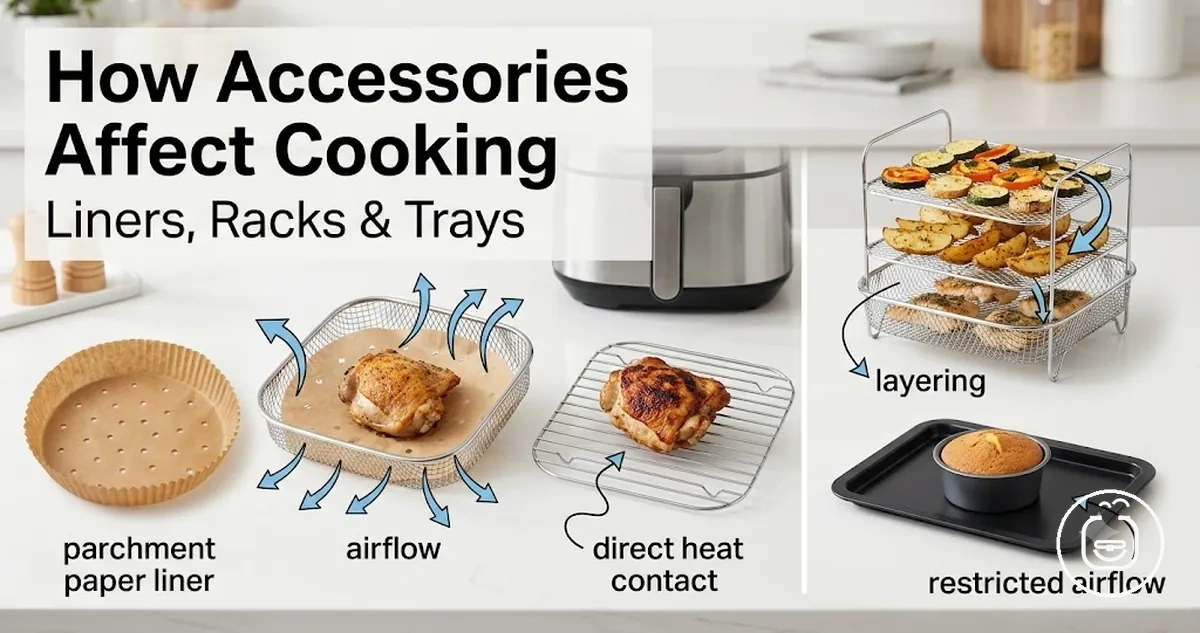
Air fryer accessories are add-ons and inserts that can change cooking results by influencing airflow, contact, spacing, moisture control, and finish inside the basket. Their effect is conditional rather than fixed, meaning outcomes like crisping, browning, and texture depend on how they interact with food load, fit, and placement.
These air fryer accessories affect cooking results by changing how hot air moves around food in the basket and how much direct or indirect contact occurs during cooking. Depending on basket shape, accessory fit, food type, and load size, they can support more even cooking or introduce constraints that alter crisping, browning, and overall texture. The same accessory may perform differently across different setups because airflow and moisture behavior are not constant.
Liners, racks, trays, and similar tools modify the cooking environment before heat fully develops, changing how food is exposed to air circulation and surface contact. This shift explains why cooking results can vary even when the same settings are used, and it sets the foundation for understanding how each accessory changes airflow, spacing, and heat interaction inside the basket.
What changes when accessories sit between food and the air fryer basket
What changes when accessories sit between food and the air fryer basket is the cooking environment, as accessory position introduces height, separation, contact surface, lining, spacing, and moisture differences. These shifts affect how airflow reaches the food surface and how heat interacts with it, which can influence texture and evenness depending on the setup.
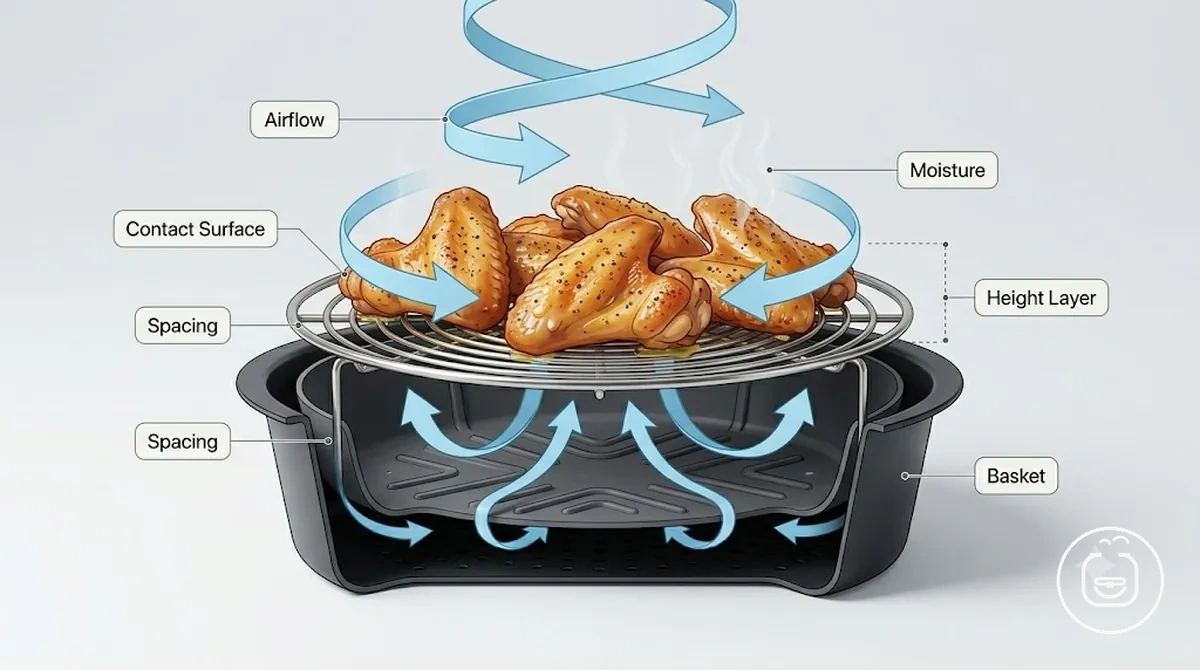
Accessory position in the basket changes how the food surface meets airflow and contact conditions during cooking. When an insert or raised layer sits between food and the basket, it creates a barrier that alters direct contact surface and reshapes spacing inside the cooking environment. This can influence moisture behavior and airflow distribution, which may affect texture and evenness depending on how tightly the basket is loaded.
This barrier effect comes from the relationship between accessory position, airflow, and contact surface inside the basket. A liner can increase separation and affect moisture retention, while a raised rack changes height and surface exposure to heat. These shifts do not guarantee a fixed result but instead change the conditions that influence browning, texture, and evenness, depending on fit and food load. These principles form the basis of the air fryer accessories guide.
Different accessory types modify the cooking environment in different ways rather than producing uniform outcomes. Liners mainly affect lining and moisture, racks adjust spacing and height, and trays influence direct contact with the cooking surface. These variations explain how accessory types relate to results and are further explored in accessory types and results.
How airflow changes crisping, browning, and cooking evenness
Airflow is the movement of hot air through the basket that connects accessory setup to crisping, browning, and cooking evenness. It controls how evenly heat reaches the food surface and how consistently color and texture develop during cooking. This makes airflow the central mechanism behind surface response inside the basket.
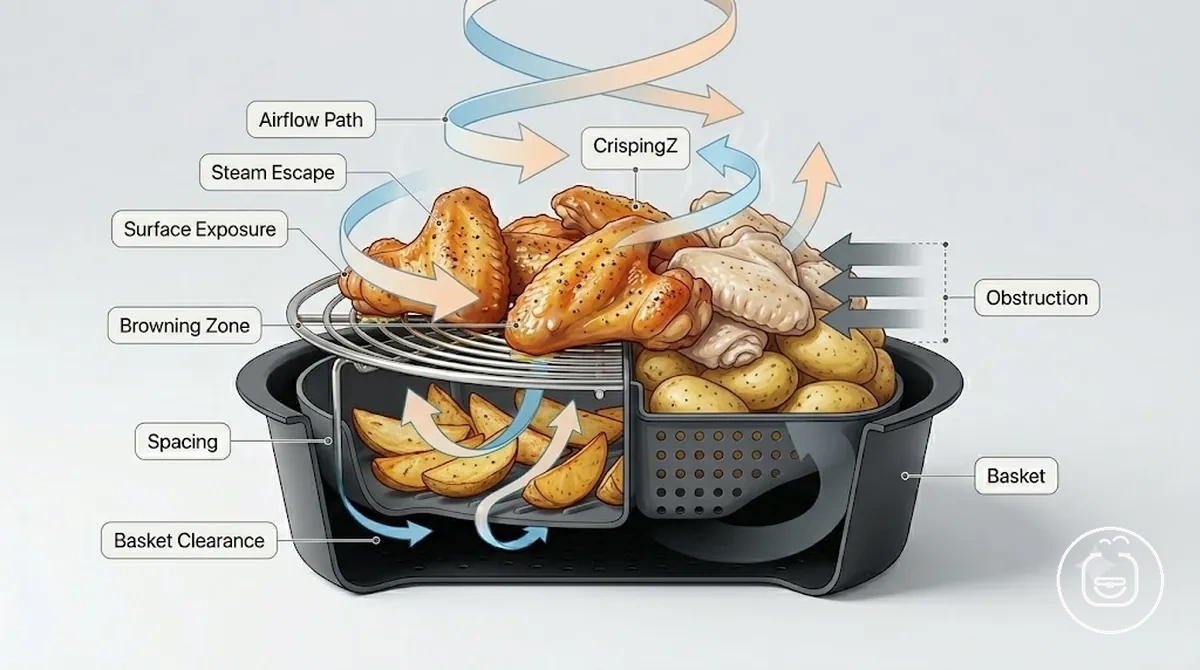
Airflow changes how surface exposure and obstruction form around the food inside the basket. Obstruction happens when an insert or layer partially blocks the circulation path, while basket clearance and perforation affect how freely hot air moves through gaps. Steam escape also plays a role by influencing moisture levels around the food surface, which can shift texture and evenness depending on spacing and airflow direction.
When airflow attributes vary across setups, it becomes useful to organize them by how they influence cooking results. The table below summarizes how air path, surface exposure, perforation, clearance, food spacing, and steam escape interact with crisping, browning, and cooking evenness.
| Attribute | Helpful condition | Risk condition | Likely result |
|---|---|---|---|
| Air path | Open circulation path | Blocked airflow channels | More or less even heat exposure |
| Surface exposure | Food widely exposed to airflow | Covered or shielded surfaces | Varied crisping and browning |
| Perforation | Allows air movement through layers | Solid barriers without openings | Changes in bottom texture |
| Clearance | Enough space in basket | Crowded arrangement | Uneven cooking distribution |
| Food spacing | Separated pieces | Overlapping food | Inconsistent browning |
| Steam escape | Moisture can exit freely | Trapped steam inside basket | Softer texture development |
Airflow effects depend on whether circulation is supported or restricted by accessory design and basket conditions. When airflow is supported, surface exposure tends to increase and results can shift toward more consistent texture development, while obstruction can reduce evenness depending on load and spacing. In practical use, choosing how to use accessories without blocking airflow helps maintain balanced circulation paths inside the basket.
How racks and raised inserts expose more food surface
Racks and raised inserts expose more food surface by lifting food away from the basket floor and reducing overlap between pieces. This elevation increases surface exposure and allows more sides of the food to remain open during cooking. The effect depends on correct rack fit, stable placement, and controlled load height inside the basket.
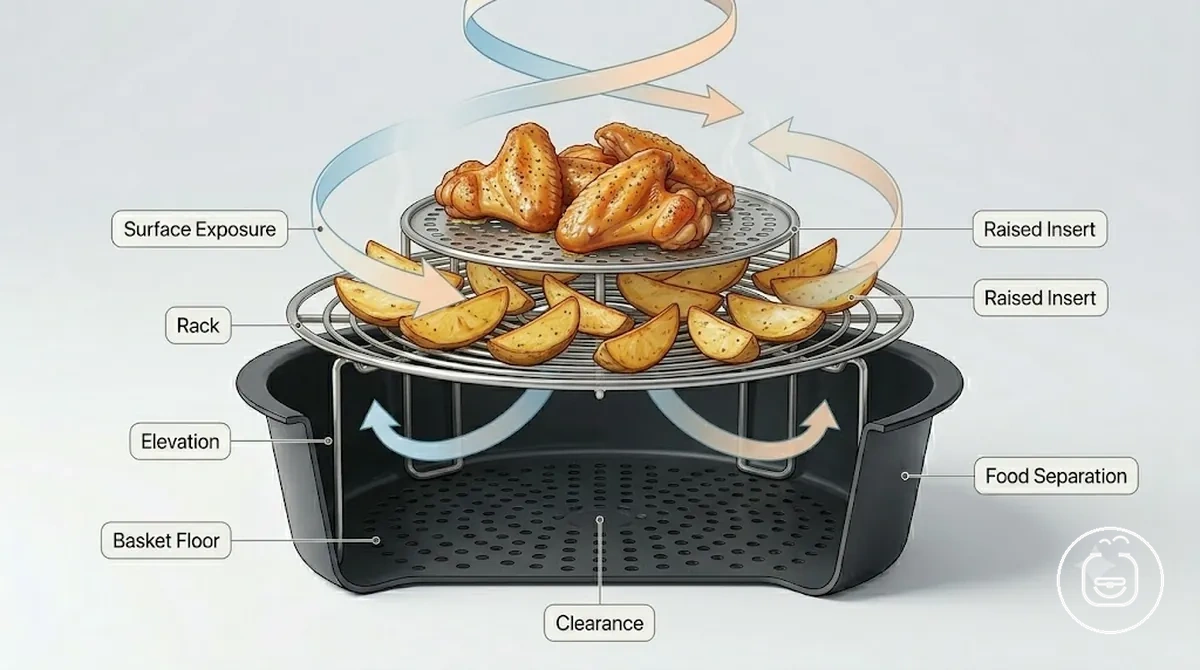
Elevation changes how surface exposure develops by creating a gap under the food and improving side exposure. Raised inserts also influence food separation, basket floor clearance, and load height, which together determine how evenly heat reaches exposed areas. When spacing is balanced, crisping and evenness may improve, but overcrowding or excessive height can reduce stability and limit circulation around the food.
Racks and raised inserts are most effective when they match the food type and avoid overloading the vertical space inside the basket. For example:
- Breaded foods that need full coating exposure for consistent surface contact
- Fries or wedges that require separation to reduce overlap and uneven browning
- Small meat pieces that benefit from spacing to improve side exposure
These results depend on elevation, load height, and food arrangement, and they may vary when airflow conditions or basket space are restricted.
Rack height, spacing, and separation for crispier surfaces
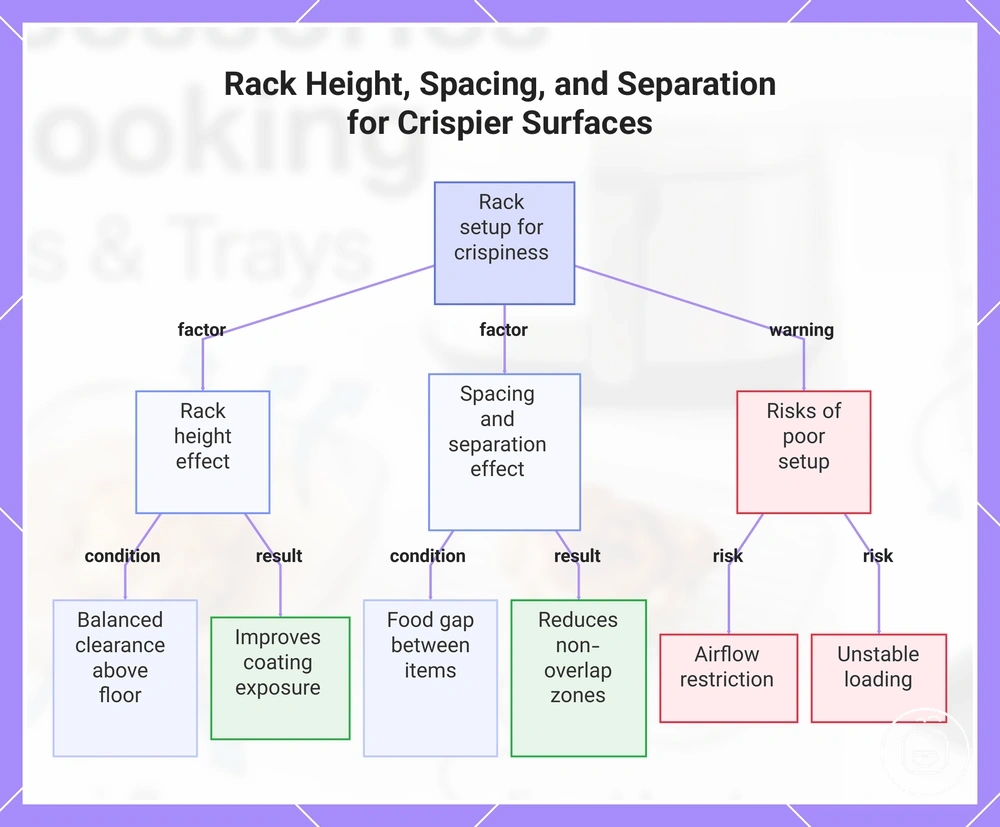
Rack height, spacing, and separation affect crispier surfaces by controlling how much of the food surface stays open to heat and airflow within the raised-insert setup. When rack height creates balanced clearance above the basket floor, more surface areas can remain exposed instead of pressed or overlapped. This improves access to coating exposure and supports more consistent surface development when load conditions are stable.
Spacing and separation influence crispiness by reducing non-overlap and improving food gap distribution across the rack. When pieces are properly separated, heat can reach more sides, but if rack height is too high or spacing becomes crowded, airflow restriction and unstable loading may reduce performance. The effect depends on controlled elevation, even spacing, and maintaining balanced clearance rather than maximizing height or layers.
- Clearance: space between rack and basket floor that supports surface access
- Food gap: separation between items to reduce blocked surfaces
- Non-overlap: prevents stacked zones that reduce crispier surfaces
- Turning: exposes hidden sides for more even texture development
- Coating exposure: keeps breaded surfaces open to heat contact
This chart explains how rack height and spacing affect crispiness, including key conditions, results, and risks of poor setup.
Skewer racks and multi-layer racks for more even exposure
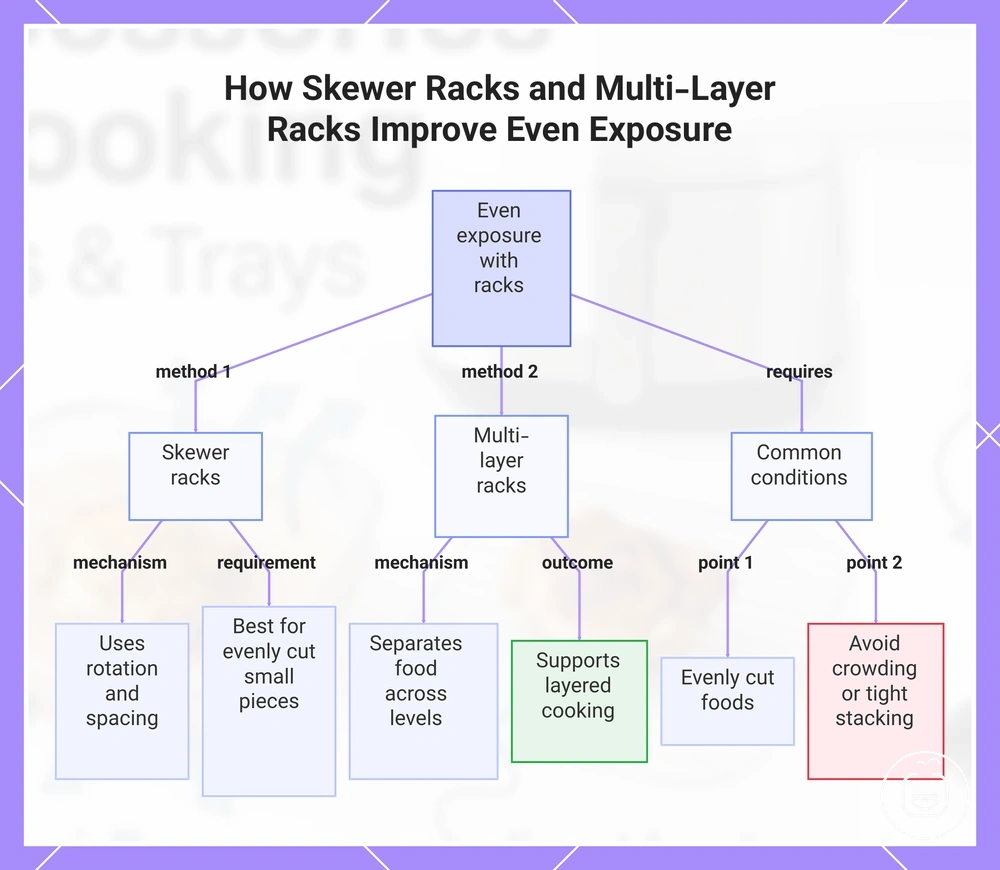
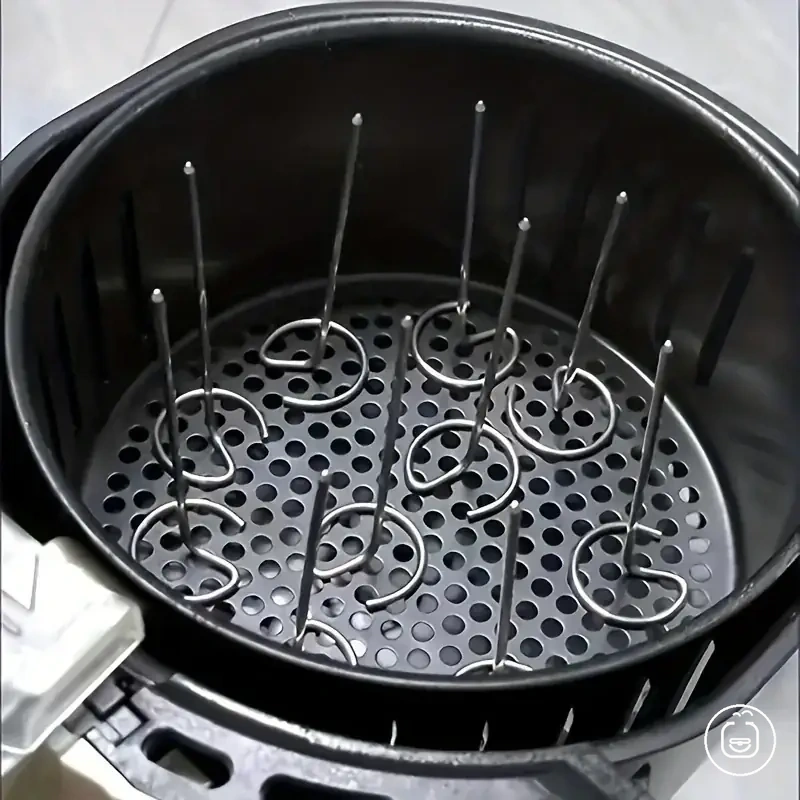
Skewer racks and multi-layer racks improve even exposure when food size is consistent and arranged for stable spacing. Skewers expose multiple sides of small pieces by allowing rotation, while multi-layer racks separate food across levels to distribute heat exposure more evenly. This works best with evenly cut foods where rotation and alignment can function without obstruction.
Skewer rack use depends on rotation, food size, and how tightly pieces are placed, while multi-layer racks depend on layer distance, drip path, and heat exposure balance across levels. Skewers can expose all sides when spacing allows free turning, but uneven cuts reduce consistency. Multi-layer setups can support layered cooking for evenly cut foods such as small vegetable chunks, uniform meat strips, or similar bite-sized portions, where drip flow and heat exposure remain balanced across layers. However, crowding or tight stacking may reduce even exposure and limit airflow between layers.
This chart outlines the two rack methods for improving even heat exposure and the key conditions required for optimal results.
How trays, baking pans, and grill pans change heat contact
Tray, baking pan, and grill pan change heat contact by controlling how food touches the cooking surface and how heat transfers between food, the insert surface, and moving air. A tray usually keeps contact thinner and more open, while baking pans and grill pans increase structured contact through depth or surface shaping. These changes directly affect contact surface balance between support and airflow.
Tray use typically provides shallow food support with partial contact and often relies on perforation or open structure to maintain airflow beneath the food. This setup helps stabilize small or evenly cut portions while reducing excessive moisture buildup under the base. Depending on food thickness and spacing, the texture may shift between lighter browning and softer contact zones due to limited but consistent surface interaction.
Baking pan and grill pan modify heat contact more strongly through pan depth and surface design. Baking pan depth increases moisture retention and supports shaped or layered foods, which can influence internal softness and surface development depending on thickness. Grill ridges reduce full-surface contact and create raised contact points that affect browning patterns and surface marks, especially when food does not fully conform to the ridged structure.
These differences in heat contact can be understood more clearly when compared side by side based on how each accessory structures support, moisture, and surface interaction.
| Accessory surface | What it changes | Result effect | When to qualify |
|---|---|---|---|
| Tray | Light contact with partial perforation and base support | Balanced airflow access with moderate surface interaction | When small or evenly spaced foods are used |
| Baking pan | Increased pan depth and enclosed contact area | Higher moisture retention and structured texture formation | When batter-based or layered foods are used |
| Grill pan | Raised grill ridges limiting full surface contact | Distinct browning patterns and partial surface marking | When surface marking or ridged contact is desired |
Flat trays and crisper plates for direct bottom support
Flat tray and crisper plate provide direct bottom support by shaping how food sits on the cooking surface and how heat reaches the underside through contact and airflow. This bottom support influences bottom contact behavior, where texture changes depending on perforation level and how much of the food base is exposed to moving air versus surface contact.
A flat tray increases bottom contact through a continuous surface and tray edge stability, which can help maintain food shape while limiting movement during cooking. A crisper plate introduces perforation that reduces full bottom contact and supports stick prevention while allowing oil drainage through openings. For example, soft items that need structure may benefit from flat tray support, while breaded or coated foods may rely on perforation for better underside airflow and drainage, depending on moisture retention and food thickness. Outcomes vary based on how airflow reaches the underside.
Baking pans and grill pans for shape, moisture, and surface marks
Baking pan and grill pan change cooking results by controlling how food holds shape, retains moisture, and develops surface marks through differences in pan depth, ridges, and contact area. Baking pan supports structured food shapes and steadier steam retention, while grill pan reduces full contact through raised ridges that influence where browning occurs. The main tradeoff is between moisture retention and more defined surface marking.
Pan shape influences results more than accessory name alone when comparing baking pan and grill pan, because depth and ridges directly change how food interacts with heat and surface contact.
| Aspect | Baking pan (Shape/Moisture) | Grill pan (Surface/Contact) |
|---|---|---|
| Pan structure | Deeper form supports food structure | Raised ridges reduce full contact area |
| Moisture behavior | Higher steam retention depending on food thickness | Lower retention due to open ridge spacing |
| Surface effect | More uniform surface development | More defined surface marks from ridge contact |
| Outcome condition | Depends on food structure and pan depth | Depends on ridge contact and food thickness |
Baking pan typically increases pan depth, which helps maintain food structure and can retain steam depending on food thickness and load. Grill pan uses ridges that reduce continuous contact and create segmented surface marks, which may vary based on how evenly food sits on the raised structure. Results from both pans remain conditional and depend on food type, thickness, and heat exposure.
How liners trade crispiness for cleaner cooking
Liners trade crispiness for cleaner cooking by adding a barrier between food and the basket that can reduce mess but may soften or slow crisping when airflow is interrupted or moisture is trapped underneath. The result depends on how much airflow still reaches the bottom surface through the liner setup.
Liners affect crispiness through paper liner, perforated liner, and silicone liner behavior, along with factors like liner thickness, hole pattern, and basket coverage. A paper liner often increases basket coverage and can reduce airflow under food, which may lead to moisture pooling and softer bottom texture. A perforated liner allows partial airflow through holes, which can support better bottom texture while still reducing cleanup. A silicone liner adds a thicker reusable base that may hold more moisture depending on load and fit. These variables shape the balance between crispiness, cleaner cooking, and cleanup.
To clarify how different liner conditions influence results, the trade-off between airflow, texture, and cleanup is summarized below.
| Liner condition | Airflow effect | Texture effect | Cleanup effect |
|---|---|---|---|
| Perforated paper liner | Partial airflow maintained | Moderate bottom crispiness | Cleaner basket surface |
| Solid paper liner | Reduced airflow under food | Softened bottom texture possible | High cleanup reduction |
| Silicone liner | Limited direct airflow at base | May increase moisture pooling and softer texture | Reusable cleanup layer |
| Poor fit / over-coverage | Uneven airflow distribution | Inconsistent crispiness | Unstable cleanup benefit |
In some setups, liner safety and material suitability depend on heat-safe use and proper fit, but those checks belong to materials and cooking safety. This section focuses only on how liners influence crispiness and cleanup behavior.
Perforated liners and airflow-dependent crisping
Perforated liner affects airflow-dependent crisping by allowing more airflow through hole patterns compared to solid liners while still creating a barrier between food and the basket. This preserves partial air movement under the food, which can support bottom crisping and evenness, but the effect remains conditional based on setup and load conditions.
Hole pattern, liner fit, food weight, and moisture release determine how much airflow actually reaches the bottom surface. A more open hole distribution can improve airflow paths, while tighter patterns reduce circulation and shift results toward softer texture. Liner fit influences how evenly air passes underneath, and heavier food weight can compress airflow gaps, limiting movement and reducing bottom crisping potential. These effects vary by configuration and do not fully replicate open basket airflow in every case.
Silicone liners and softer bottom texture
Silicone liner can contribute to a softer bottom texture when it reduces direct heat contact between the food and the basket while also increasing the chance of trapped moisture underneath. This effect typically appears when the barrier created by the liner slows heat transfer at the base. The result is more moisture remaining under the food surface instead of evaporating, which can shift the underside toward a softer finish.
Silicone liner behavior depends on liner thickness, raised ridges, food moisture, oil pooling, and basket clearance. A thicker silicone liner can increase separation from direct heat contact, while raised ridges may create uneven contact points that still limit consistent heat transfer. When food moisture and oil pooling accumulate under reduced basket clearance, trapped moisture can increase and soften the bottom texture further. These effects vary by setup, and improved drainage or more clearance can sometimes reduce softness and support more balanced cleanup behavior without guaranteeing a specific result.
How oil sprayers and handling tools change the finish
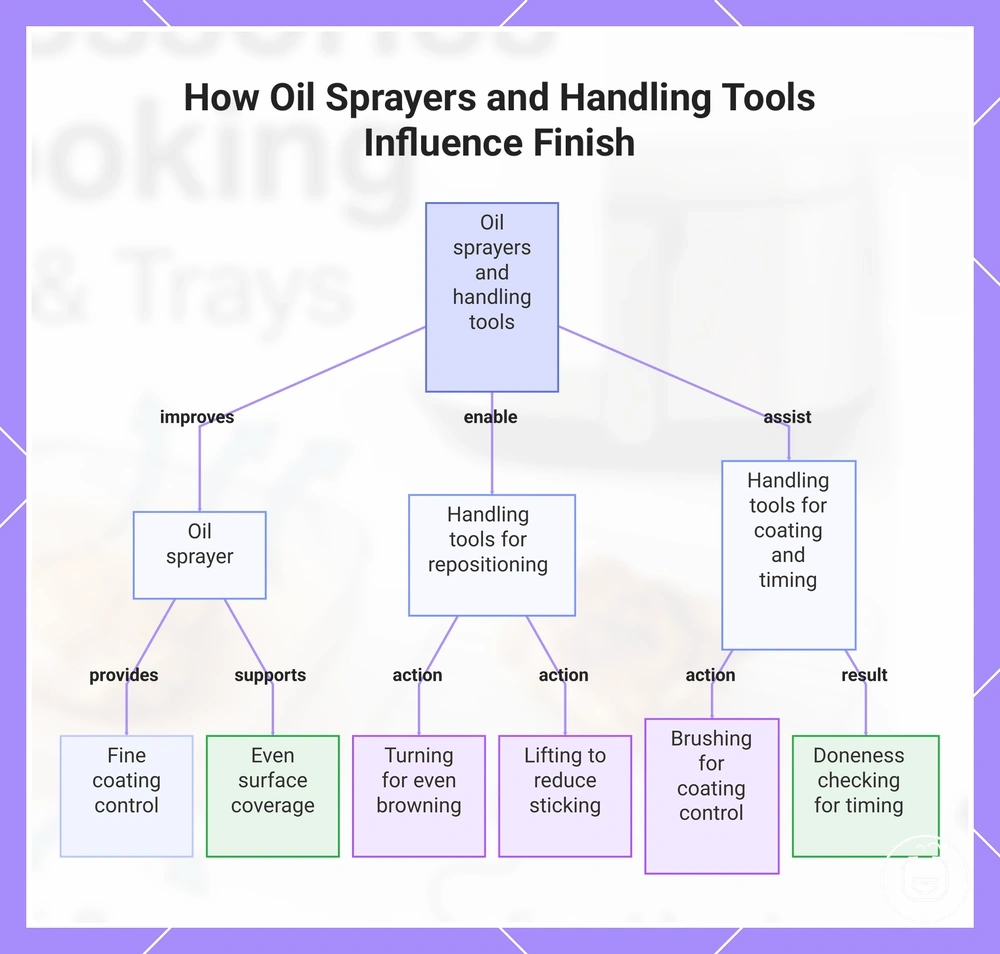
Oil sprayer and handling tools influence finish by improving coating control, turning, lifting, and food handling during cooking. They shape how oil is distributed and how surfaces are managed rather than changing airflow conditions like structural accessories. This keeps finish control focused on surface behavior and handling timing rather than circulation changes.
When an oil sprayer is used early or during cooking, fine oil distribution can support more even surface coverage, which may influence browning consistency and reduce uneven dryness in some cases. If excess oil is applied or handling is delayed, sticking can increase and surface finish may become less uniform depending on food thickness and timing. Turning, lifting, and repositioning with handling tools such as tongs or a brush can adjust contact points, which may affect browning balance and surface stability during doneness checks.
Finish outcomes depend on how surface coating and handling actions are organized during cooking. The tools below show how different functions contribute to finish control.
- Oil distribution: oil sprayer supports fine coating control across the surface
- Turning: handling tools help reposition food for more even browning
- Lifting: tongs reduce sticking and adjust contact points during cooking
- Brushing: brush improves coating control and surface coverage consistency
- Doneness checking: handling tools support timing decisions and cooking confidence
This chart shows the main tool categories and their specific functions that affect finish during cooking.
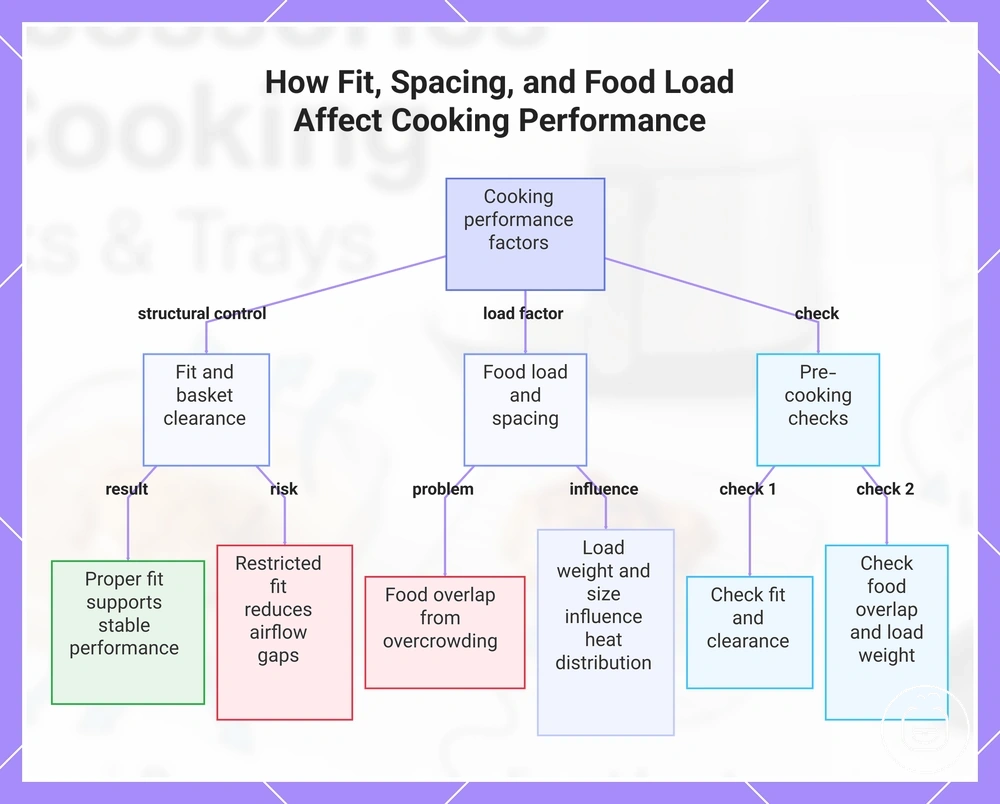
How fit, spacing, and food load affect cooking performance
Fit, spacing, and food load affect cooking performance by determining how much usable basket clearance remains for heat movement around the food. When an accessory is too large, crowded, tall, or mismatched to the food load, cooking performance can drop through reduced crisping and uneven results. The main risk condition is overcrowding or restricted airflow gaps caused by poor fit or excessive load.
Fit defines how well an accessory matches the basket shape and how much basket clearance remains during cooking. When fit is too tight or too tall, it reduces airflow gaps and limits heat movement around the food surface. Proper fit supports more stable cooking performance, while restricted clearance may affect crisping and evenness depending on food size and placement. In this relationship, fit and basket clearance act as direct structural controls.
When food load increases, spacing and overlap become key factors influencing cooking performance. Problem to solution pattern: overcrowding can lead to food overlap, which may reduce evenness and slow browning across the batch. Load weight and food size also influence how heat distributes through tightly packed areas, affecting cooking performance consistency. Verification cues include checking fit, basket clearance, airflow gaps, food overlap, load weight, and food size before cooking.
Scenario-based outcomes depend on how these criteria combine in real use. A well-fitted accessory with balanced food load may support more consistent crisping and evenness, while mismatched fit or dense loading can reduce cooking performance.
Here are product examples that may make comparison easier. Before buying, always review the compatibility criteria, essential features, and product details.
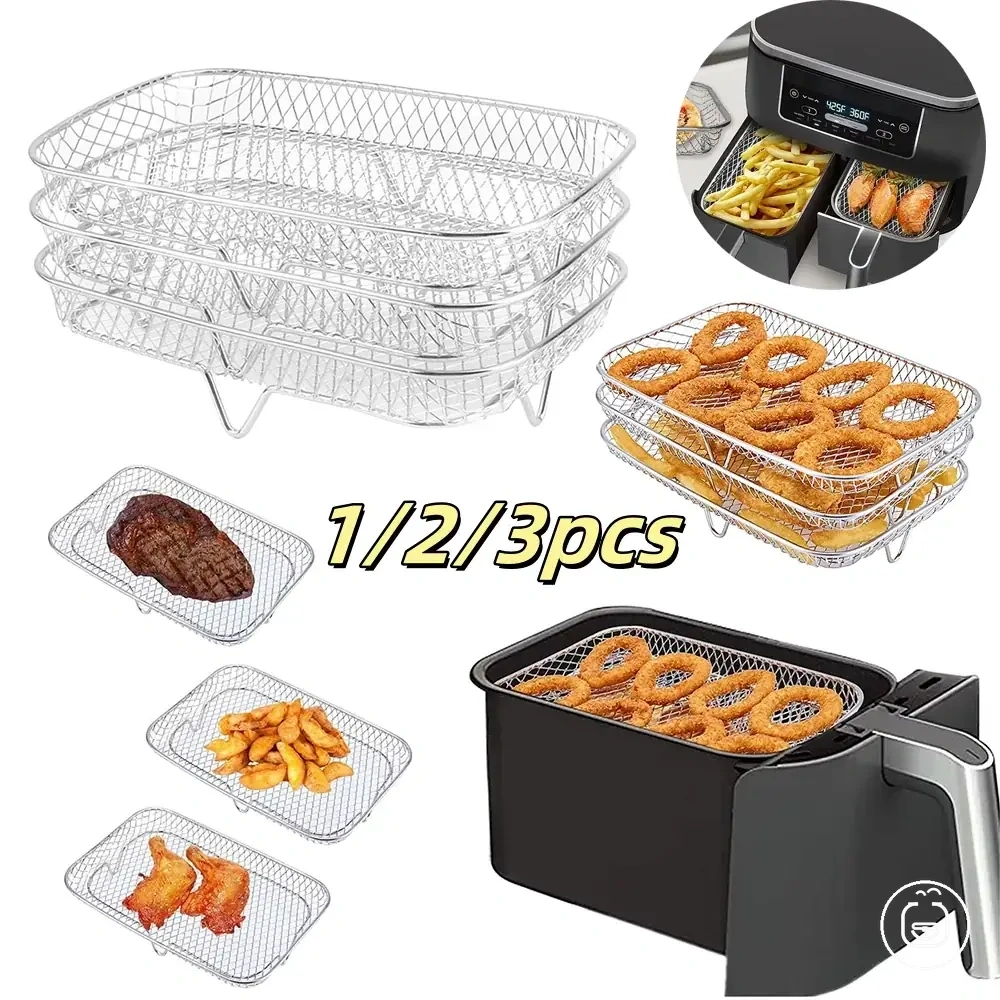
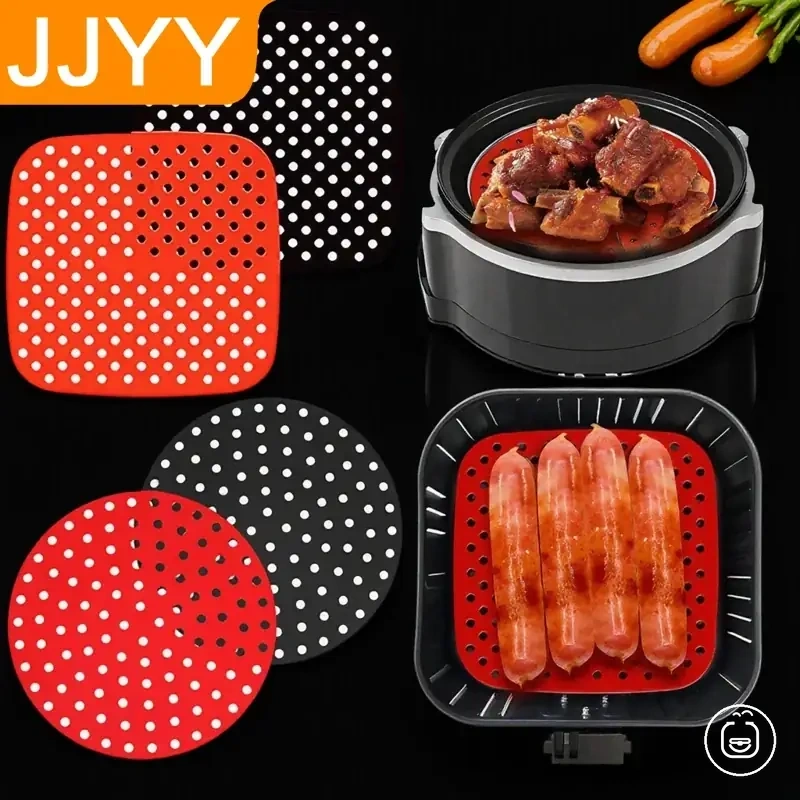
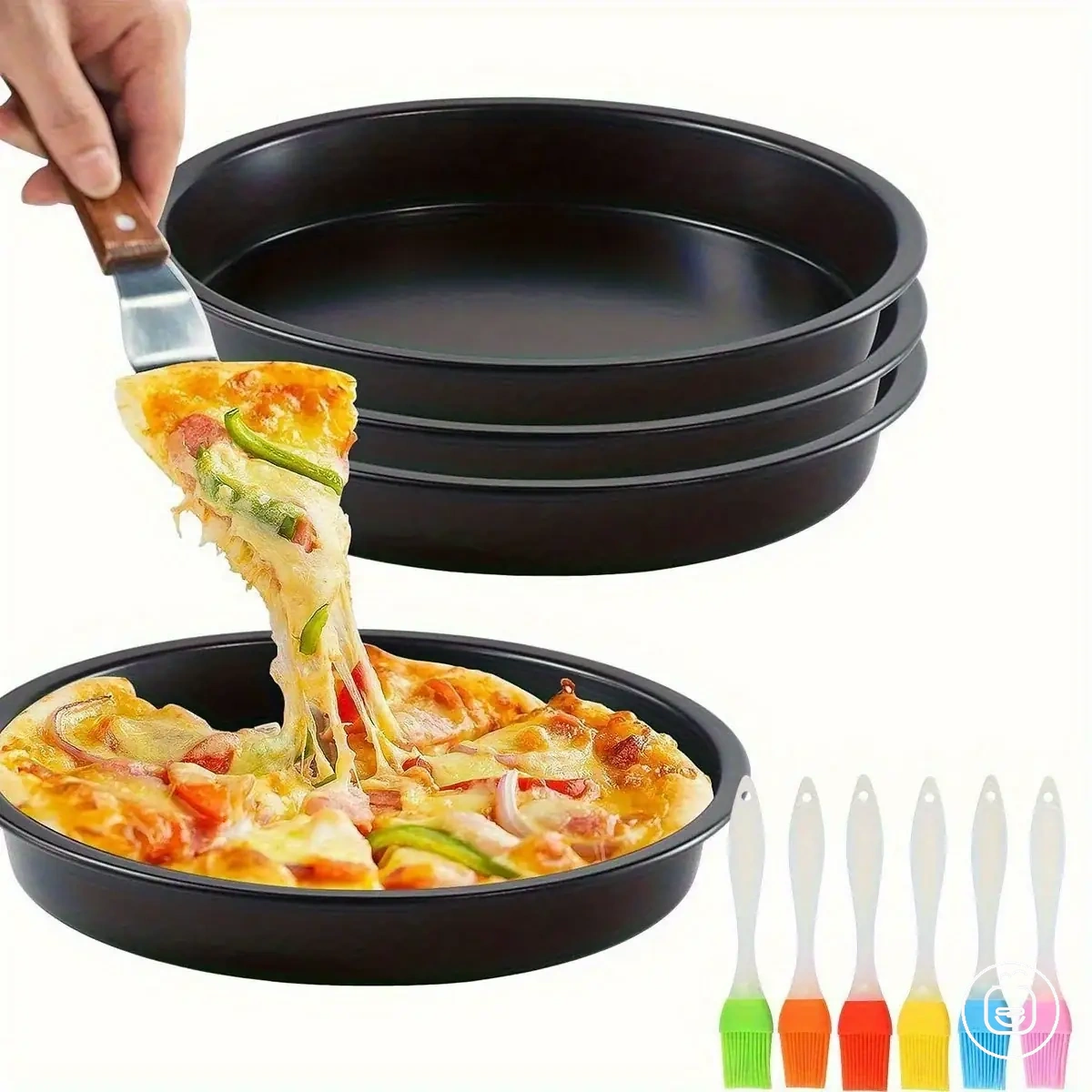
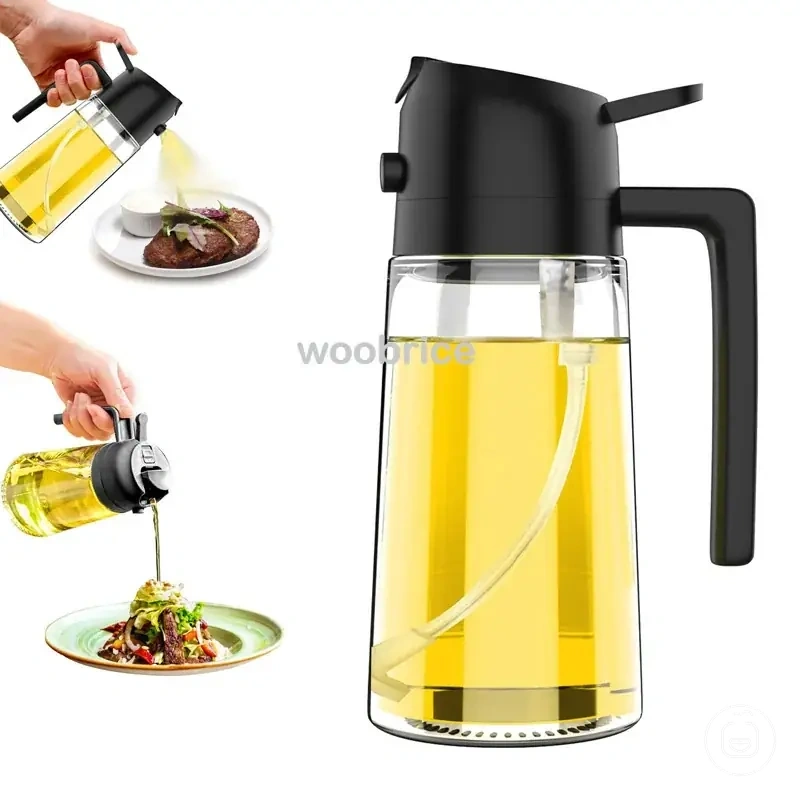
This chart shows how fit, spacing, and food load influence cooking performance through basket clearance and airflow, including key checks before cooking.
When accessories improve results and when they reduce performance
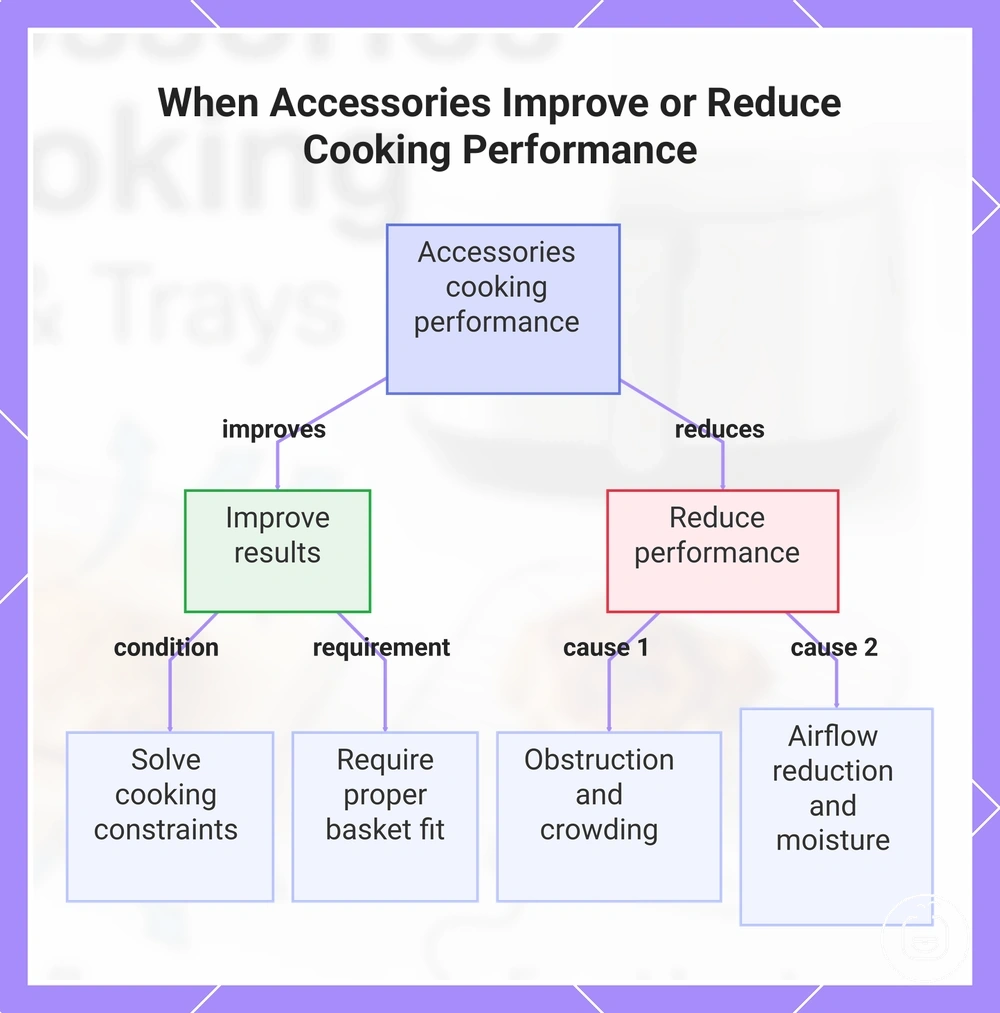
Accessories improve results when they solve a specific cooking constraint such as supporting crisping, stabilizing even cooking, or improving finish control. They reduce performance when they introduce obstruction, moisture, crowding, or unnecessary contact that limits heat interaction. The key distinction is whether the accessory matches the cooking need or creates resistance to it.
Accessories improve results in scenarios where they directly support the intended outcome. Baking support can help structured foods maintain shape, grilling-style contact can improve surface browning, and handling tools can improve finish control during cooking. These functions can improve crisping and even cooking when basket fit is appropriate and the accessory does not create unnecessary restriction. Cleanup and finish consistency may also improve when the cooking constraint is properly addressed.
Accessories reduce performance when they interfere with spacing or introduce unfavorable conditions. Overcrowding, poor basket fit, or accessories that reduce airflow gaps can increase moisture retention and create uneven contact. This may affect crisping, reduce even cooking consistency, and weaken finish control, especially when food type and load weight exceed available space in the basket.
The decision depends on whether the accessory resolves a cooking constraint or introduces obstruction. Food type, basket fit, and intended result should guide this choice to avoid unnecessary trade-offs in performance. This balance determines whether the accessory supports or disrupts cooking behavior. choose accessories by cooking need
Accessories should be evaluated based on how they influence crisping, even cooking, cleanup, and finish control under real basket conditions. Choose accessories by cooking need to ensure alignment between function and cooking result.
Here are product examples that may make comparison easier. Before buying, always review the compatibility criteria, essential features, and product details.
This chart shows the conditions under which cooking accessories improve results or reduce performance, based on whether they solve cooking constraints or introduce obstruction.