Safe materials for air fryer accessories
Safe materials for air fryer accessories refer to material choices that remain stable under air fryer heat, direct food contact, and repeated cooking conditions. The safety of these materials depends on the heat rating, manufacturer instructions, coating condition, and how the accessory is used inside the basket. There is no universal rule because silicone, stainless steel, parchment paper, and nonstick coating all behave differently depending on temperature and placement. Safety is therefore conditional and must be evaluated through use context rather than assumptions.
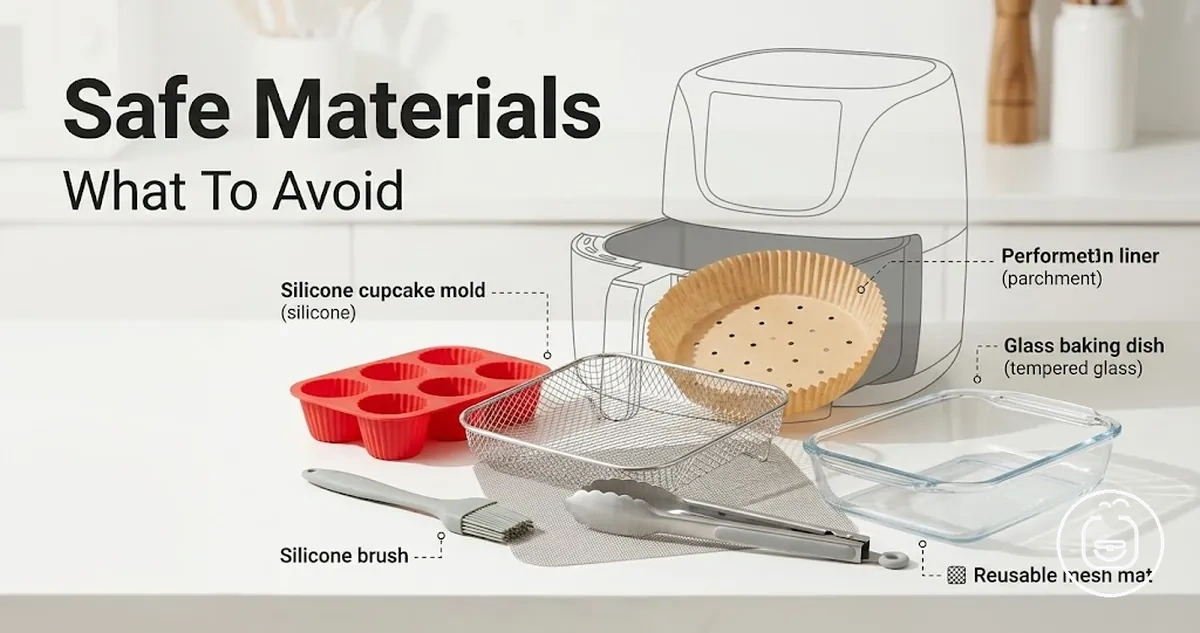
Common safe material families for air fryer accessories include silicone liners, stainless steel racks, parchment paper liners, and coated metal trays. Silicone can support flexible food contact when it has a verified heat limit and food-grade quality. Stainless steel is often used for racks because it remains stable under heat and supports airflow when properly fitted. Parchment paper works as a liner when it is designed for heat exposure and does not block air circulation, while nonstick coated surfaces depend heavily on coating stability during repeated heating.
Risk increases when air fryer accessories lack a clear heat rating, show coating wear, or use low-quality plastic-like materials that cannot handle hot air exposure. Damaged nonstick coating, missing manufacturer instructions, or improper placement can affect both food contact safety and airflow performance. Even materials that are generally suitable can become unreliable when exposed to overheating, poor fit, or visible surface deterioration. These conditions require careful evaluation rather than assumptions about material type alone.
Material safety is also guided by label verification such as food-grade silicone, heat-resistant ratings, PFAS-free claims, BPA-free labeling, and dishwasher-safe indications. These labels help indicate intended use, but they must always be confirmed with manufacturer instructions for accurate heat and food contact limits. Without this verification, material claims remain incomplete and may not reflect real usage conditions inside an air fryer environment.
Before selecting or using air fryer accessories, it is important to connect material type with heat rating, food contact behavior, and visible condition to ensure stable performance during cooking. This foundation helps separate suitable options from risky ones and prepares the reader for deeper criteria-based evaluation. air fryer accessories hub provides the broader context for comparing types, fit, and usage conditions across different accessory categories.
What makes an air fryer accessory material safe
Material safe for air fryer accessories depends on heat rating, food-contact suitability, coating stability, size fit, and accessory condition. These criteria determine whether silicone, stainless steel, parchment paper, or nonstick-coated parts can stay stable under cooking heat and repeated use. Safety is not fixed because the same material can shift risk level when used beyond its rating or when damage appears. The final material safe decision always connects heat performance with food-contact stability and usage context.
What makes an air fryer accessory material safe can be understood more clearly when the key criteria are visually mapped across heat, food contact, coating, and fit conditions.
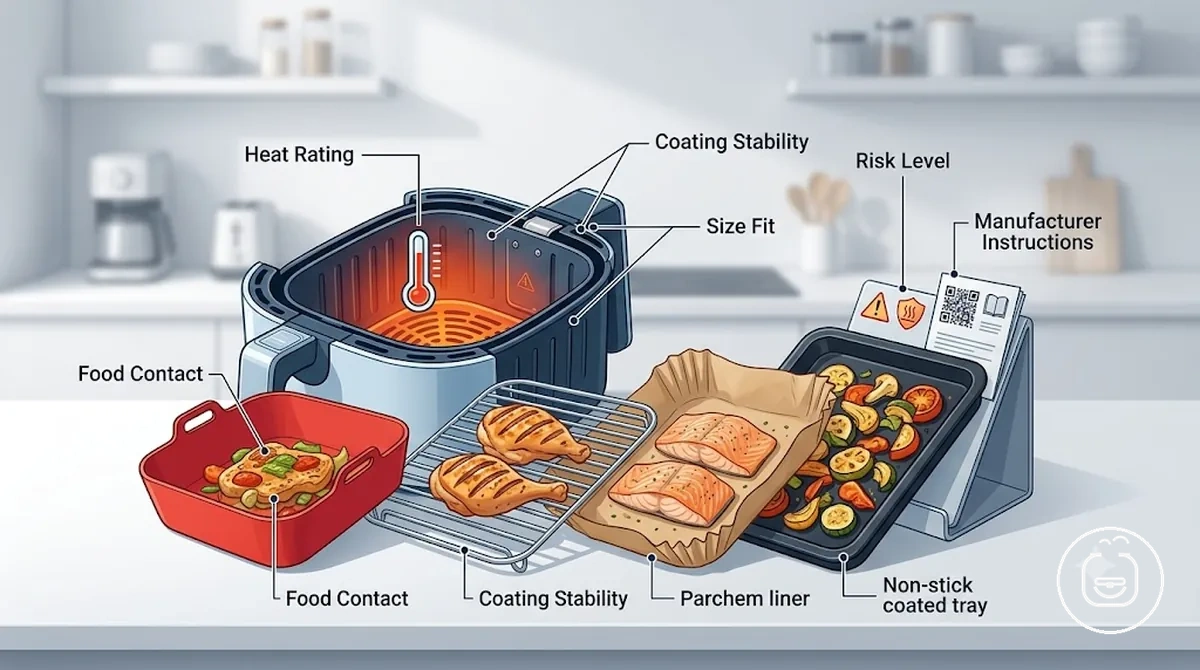
Heat rating and food-contact suitability form the base of material safety for air fryer accessories. A rated material must tolerate air fryer heat without breaking down or deforming during use. Food-contact suitability matters when silicone or coated surfaces directly touch food, as stability depends on surface integrity and approved use conditions. Coating stability and accessory condition then become critical because scratches, wear, or degradation can change how the material behaves under heat and repeated cycles.
The criteria below organize how material safety is evaluated in practice once the main conditions are identified. The table connects each factor to its safe-use condition and the risk level that appears when limits are exceeded or instructions are ignored.
| Criterion | What to check | Safe condition | Risk signal |
|---|---|---|---|
| Heat rating | Maximum temperature tolerance | Matches air fryer operating heat | Warping or breakdown under heat |
| Food-contact suitability | Silicone, stainless steel, parchment labeling | Approved for direct or indirect food contact | Unknown or unverified contact safety |
| Coating stability | Nonstick surface condition | Intact, no peeling or scratches | Exposed or flaking coating |
| Size fit | Basket clearance and placement | Proper airflow and stable placement | Blocked airflow or poor fit |
| Accessory condition | Wear, cracks, deformation | Clean and structurally stable | Visible wear or damage |
Even when a material appears suitable, it can become risky when used above its heat rating, placed incorrectly, or damaged during repeated use. Fit and placement also influence how safe materials perform, especially when airflow or contact points are restricted, and this is further explained in fit and compatibility checks. Material safety therefore remains conditional and must always align with manufacturer instructions and real accessory condition before use.
Food-contact surfaces and heat exposure
Food-contact surfaces and heat exposure determine that a food-contact surface requires stronger verification than support-only surfaces because direct contact, hot circulating air, and food-contact claim considerations increase material stress. This is important for air fryer accessories where liners, racks, trays, and mats may experience both direct food contact and indirect exposure in the same cooking cycle.
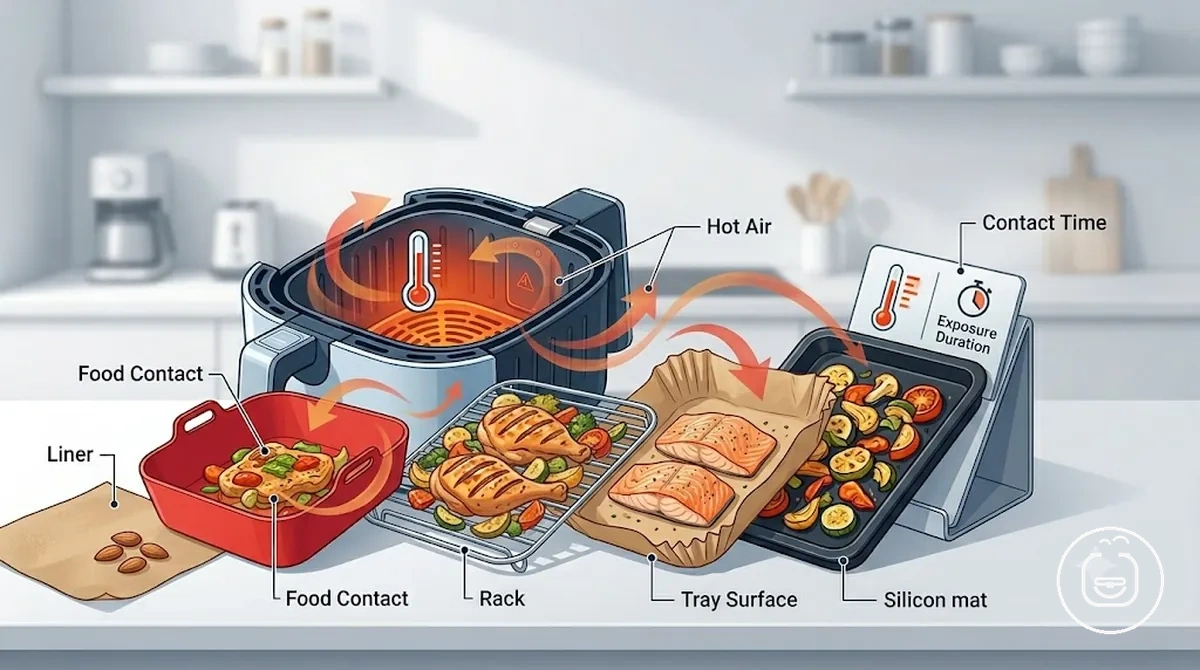
Hot circulating air affects both direct and indirect surfaces by increasing continuous exposure throughout the cooking process. Contact duration influences how long a liner or tray remains in contact with food, which can affect residue buildup or surface wear depending on material stability. When exposure repeats over time, conditions such as warping or reduced surface reliability may appear depending on manufacturer instructions and accessory material limits.
Surface types can be separated based on contact level and exposure context.
- Liner: direct food-contact surface with higher exposure and stronger need for food-contact claim verification, where residue and heat exposure vary by material stability
- Rack: support surface with indirect contact, lower direct exposure but still affected by hot circulating air and load distribution
- Tray: semi-direct contact surface where heat exposure and food placement influence stability, contact duration, and warping risk
- Mat: direct contact surface where contact duration and airflow conditions affect residue behavior and surface response
- Pan: enclosed contact surface where heat concentration and surface condition influence overall stability under repeated use
In practical use, liners and racks can behave differently inside the same air fryer because placement, airflow, and contact duration change local exposure conditions. This distinction helps interpret how food-contact surfaces respond under repeated cooking cycles without assuming identical performance across accessory types.
Heat resistance and coating stability
Heat resistance and coating stability determine whether an air fryer accessory remains suitable under repeated air fryer temperatures and usage cycles. This depends on verifying the heat limit, surface condition, repeated heating effects, and how coating wear such as scratches or peeling influences performance, including potential fumes concern in degraded nonstick coating or silicone surfaces. Continued-use decision relies on whether the material stays within its rated heat limit and maintains structural stability under normal operating conditions.
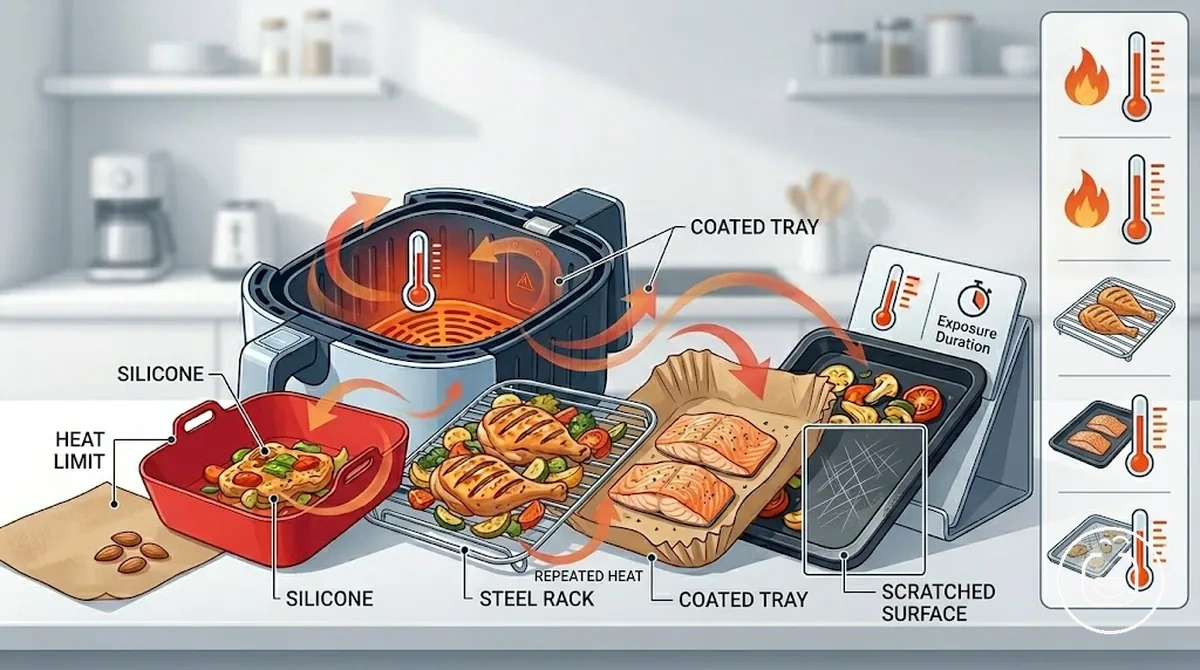
Heat resistance and coating stability can be understood by comparing how materials respond to temperature exposure, repeated heating, and surface wear. The table below highlights how heat limit, coating stability, and damage signals influence continued-use decisions.
| Material or coating | Heat-use check | Damage signal | Safer decision |
|---|---|---|---|
| Silicone | Rated temperature tolerance under repeated heating | Warping, odor, or surface change under heat exposure | Continue use only when heat limit and stability remain within range |
| Coated metal (nonstick) | Coating stability under repeated heating cycles | Scratches, peeling, or coating wear | Replace or limit use when coating stability declines |
| Stainless steel | High heat resistance with structural stability | Surface discoloration from prolonged heating | Generally continues use if structure remains stable |
| Parchment | Limited heat exposure suitability and duration | Browning or brittleness under heat | Use only within safe exposure limits |
| Glass or ceramic | Thermal resistance depends on product rating | Cracking risk under rapid temperature change | Use only when thermal shock risk is controlled |
Damaged or unrated coatings increase uncertainty in performance, especially when repeated heating or coating stability cannot be verified. In such cases, continued-use decision depends on visible surface condition, verified heat limit, and whether deformation, peeling, or fumes concern may arise under normal air fryer temperatures. :contentReference[oaicite:0]{index=0}
Safe materials commonly used in air fryer accessories
Safe materials commonly used in air fryer accessories refer to material families such as silicone, stainless steel, parchment paper, oven-safe glass, ceramic, and coated metal that are used in heat-safe and food-contact conditions when their usage aligns with temperature, airflow, and surface condition requirements. Their suitability depends on how each material responds to heat exposure, repeated use, and structural stability during cooking cycles.
The table below organizes these material families by accessory type, safe-use condition, and main caution to clarify how material behavior changes under airflow and heating conditions.
| Material family | Common accessory type | Safe-use condition | Main caution |
|---|---|---|---|
| Silicone | Liners and molds | Heat-safe within rated range with flexible airflow adaptation | May deform if heat limit is exceeded |
| Stainless steel | Racks and trays | Stable under repeated heating with open airflow | Heat transfer varies with direct contact |
| Parchment paper | Disposable liners | Suitable for light food load and limited heat exposure | May curl or burn under strong airflow |
| Oven-safe glass | Baking dishes | Requires controlled heating and stable temperature change | Risk of thermal shock under rapid change |
| Ceramic | Baking trays and bowls | Heat-safe when rated for steady heating conditions | May crack under sudden temperature shifts |
| Coated metal | Nonstick trays | Requires intact coating condition under repeated heating | Coating wear may reduce stability over time |
Silicone is commonly used for flexible liners and molds due to its food-contact compatibility and ability to adapt to airflow, while stainless steel is used for racks and trays because it maintains structural stability under repeated heating cycles.
Parchment paper supports light food-contact use under limited exposure, while oven-safe glass and ceramic depend on controlled heating conditions to reduce thermal stress. Coated metal is widely used for nonstick trays, but its performance depends strongly on coating condition and repeated heating exposure.
The role of liners often overlaps in usage scenarios, and comparing options like silicone and paper liners helps clarify differences in reusability and heat exposure behavior under airflow conditions.
Food-grade silicone liners, mats, and baskets
Food-grade silicone liners, mats, and baskets refer to silicone accessories that can be suitable for air fryer use when the material is properly rated for heat exposure and meets food-contact requirements. Their performance depends on heat limit, flexibility, placement inside the basket, and how airflow is affected during repeated heating cycles.
Food-grade silicone, including a silicone liner or silicone mat, can be suitable when it is verified for heat-safe use and applied correctly. The key factor is not the material alone but whether the product is labeled food-grade silicone and whether its heat limit aligns with air fryer conditions. Thickness, flexibility, and placement also influence stability during cooking, especially when exposed to strong airflow.
Verification checklist for silicone safety:
- Food-grade confirmation: ensure the silicone liner or silicone mat is explicitly labeled food-grade silicone
- Heat limit: check that the rated heat-safe range matches typical air fryer use conditions
- Placement: confirm it does not block airflow inside the basket during cooking
- Flexibility: excessive softness may lead to shifting or instability under hot air circulation
- Odor or wear: unusual odor, surface changes, or visible wear may indicate reduced suitability
Even when food-grade silicone is used, silicone liners and mats may behave differently depending on thickness and design. A silicone basket or liner that is too flexible can shift under airflow, while poor placement may reduce circulation and affect cooking consistency. Suitability depends on maintaining balance between heat limit, airflow, and structural stability during repeated heating.
This chart shows the key requirements and warning signs for using food-grade silicone liners, mats, or baskets in air fryers.
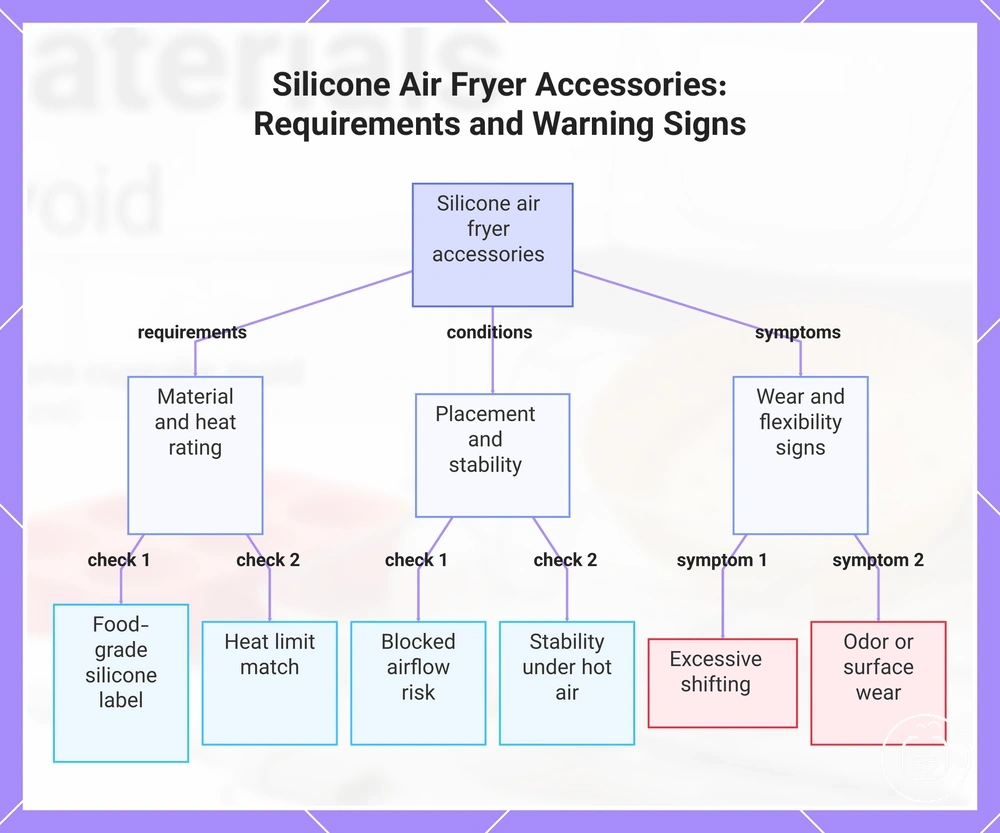
Stainless steel racks, trays, and metal inserts
Stainless steel racks, trays, and metal inserts are generally suitable for air fryer use when the stainless steel structure is stable, properly finished, and does not interfere with coated basket surfaces during cooking. The material itself supports heat exposure and repeated use, but safe performance depends on fit quality, edge condition, and how the metal insert interacts with the coated basket under airflow and load.
Stainless steel racks, trays, and metal inserts are widely used because of their structural stability and corrosion resistance, but their actual safety depends on physical-use conditions rather than material alone. Sharp edges, unstable placement, or direct contact with a coated basket can shift performance from safe support to potential wear risk during repeated heating cycles.
Material vs physical-use risk separation:
- Corrosion resistance: stainless steel can resist rust and maintain durability under repeated heating and cleaning cycles
- Sharp edges: poorly finished edges on a rack or metal insert may create handling issues and increase contact risk with food or surfaces
- Stable placement: a stainless steel tray or rack should remain stable under airflow to support consistent cooking conditions
- Coated basket contact: direct friction between metal inserts and a coated basket may contribute to surface wear depending on movement and fit
Overall, stainless steel remains a common material for racks and trays because of its durability, but its safe use depends on maintaining stable placement and avoiding damaging contact with the coated basket during operation.
This chart explains the material factor, required physical conditions, and potential risks that determine the safe use of stainless steel racks, trays, and metal inserts in an air fryer.
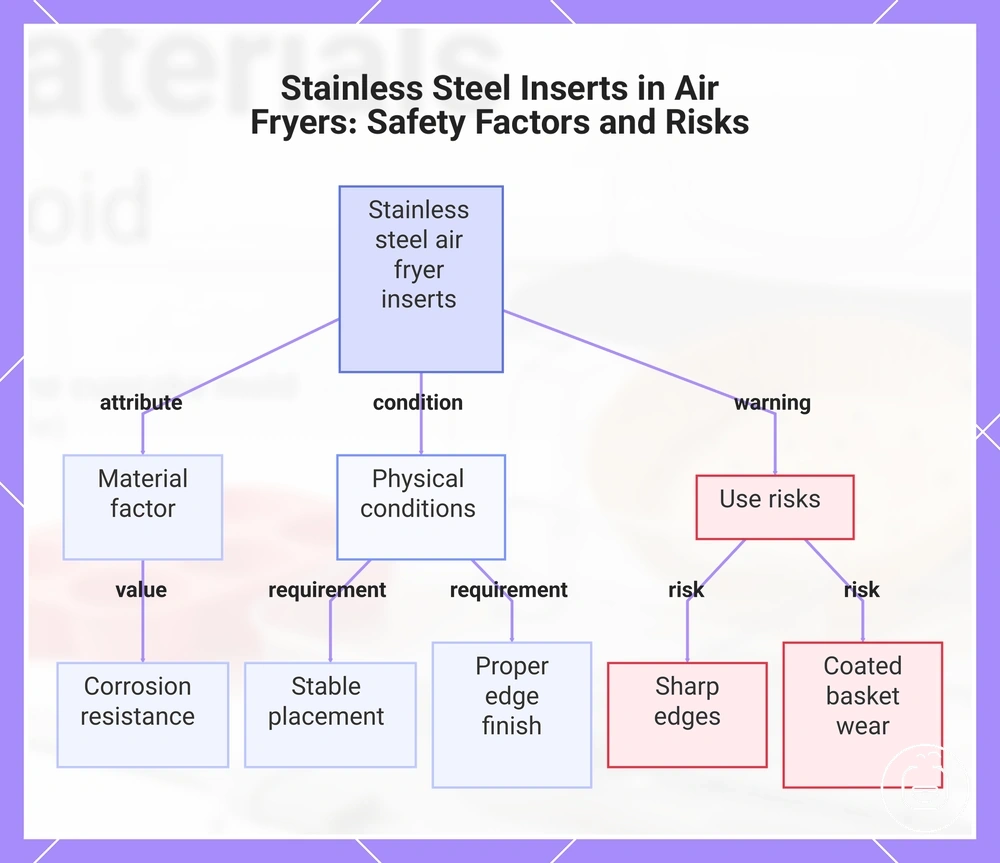
Parchment paper liners made for air fryer use
Parchment paper liners are suitable for air fryer use when the air fryer liner is heat-rated, correctly sized for the basket, and held down by food weight during cooking. Their safety depends on heat rating, basket size, airflow, and whether the parchment paper remains stable during preheating conditions, since loose placement can increase lifting or scorching risk.
Parchment liner safety checklist:
- Heat rating: confirm the parchment paper is rated for air fryer heat conditions
- Perforation: use perforated liners when airflow support is needed inside the basket
- Basket size: ensure the air fryer liner matches basket size to prevent curling or lifting
- Food weight: keep the liner held down by food to avoid movement during cooking
- Preheating: avoid empty preheating with loose parchment paper to reduce scorching risk
Parchment liners may be perforated or solid depending on design. A perforated liner can support airflow through the basket more effectively, while solid parchment paper may restrict airflow if it does not match basket size or is not properly secured by food weight.
This chart shows the key safety requirements, stability measures, and airflow considerations for using parchment paper liners in an air fryer.
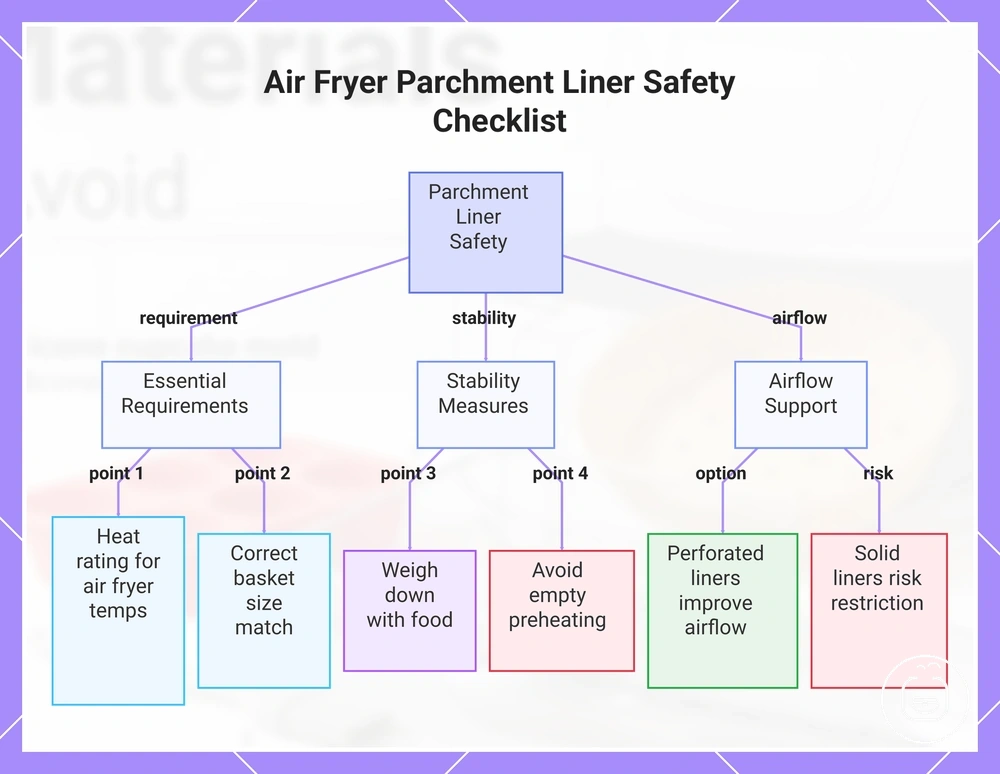
Oven-safe glass and ceramic accessories
Oven-safe glass and ceramic accessories depend on explicit oven-safe labeling and proper fit within the air fryer basket to be suitable for use in an air fryer. Oven-safe glass or a ceramic dish may be used when the product is designed to withstand direct heat exposure and maintains stable positioning inside the basket during cooking. When the oven-safe status is unclear or only microwave-safe labeling is provided, suitability becomes uncertain due to thermal shock risk and structural limits under air fryer heat conditions.
Rapid temperature changes can increase thermal shock risk in oven-safe glass and ceramic materials, especially when moving from cold storage to a hot air fryer basket. Basket clearance and handling conditions also influence whether a dish remains stable or shifts during operation. Cracking may occur when heat stress exceeds material tolerance, so controlled use conditions and proper placement remain important.
Key caution points include:
- Cold-to-hot changes: sudden temperature shifts can increase thermal shock risk in glass and ceramic
- Basket clearance: insufficient space inside the air fryer basket may restrict airflow and stability
- Weight and handling: heavier ceramic dishes may require careful placement to remain stable during use
- Cracking risk: structural stress can occur if heat limits or material tolerance are exceeded
Use of oven-safe glass and ceramic accessories remains dependent on labeling, fit, and controlled handling conditions inside the air fryer basket. :contentReference[oaicite:0]{index=0}
Nonstick coatings and chemical safety claims
Nonstick coating safety in air fryer accessories depends on interpreting PFAS-free, PTFE, Teflon, and BPA-free claims together with heat limit, scratch condition, and actual coating condition on the coated tray or pan. These chemical safety labels describe material intent, but they do not independently confirm performance under repeated air fryer heat exposure or cleaning wear conditions.
To interpret nonstick coating claims correctly, it is necessary to evaluate label statements and physical condition together rather than in isolation. The criteria below organizes how PFAS-free, PTFE-based coatings, BPA-free labeling, heat limit, scratch condition, and cleaning wear should be assessed in practical use.
| Claim or condition | Where it appears | What to verify | Safer interpretation |
|---|---|---|---|
| PFAS-free claim | Product labeling or specifications | Coating composition and documentation context | Indicates formulation intent but still depends on heat limit and coating condition |
| PTFE / Teflon | Nonstick coating description | Heat limit and usage range | Requires temperature adherence and condition monitoring |
| BPA-free claim | Material or coating label | Food-contact component details | Relevant mainly to material composition, not coating wear behavior |
| Scratched coating | Coated tray or pan surface | Visible surface damage and wear level | May reduce coating stability and increase replacement consideration |
| Overheated coating | After repeated high heat exposure | Discoloration, texture change, or degradation signs | Indicates reduced reliability under continued heat exposure |
An intact nonstick coating with valid heat limit labeling on a coated tray or pan can typically maintain stable performance when used within recommended temperature ranges and with normal cleaning wear. In contrast, scratched, peeling, or overheated coatings may show reduced stability, even if PFAS-free or PTFE-related claims are present.
For continued use decisions, chemical safety claims should be verified together with heat limit, scratch condition, and cleaning wear. When coating degradation or overheating signs appear, reassessment or replacement consideration becomes more relevant than relying on label claims alone. :contentReference[oaicite:0]{index=0}
PFAS, PTFE, Teflon, and BPA claims
PFAS, PTFE, Teflon, and BPA claims refer to common coating and material labels used on air fryer accessories to describe nonstick coating formulations and plastic-like material components. PFAS, PTFE, and Teflon are typically associated with coated surfaces used in nonstick coating systems, while BPA is generally linked to plastic-like material parts that may come into food-contact surface use. These terms appear on product labels to communicate material category, but they still require verification through heat rating and surface condition during real use.
Terms in accessory labeling:
- PFAS: coating claim related to nonstick coating systems that still requires heat limit and surface condition verification
- PTFE / Teflon: refers to a nonstick coating type applied on coated surfaces where performance depends on heat exposure and wear condition
- BPA: relates mainly to plastic-like material components that may interact with food-contact surface use and requires label verification
- Coating claim context: indicates material classification on labels but does not confirm safe performance under all heat or wear conditions
These PFAS, PTFE, Teflon, and BPA claims help identify coating or material categories on an accessory label, but actual suitability depends on heat rating, coating condition, and whether the food-contact surface remains stable during repeated use cycles.
Scratched, peeling, or overheated coated accessories
Scratched coating, peeling, or overheated coated accessories change the use decision because visible surface damage affects the stability of a previously suitable coated tray or pan. Once scratching exposes deeper layers, peeling begins at edges, or overheating leads to discoloration, the surface no longer behaves consistently under food-contact use and repeated heating, leading to continued-use caution.
When these conditions appear, evaluation should shift to a replace-or-avoid decision based on specific signals:
- Scratch depth: scratched coating that exposes underlying layers increases continued-use caution due to surface damage
- Peeling or flaking: peeling coating on a coated tray or pan indicates exposed surface and typically requires replacement
- Odor changes: persistent odor after heating may signal overheated material behavior and reduced stability
- Discoloration: overheating signs or uneven color changes suggest heat damage and surface stress
- Cleaning wear: increased residue or difficulty cleaning may indicate coating wear and declining performance
Light marks may differ from active flaking or peeling, but progressive cleaning wear or repeated overheating can move the accessory toward replacement. The decision depends on whether the scratched coating or overheated surface continues to degrade during use, with manufacturer guidance supporting removal when visible deterioration persists.
Materials and accessory conditions to avoid in an air fryer
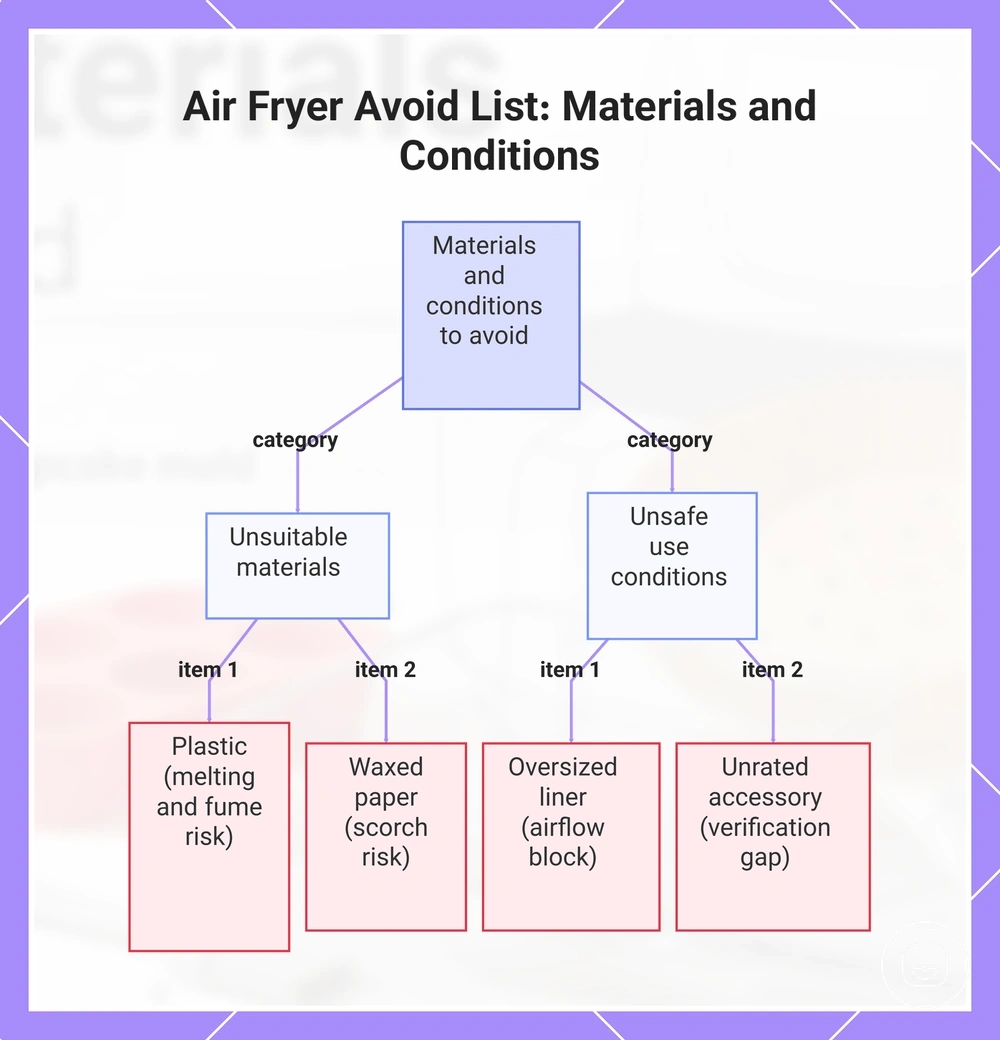
Materials and accessory conditions to avoid in an air fryer are typically linked to missing heat rating, restricted airflow, unstable placement, or low-heat coating limits. Unsafe behavior often occurs when plastic or household substitutes are exposed to heating conditions they were not designed for, or when airflow inside the basket is disrupted. These situations can lead to melting, scorching, or movement of lightweight items during operation.
The avoid-list below separates unsuitable materials from unsafe use conditions. It should be read as a risk-based guide where each item explains the mechanism and why it requires an avoid decision rather than simple use.
- Plastic: may melt under heat exposure and release unstable fumes, so it should be avoided unless explicitly heat-rated for air fryer use
- Waxed paper: can scorch under direct heat and airflow, making it unsuitable in high-temperature cooking conditions
- Paper plates: may weaken or deform under heat and airflow, creating instability and potential contact issues inside the basket
- Loose paper: can lift and move with airflow, risking contact with heating elements and uneven burning
- Low-heat coating: may degrade or break down under higher temperatures, leading to coating failure and reduced surface stability
- Oversized liner: can block airflow and affect circulation inside the basket, increasing uneven heating and operational risk
- Unrated accessory: missing heat rating or instructions creates verification gaps and should be avoided due to unknown performance limits
Some materials like plastic or waxed paper are unsuitable by nature, while others depend on conditions such as placement, rating, or coating quality. For example, paper plates or loose paper can behave differently depending on airflow intensity and how they are positioned in the basket. This boundary is important because the same material family may be safe or unsafe depending on its specification and use context.
Unsafe outcomes usually come from airflow disruption, melting risk, or missing rating rather than a single material category. Oversized liners and unrated accessories are especially sensitive because they affect circulation and verification reliability. Safe use depends on matching accessory rating and placement with the actual operating conditions inside the air fryer.
This chart shows the main materials and use conditions that should be avoided in an air fryer, along with the specific risks they pose.
Plastic, paper plates, and low-heat materials
Plastic, paper plate, waxed paper, and other low-heat material household substitutes are usually not suitable as air fryer accessories unless there is clear heat rating evidence for hot air exposure. These items often fail because their melting point, coating stability, or structural strength is designed for lower-temperature use, and direct exposure to circulating hot air can lead to melting, scorching, or deformation. In most cases, they should be treated as avoid or verification-required items rather than replacements for rated accessories.
The comparison below highlights how low-heat household substitutes differ from properly rated air-fryer-safe accessories. A key distinction is that a microwave-safe label does not automatically indicate air-fryer-safe performance, since hot air circulation creates different thermal and airflow stress conditions.
| Item | Why it is risky | What to check instead |
|---|---|---|
| Plastic | May melt under hot air exposure due to low heat rating | Verified heat rating suitable for air fryer temperatures |
| Paper plate | Can weaken, scorch, or deform under hot air exposure | Air-fryer-safe or oven-rated material specification |
| Waxed paper | Coating may break down or scorch at elevated temperatures | Heat-rated liner designed for hot air circulation |
| Low-heat material insert | Structural breakdown possible when melting point is exceeded | Confirmed heat rating for hot air use conditions |
| Microwave-only container | Designed for microwave heating, not hot air circulation | Air-fryer-safe labeling or verified high-heat compatibility |
Loose paper, oversized liners, and lightweight accessories
Loose paper, oversized liner, and lightweight accessory behavior in an air fryer depends on airflow interaction and placement stability, because circulating air can lift, shift, or expose edges regardless of material type. When food weight is insufficient to hold the item down or when basket clearance is uneven, these items may move during operation, increasing the likelihood of edge exposure, scorching, or blocked airflow conditions inside the basket.
Airflow-driven movement creates a local safety concern where stability is determined by size, perforation, placement, and load rather than material alone. A loose paper sheet or oversized liner can behave unpredictably if airflow passes underneath or around lifted edges, especially during preheating or high circulation phases.
A lightweight accessory should be assessed using a focused placement checklist that evaluates movement control inside the basket:
- Size: match liner or accessory dimensions to the basket to reduce lifting or shifting
- Perforation: allow airflow passage where applicable to reduce upward pressure buildup
- Food weight: ensure sufficient food weight is present to hold loose paper or liners in place
- Edge exposure: check for lifted corners that may increase scorching or hot-zone contact risk
- Basket clearance: maintain proper clearance to prevent blocked airflow and unstable positioning
For example, a loose sheet of paper or oversized liner without sufficient food weight may lift during circulating hot air, increasing edge exposure and reducing stability. The outcome depends on placement, basket design, and airflow intensity rather than the material category alone.
Unknown coatings and accessories without heat ratings
Unknown coating and accessories without a heat rating reduce confidence for air fryer use because missing heat rating, unknown coating, unclear manufacturer instructions, unclear food-contact status, or unusual odor remove the evidence needed to evaluate safe performance, so the item should be treated through verify, avoid, or replace decisions depending on available information.
Before using an unrated accessory, the following verification points should be checked to decide whether it can be used or should be avoided or replaced:
- Heat rating: confirm whether a defined heat limit exists for hot air exposure
- Food-contact status: verify whether the material is intended and approved for direct food contact
- Coating identity: identify the unknown coating type or surface composition before use
- Manufacturer instructions: check whether usage guidance or restrictions are provided
- Unusual odor: assess odor changes under low heat exposure as a caution signal
- Visible wear: inspect for peeling, breakdown, or surface degradation before operation
How material choice affects safe accessory use
Material choice directly determines safe accessory use in an air fryer because it defines how an accessory responds to temperature tolerance, placement, airflow, rigidity, weight, perforation, and cleaning method. These factors control whether a liner, rack, or container stays stable under circulating heat or shifts into restricted or uneven conditions. Safe accessory use depends on matching material behavior with the operating environment rather than relying on appearance or general suitability.
Material choice changes practical use conditions inside the air fryer, and these differences can be summarized through a usage matrix that connects material type with placement, temperature tolerance, airflow, and cleaning method.
| Material | Use condition | Main risk | Safer action |
|---|---|---|---|
| Silicone | Flexible use with moderate heat tolerance | Deformation under high temperature exposure | Maintain stable placement and avoid overload |
| Parchment | Lightweight liner with perforation dependence | Blocked airflow or lifting at edges | Ensure proper fit and food weight support |
| Stainless steel | Rigid structure with high rigidity | Contact wear on basket surface | Maintain clearance and stable positioning |
| Coated metal | Nonstick surface with cleaning sensitivity | Coating wear from repeated cleaning | Use gentle cleaning method and inspection |
| Glass | Heavy, stable placement with temperature sensitivity | Thermal stress from sudden temperature changes | Avoid abrupt heating transitions |
| Ceramic | Stable but brittle under stress conditions | Cracking under uneven heating or impact | Ensure even placement and gradual heating |
Placement, temperature tolerance, and airflow interaction determine how each material behaves during operation. Rigidity and weight influence stability, while perforation affects airflow movement and potential blockage inside the basket. Cleaning method also affects long-term durability, especially for coated surfaces where wear patterns develop over repeated use cycles.
Broader usage steps for handling accessories safely are explained in the using accessories safely page.
Temperature limits and stable placement during cooking
Temperature limits and stable placement during cooking control how material risks stay within safe boundaries by keeping the accessory inside its heat rating and ensuring it remains fixed under airflow conditions. Staying within temperature limits and maintaining stable placement reduces the likelihood of warping, lifting, or surface stress during cooking cycles, especially when airflow and heat exposure increase internal movement.
Safe use during cooking depends on a few core conditions that connect temperature limits with placement stability and airflow behavior.
Key conditions for safe control:
- Heat rating: keeps temperature limits within the material’s tolerance and reduces warping risk
- Preheat exposure: limits sudden heat stress that can trigger lifting or surface scorching
- Food weight: supports stable placement and helps keep the accessory fixed during airflow movement
- Basket clearance: maintains space for airflow path and reduces contact stress inside the basket
Temperature limits, preheat exposure, food weight, and basket clearance together determine whether airflow path conditions remain stable or cause movement, lifting, or warping during cooking. These factors work collectively with stable placement to keep material behavior under control in real use conditions.
Dishwasher-safe claims and material durability
Dishwasher-safe claims indicate cleaning convenience rather than guaranteed long-term material durability, because exposure to heat drying, abrasion from water pressure, and detergent interaction can influence surfaces differently depending on material type and coating structure. Material durability depends on how silicone, stainless steel, coated metal, glass, and ceramic respond to cleaning wear over repeated cycles, not on the dishwasher-safe label alone.
A dishwasher-safe claim should therefore be interpreted as a cleaning-method suitability signal, while visible wear, residue buildup, and surface change determine whether the accessory continues to perform reliably over time.
Care overview by material:
| Material | Dishwasher claim meaning | Wear signal | Safer care decision |
|---|---|---|---|
| Silicone | Can tolerate dishwasher cycles but may retain residue | Odor or residue buildup | Re-clean or adjust washing intensity when residue appears |
| Stainless steel | Generally resistant with good drying stability | Water spots or minor corrosion over time | Ensure proper drying to support durability |
| Coated metal | Depends on coating type and heat drying exposure | Peeling or abrasion of coating layer | Switch to gentler cleaning when wear is visible |
| Glass | Stable in dishwasher cycles under normal conditions | Clouding or surface dullness | Monitor clarity and reduce harsh detergents if needed |
| Ceramic | Generally stable but glaze can wear gradually | Glaze dulling or micro-surface wear | Avoid aggressive cycles if wear increases |
Cleaning wear, abrasion, residue retention, and heat drying exposure together define how material durability evolves beyond the dishwasher-safe claim. In many cases, coated metal and silicone show earlier signs of surface change, while stainless steel and glass tend to maintain structural stability longer depending on usage and care conditions.
For material-specific care considerations, see cleaning accessories by material.
Material safety checks before choosing air fryer accessories
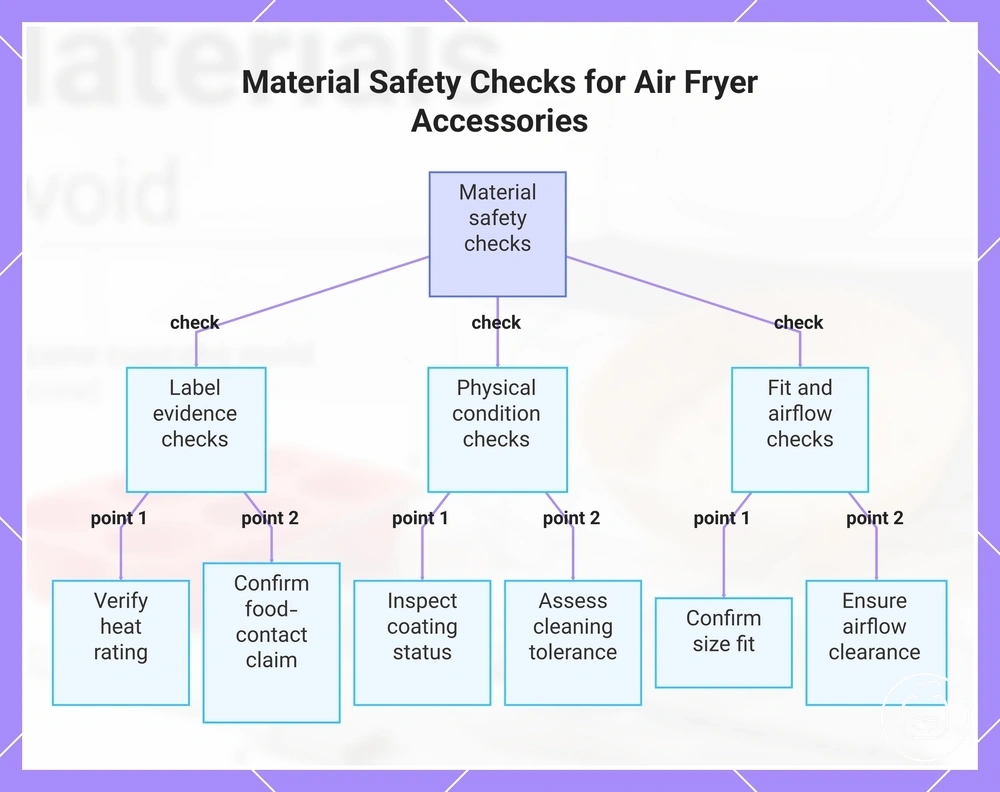
Material safety checks before choosing air fryer accessories depend on combining label evidence, material condition, fit, and intended use into one final evaluation. These material safety checks help reduce risk by verifying heat rating, food-contact claim, coating status, and physical compatibility with airflow and basket structure before any use decision is made.
The final check works as a structured checklist that evaluates both documentation and real-world condition. It supports a clear decision outcome based on whether the accessory should be bought, verified, used cautiously, or avoided.
Material safety checks checklist:
- Material type: confirm silicone, stainless steel, coated metal, glass, or ceramic suitability for intended use
- Heat rating: verify temperature limit to reduce deformation or overheating risk
- Food-contact claim: check whether the accessory is approved for direct food contact
- Coating status: inspect for peeling, abrasion, or visible wear affecting stability
- Size fit: confirm proper basket fit to prevent movement during operation
- Airflow clearance: ensure airflow paths remain unobstructed during use
- Cleaning tolerance: assess whether cleaning method may accelerate wear
- Manufacturer instructions: verify usage limits and safety guidance
These material safety checks function as a decision rule that combines label evidence, condition, fit, and intended use. If heat rating, food-contact claim, coating status, and size fit align with intended use, the accessory may be considered suitable. If uncertainty appears across multiple checks, such as coating wear or unclear instructions, the accessory should be used cautiously or avoided.
Final selection depends on aligning label evidence with physical condition and airflow behavior, since material durability and placement stability determine real-world safety performance.
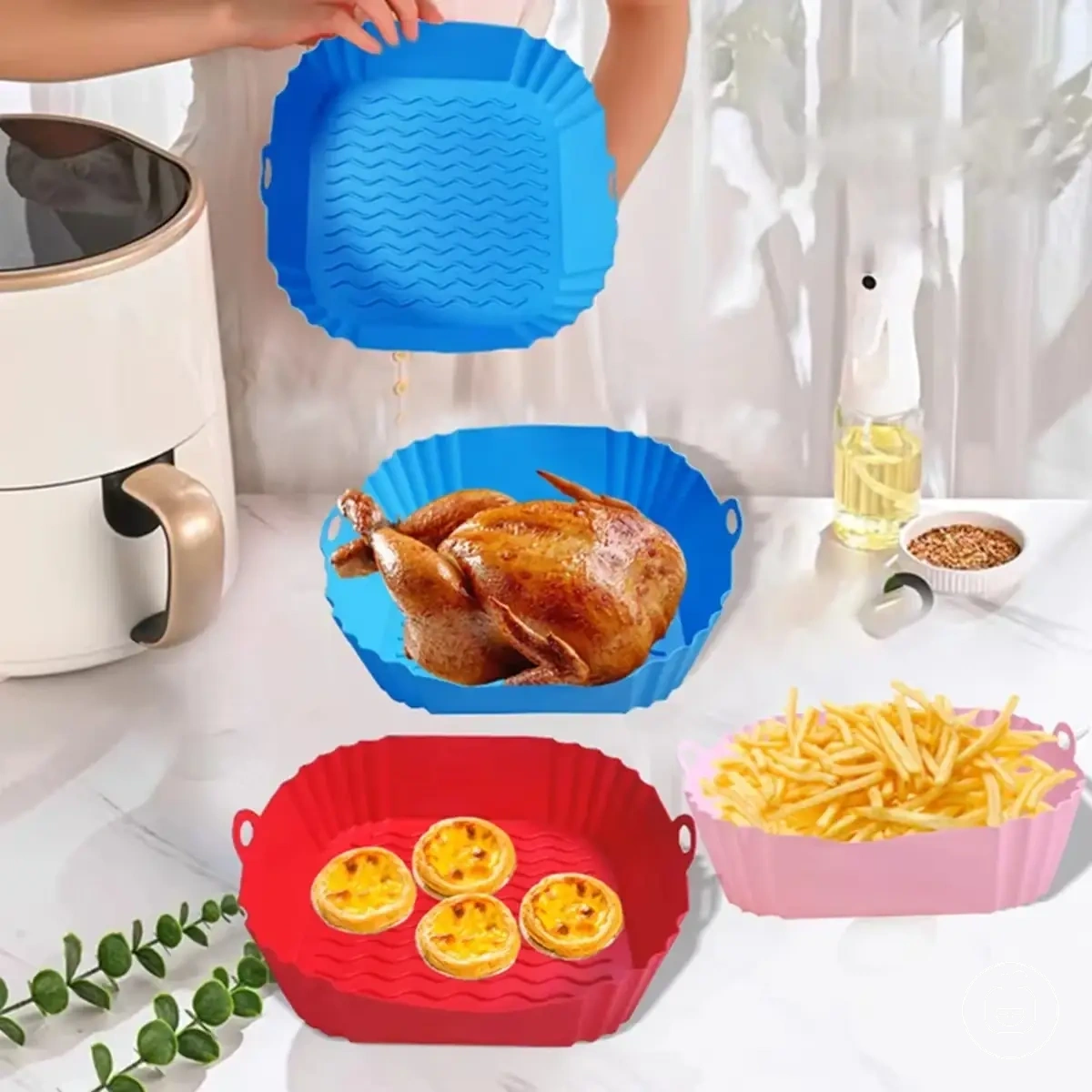
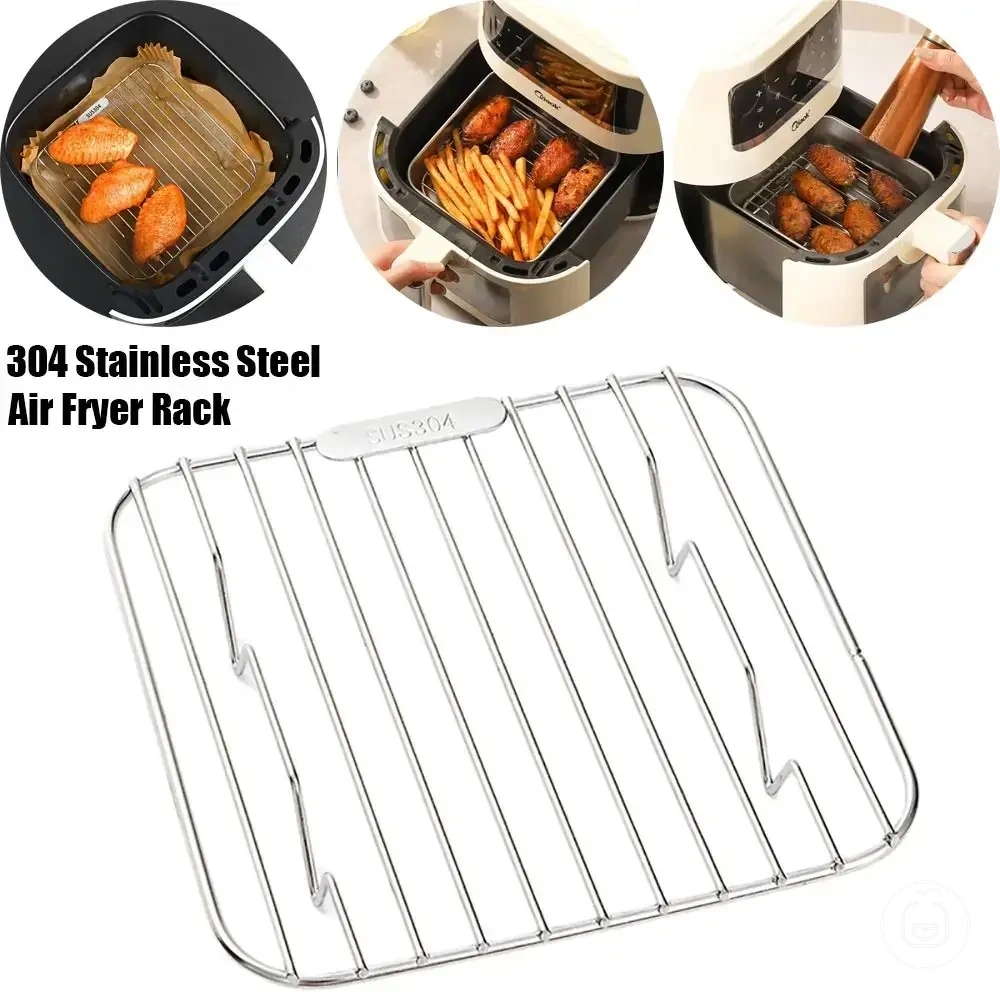
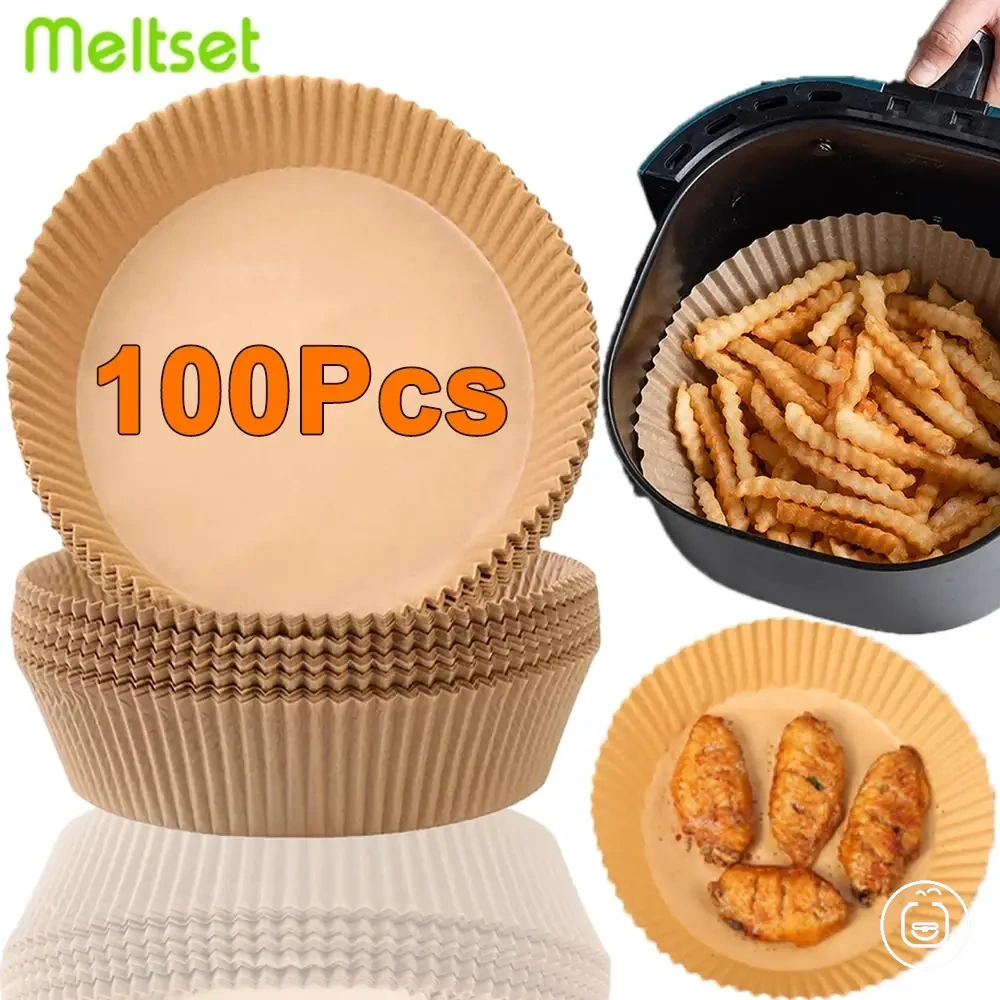
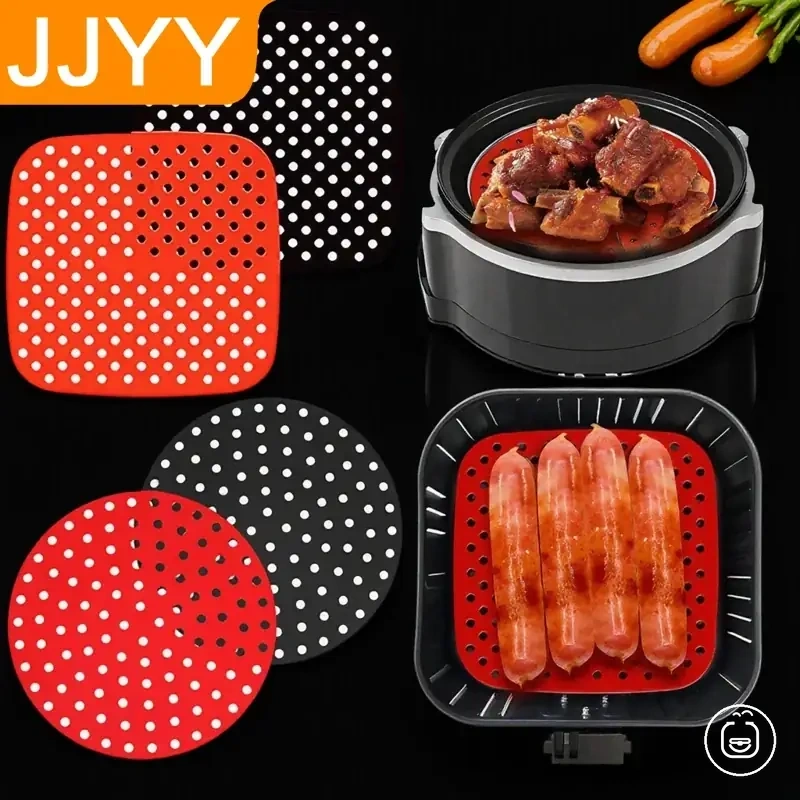
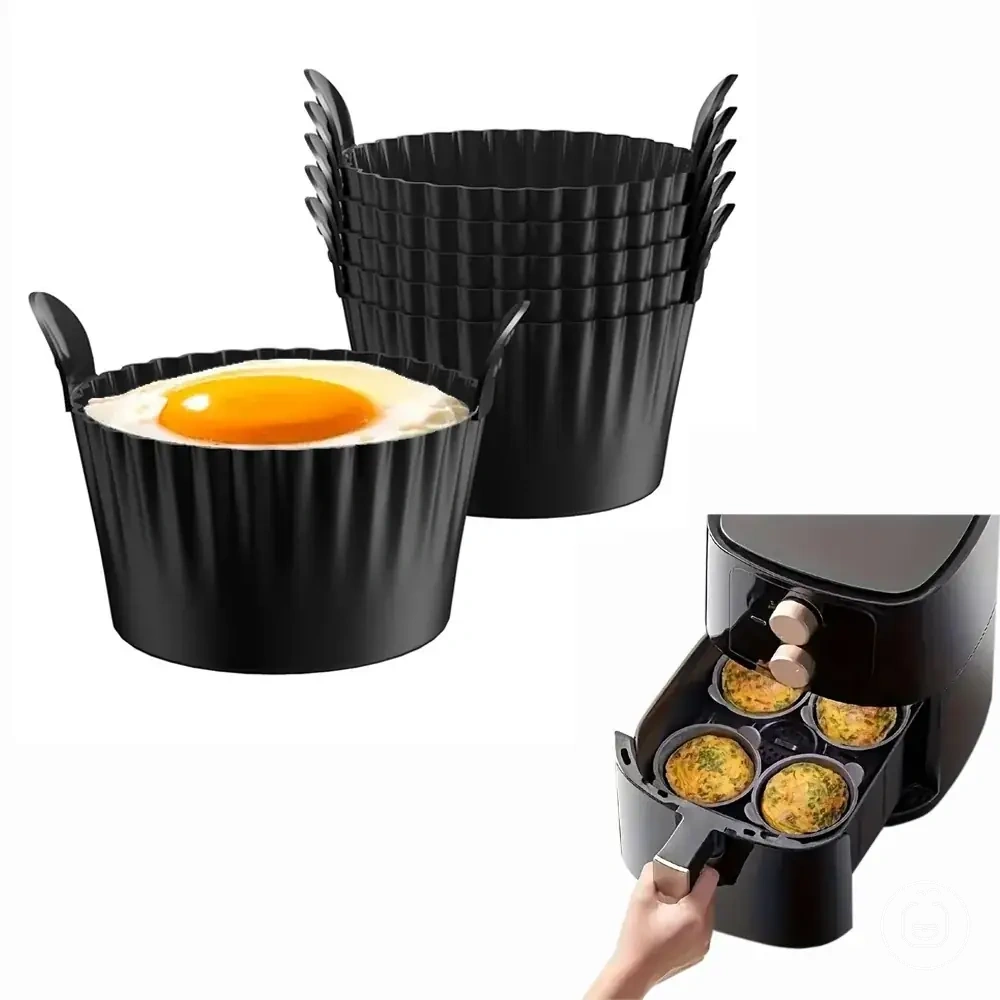
Here are product examples that may make comparison easier. Before buying, always review the compatibility criteria, essential features, and product details.
This chart groups the essential material safety checks by label evidence, physical condition, and fit and airflow to help evaluate an air fryer accessory before use.