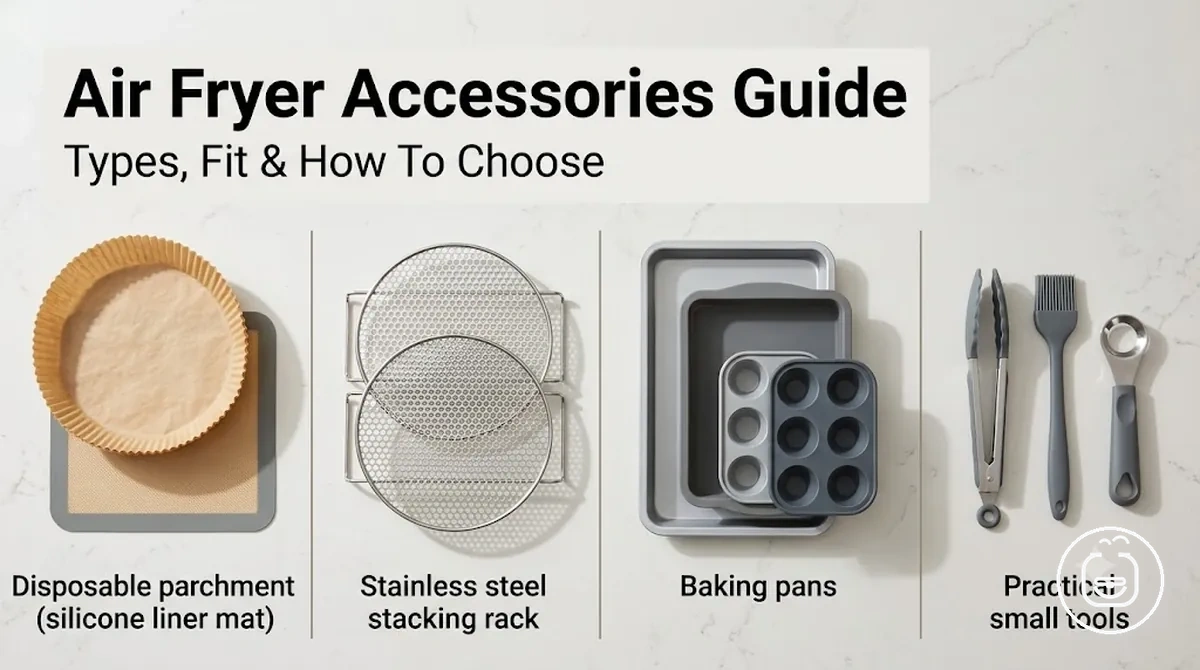
Air Fryer Accessories Guide for Useful, Compatible, and Safe Add-Ons
Air fryer accessories are add-ons used with an air fryer to support cooking, cleanup, handling, or food placement. Their value depends on how well each liner, rack, pan, or tool matches the basket, material requirements, airflow needs, and cooking use case.
Useful accessories solve a clear problem before they add complexity. A liner may help with cleanup when food weight keeps it stable, a rack may support extra spacing when clearance allows it, and a pan may help contain foods that need a shaped surface. An accessory becomes unnecessary when it does not fit the basket, crowds airflow, duplicates a tool already owned, or adds storage burden without a frequent cooking need.
For everyday cooking, the right buying advice starts with fit, material, airflow, and safe use rather than with a set or kit. A useful piece should match the appliance space, tolerate the cooking environment, and support the food being prepared without blocking circulation. This guide uses those conditions to ground accessory types, compatibility, safety, value, and use limits.
Air fryer accessories are optional decision-support items, not required parts of the appliance. Treat any add-on as useful only when it improves a real cooking, cleanup, handling, or capacity need for the specific basket and routine, rather than as something every user must own.
What counts as an air fryer accessory
An air fryer accessory is an add-on used with an air fryer basket, tray, rack, liner, pan, or handling tool to support cooking, cleanup, fit, or safety. The accessory is intended to work with the air fryer cooking area or with handling tasks around it. This definition creates the main boundary between a true air fryer accessory and an unrelated kitchen tool.
When food is placed in the basket or cooking chamber, accessories can help organize space, support food placement, or simplify cleanup. Common examples include a liner placed inside the basket, a rack used to add another cooking level, and a pan or tray that provides a contained surface for food. A handling tool may help move hot components around the appliance. These examples remain distinct from ordinary tools that are useful nearby but are not designed for the basket.
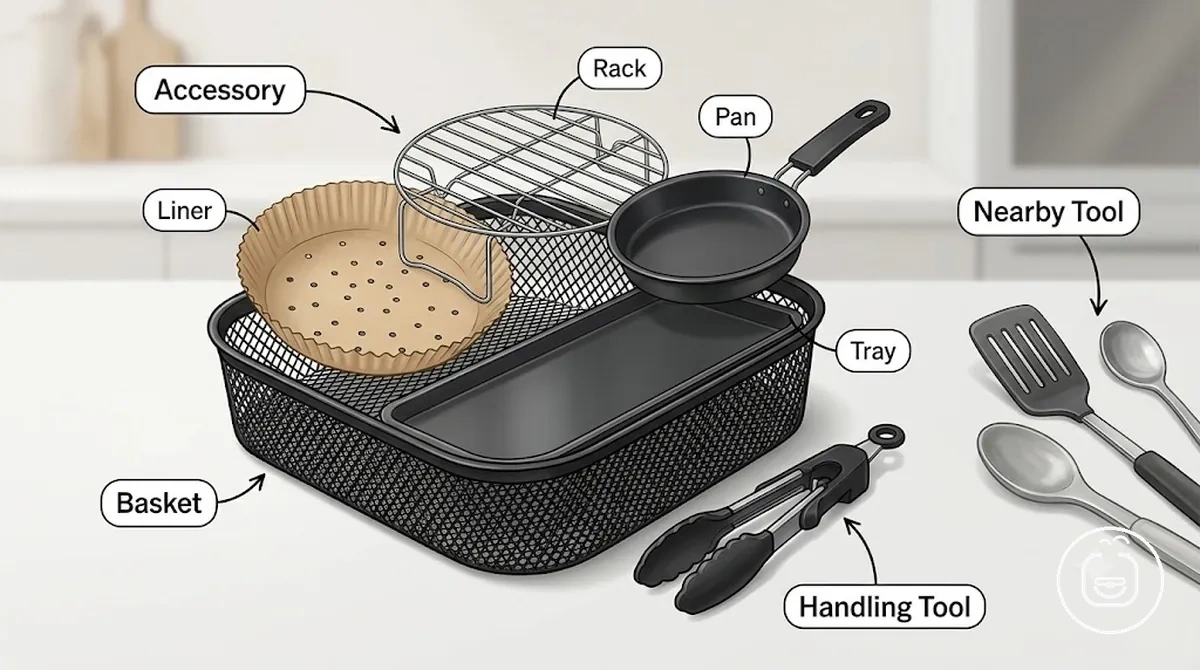
What counts as an air fryer accessory is easier to understand when in-scope accessories and nearby tools are shown together. The image below labels which items belong within the accessory category and which items are intended for nearby use rather than the cooking chamber.
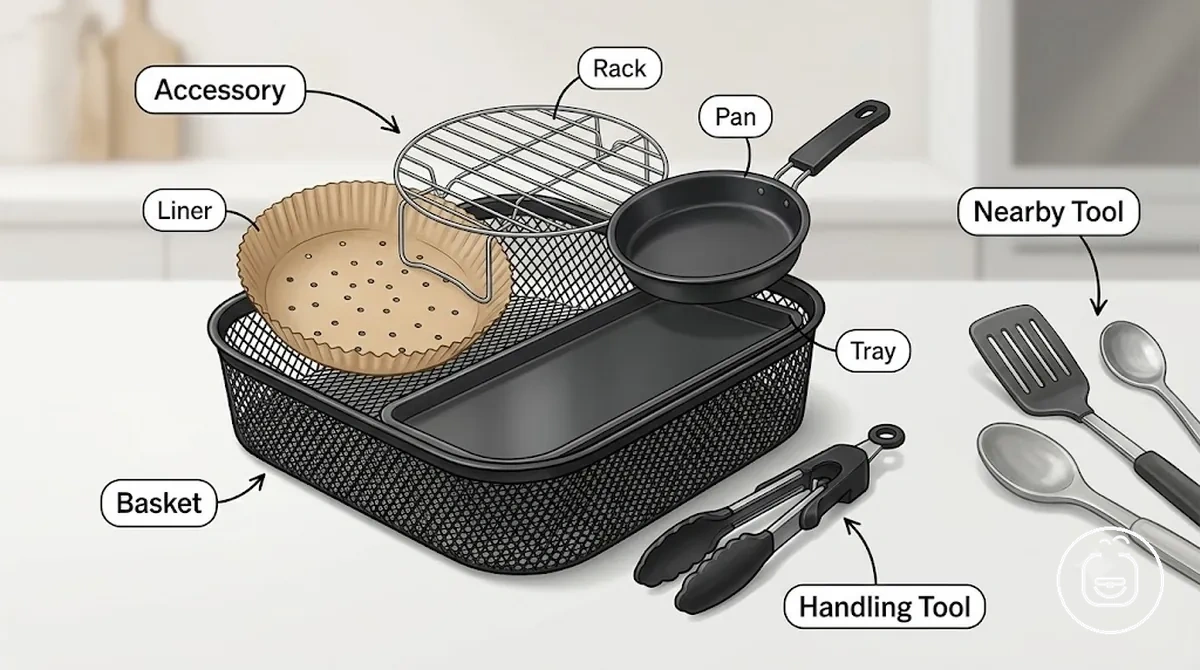
The following examples clarify the main accessory categories:
- Liner — supports cleanup inside the basket or tray.
- Rack — adds an elevated cooking surface within the basket.
- Pan — provides a contained surface for specific foods.
- Tray — supports food placement inside the cooking area.
- Handling tool — helps move or remove hot accessories.
A common misconception is that every item used near an air fryer is an air fryer accessory. The more accurate distinction is that a nearby kitchen tool may be useful without being designed for the basket or cooking chamber. Replacement parts, appliance repair components, food items, and brands are outside the scope of this accessory definition.
Main accessory types and cooking roles
Accessory types are most useful when grouped by cooking role rather than by product category. The right accessory family depends on the task, basket setup, food type, and available airflow. Broadly, accessories support cleanup, food support, handling, cooking control, or maintenance.
Main accessory types and cooking roles are easier to compare when viewed by function. The image and table below organize accessory families by role, useful condition, and limit to check for a clearer role-based comparison.
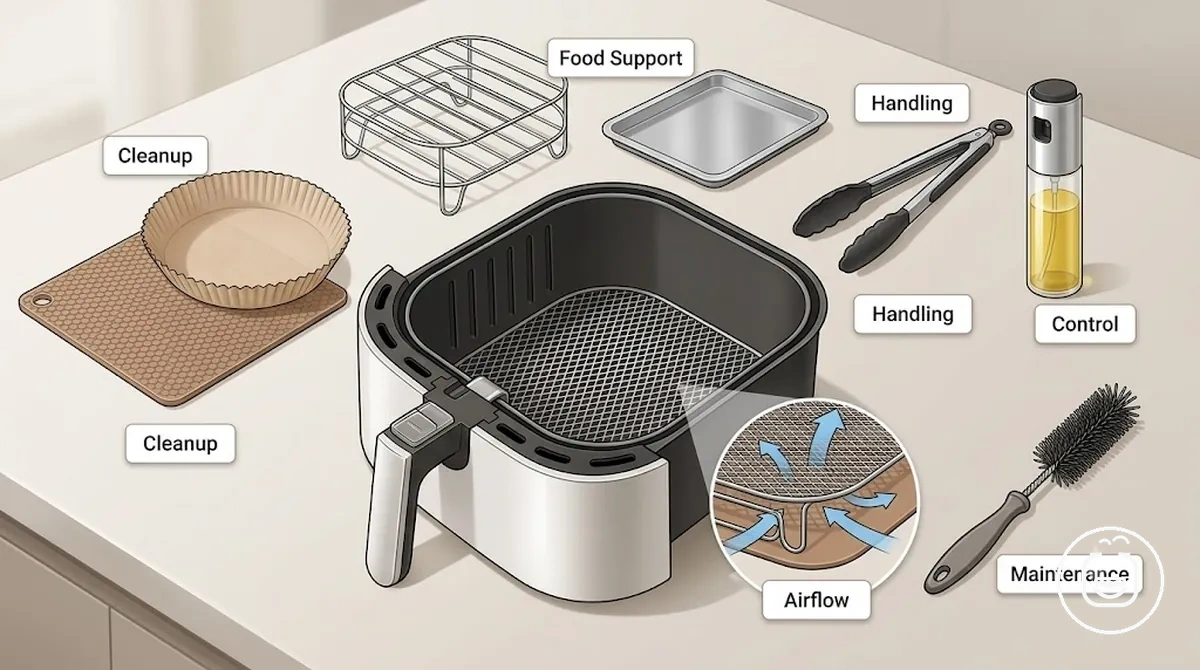
| Accessory family | Typical role | Useful condition | Limit to check |
|---|---|---|---|
| Liner or mat | Cleanup support | When reducing residue or sticking on the basket surface is a priority | May affect airflow if coverage is excessive |
| Rack or stand | Food support | When additional cooking levels or spacing are needed | Requires adequate clearance |
| Tray or pan | Food containment | When foods benefit from a contained cooking surface | May reduce available cooking space |
| Mold | Shape support | When food needs a defined form during cooking | Fit depends on basket dimensions |
| Tongs | Handling | When moving or turning hot food | Should suit the food and basket size |
| Oil sprayer | Cooking control | When applying a light coating during preparation | Results may vary by food type |
| Thermometer | Temperature checking | When monitoring cooking progress | Requires correct placement and use |
| Measuring tools | Portion control | When ingredient consistency matters | Do not directly affect basket performance |
| Cleaning brush | Maintenance | When removing residue from the basket surface | Tool type should suit the surface material |
When basket space is limited, a liner, mat, rack, tray, or pan may involve a balance between food support and airflow. Tongs, an oil sprayer, a thermometer, and measuring tools support handling or control around the cooking process rather than sitting inside the basket. A cleaning brush serves a maintenance role after cooking. These patterns help organize accessory families by function instead of encouraging catalog-style selection.
This overview introduces the major accessory families without expanding into detailed guidance for each type. Readers who need a deeper breakdown can explore how each category differs in purpose, fit, and use conditions. For a detailed category guide, see types of air fryer accessories.
Liners and mats for cleanup and basket protection
When foods are likely to leave residue or stick to the basket surface, a liner or mat can help create separation between the food and the basket. Liners and mats support cleanup, sticking control, and surface protection, but their effect depends on basket coverage, food weight, perforation, and airflow. Within the accessory-type discussion, their primary role is cleanup support and basket protection.
Liners and mats for cleanup and basket protection can influence both cleanup and airflow depending on placement and coverage. The image below shows how liner position, perforation, and food weight help balance basket protection with circulation.
- Silicone liner — reusable format that can simplify cleanup when basket fit is appropriate; extensive basket coverage may limit airflow in certain setups.
- Paper liner — useful for reducing residue during cooking when food weight keeps the liner in place; loose paper may shift if not held down by food.
- Parchment sheet — can help with sticking control when matched to the basket and heat rating; perforation and coverage may affect circulation.
- Mat — supports surface protection and cleanup while separating food from the basket surface; an oversized mat may reduce airflow beneath the food.
- Perforated liner — provides airflow openings through the liner surface; results still depend on basket coverage and food placement.
A liner may be helpful when cooking foods that leave residue on the basket and make cleanup more difficult. If coverage is excessive or circulation is restricted, crisping may be reduced, so liner choice remains a secondary decision within the broader accessory-type category.
Racks, trays, pans, and molds for food support
When a recipe needs elevated placement, contained ingredients, or layered cooking, racks, trays, pans, and molds change how food sits inside the basket. Their food support role depends on basket shape, recipe type, and available clearance. These accessories affect placement, food contact surface, and capacity while remaining limited by the available cooking space.
| Accessory | Support role | Fit check | Result risk |
|---|---|---|---|
| Rack | Raises food and supports layered cooking | Rack height should leave adequate clearance | Additional layers may reduce airflow around food |
| Tray | Provides a support surface for food placement | Tray perforation should suit the basket shape | Greater food contact may reduce airflow beneath food |
| Pan | Contains ingredients for baking support | Pan diameter should suit the basket shape | Reduced open space may limit circulation |
| Mold | Supports portioning and shape retention | Mold material and size should fit the available space | Heat exposure may vary by design and placement |
Support accessories fall into two groups: spacing-support items such as a rack, and containment-support items such as a tray, pan, or mold. A rack changes food placement by adding height and supporting layered cooking, while a tray or pan changes the food contact surface and containment area. A mold focuses on portioning and shape support rather than increasing capacity. If added layers increase the food load, airflow may become more restricted and food may require turning or repositioning to maintain exposure to circulating air.
Handling, oiling, measuring, and cleaning tools
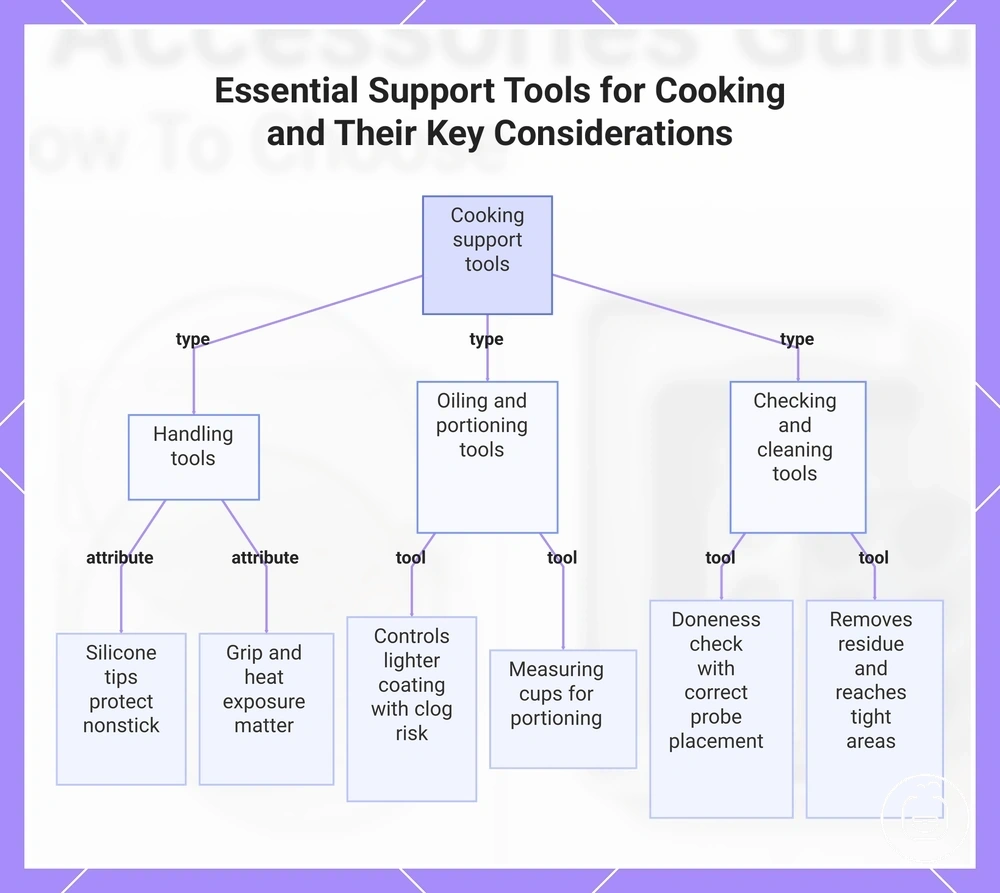
When hot food needs turning, oil needs controlled application, or residue makes cleanup more difficult, handling and support tools can improve control around the cooking process. Tongs, an oil sprayer, a thermometer, measuring cups, and a cleaning brush are used before, during, or after cooking rather than staying in the basket. Their main value comes from supporting handling, checking, portioning, and cleanup while remaining separate from in-basket accessories.
These tools are most useful when they influence cooking decisions or simplify routine tasks. Tool material, grip, nonstick surface contact, heat exposure, and cleaning reach can affect how practical a tool is for a specific use case. For many beginners, improving handling and cleanup often has a greater day-to-day impact than adding extra pans or accessory kits, so handling and cleanup needs usually deserve attention first.
These tools support handling, oiling, measuring, and cleanup tasks:
- Tongs — handling task; useful when turning or removing hot food; silicone tips may be preferable for a nonstick surface, but grip quality and heat exposure still matter.
- Oil sprayer — controlled oiling task; useful when applying a lighter coating; even coverage may vary, and clog risk can affect use over time.
- Thermometer — doneness check task; useful when cooking progress is uncertain; results depend on correct probe use and placement.
- Measuring cups — portioning task; useful when ingredient consistency matters; they support preparation decisions rather than basket performance.
- Cleaning brush — cleanup task; useful for removing residue from the basket surface and reaching tighter areas; brush material should suit the cleaning task and nonstick surface.
This chart shows the main supporting tools used in cooking, their tasks, and the most important details for each tool.
Compatibility factors before choosing accessories
Compatibility depends on usable interior space, shape, clearance, heat limit, and manufacturer guidance rather than on broad marketing claims. An accessory may fit one basket and not another even when the quart or litre capacity appears similar. Before choosing an accessory, check basket dimensions, shape, clearance, heat limit, and manufacturer guidance as separate compatibility conditions.
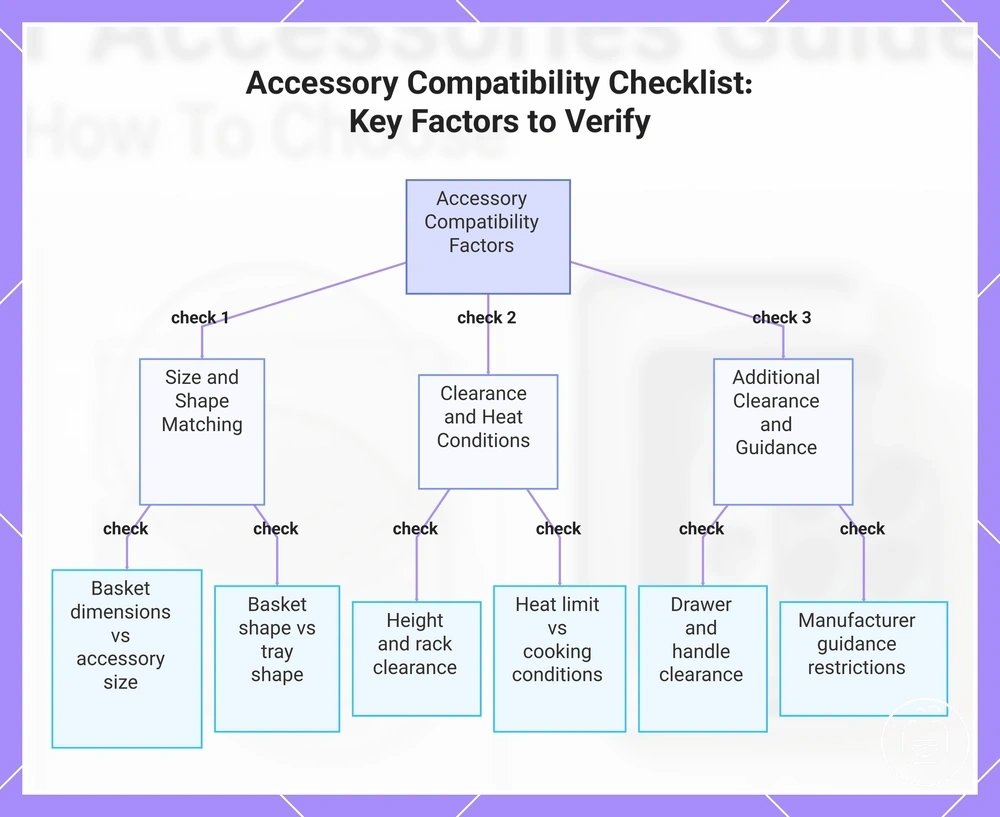
Compatibility factors before choosing accessories should be verified before purchase because size labels and universal fit claims may not reflect actual basket constraints. The checklist below focuses on measurable conditions that affect compatibility and verifies whether an accessory can fit and function within the available space.
- Check interior width and basket dimensions against accessory size to support a reliable fit decision.
- Check basket shape and tray shape because similar quart or litre ratings may still have different interior layouts.
- Check height clearance and rack height to confirm there is adequate space above the accessory and food.
- Check the material heat limit against expected cooking conditions and placement requirements.
- Check drawer movement and handle clearance to reduce the chance of interference during opening or closing.
- Check manufacturer guidance or instructions for restrictions related to accessory use.
- Check food spacing because crowded placement may reduce usable space and affect airflow around food.
When compatibility problems occur, the cause is often a mismatch between accessory size and usable interior space rather than capacity labels alone. A quart or litre rating describes overall capacity, but basket dimensions, shape, clearance, and rack height determine whether an accessory can be positioned correctly. If clearance is tight, the accessory may crowd food or interfere with drawer movement. An accessory may physically fit inside the basket yet still be unsuitable if it restricts airflow, while a safely usable accessory must satisfy both fit and operating conditions.
Universal fit should be treated as a claim that requires verification through measurable dimensions and conditions. Compatibility depends on the specific basket, accessory, heat limit, and manufacturer guidance.
This chart groups essential compatibility checks into three categories—size and shape matching, clearance and heat conditions, and additional clearance and manufacturer guidance—to help verify fit and function before choosing an accessory.
Basket size, shape, and clearance
Basket size, shape, and clearance determine whether an accessory may fit and function properly inside the cooking drawer. An accessory that matches basket dimensions may still be unsuitable if side clearance, height, or handle space is limited. For that reason, basket size and clearance should be evaluated together rather than as separate fit checks.
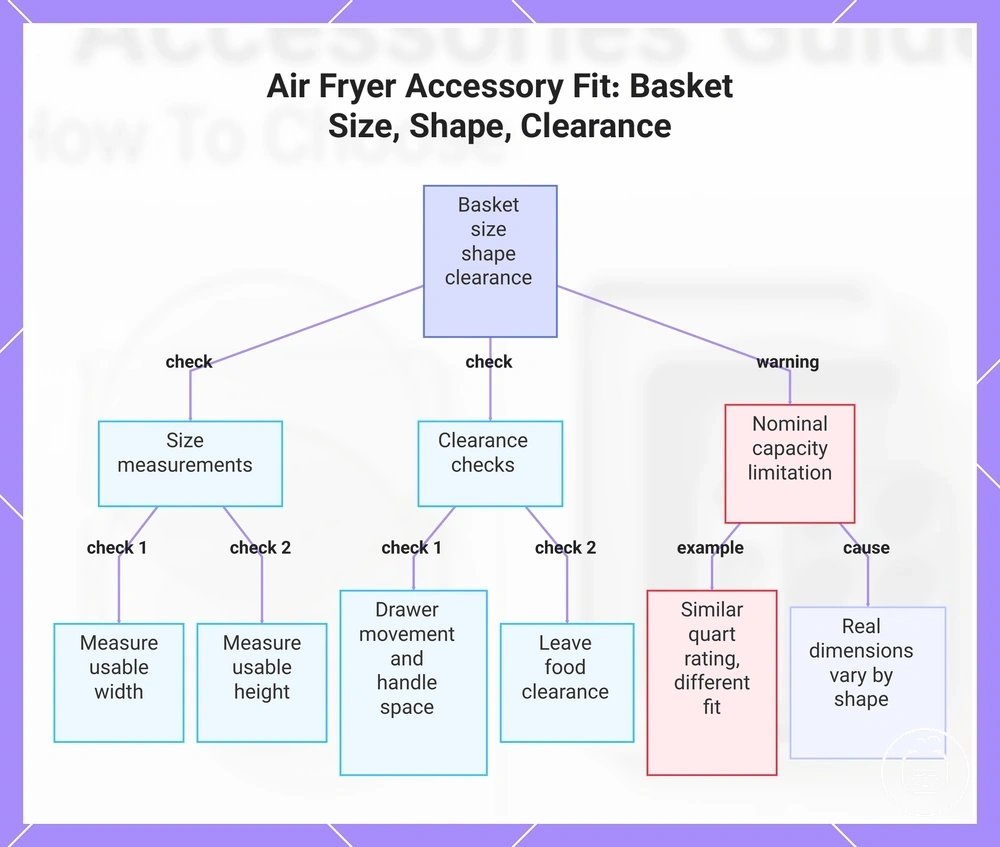
Basket size, shape, and clearance checks verify whether an accessory can sit inside the basket without touching walls, interfering with drawer movement, or crowding food. The checklist below focuses on usable internal dimensions and space requirements because nominal capacity alone does not determine accessory fit.
- Measure usable interior width and compare it with the accessory diameter or width.
- Measure usable height and compare it with accessory height, rack height, and available space below the heating element.
- Check drawer movement to confirm the accessory does not interfere with opening or closing.
- Check handle space to reduce the chance of contact with basket edges or moving components.
- Compare accessory diameter and shape with the basket design, including a round basket, square basket, or dual-basket layout.
- Leave food clearance around and above food so the accessory does not crowd the cooking area.
A measurement example shows why nominal capacity does not equal accessory fit. Two air fryers may have a similar quart rating, yet a round basket, square basket, and dual-basket design can provide different interior width, height, and usable space. An accessory may fit one basket but not another because real dimensions and food clearance vary by shape and drawer design. As a sizing criterion, review air fryer accessory size and fit when comparing accessory dimensions with available basket space.
This chart shows the main checks for verifying air fryer accessory fit, including size and clearance measurements and a warning about nominal capacity limitations.
Brand-specific fit vs universal-fit claims
Brand-specific fit and universal fit claims depend on verification rather than label wording alone. A brand-specific fit claim may indicate alignment with a compatible model list, while a universal fit claim may indicate a broader diameter range or multi-fit design. Neither claim type proves compatibility by itself, so both require measurement checks for dimensions, basket geometry, clearance, and material suitability.
The comparison below shows what each claim can suggest and what still requires verification through measurable fit conditions.
| Claim type | What it can prove | What still needs checking |
|---|---|---|
| Brand-specific fit | May indicate that the accessory was designed for a listed basket family or compatible model list. | Dimensions, accessory diameter, basket geometry, clearance, material suitability, and usable space still require verification. |
| Universal fit | May indicate that the accessory is intended for multiple basket sizes or diameter ranges. | Basket geometry, dual-zone limitations, clearance, height, and available food space still need checking. |
Direct verification remains the practical compatibility check. A compatible model list can narrow options, and a universal fit claim can broaden them, but compatibility still depends on measurable conditions. A dual-zone basket may create a shape mismatch even when the accessory diameter appears suitable. For example, a universal rack may fit physically inside a basket yet remain impractical if it reduces usable food space or crowds the cooking area. When claim wording replaces measurement checks, return risk and wasted-space decisions may become more likely.
Material and heat-safety checks
Safe accessories need food-contact suitability, heat resistant materials, stable placement, and airflow-aware use. A material that may be suitable in one air fryer can become unsuitable if its heat rating, condition, or position does not match appliance guidance. Material and heat-safety checks connect safety decisions to food-contact use, heat exposure, placement, and airflow.
Material and heat-safety checks help protect against heat-related damage, surface wear, and airflow restrictions. The table below organizes common material and claim checks by condition, safe-use requirements, and the risks they help evaluate.
| Material or claim | What to check | Safe-use condition | Risk if ignored |
|---|---|---|---|
| Silicone | Food-contact suitability and heat limit | Use when the material rating and placement match appliance instructions | Performance may vary if the heat limit is exceeded |
| Parchment | Placement and food weight | Keep parchment secured by food and away from the heating element | Loose paper may shift and contact heated components |
| Stainless steel | Rack condition and corrosion signs | Use when the surface remains intact after washing and regular use | Corrosion or wear may reduce long-term usability |
| Nonstick coating | Scratches, peeling, or surface wear | Monitor coating condition and replace damaged accessories when appropriate | Wear may signal reduced surface performance |
| BPA-free claim | Material claim and intended food-contact use | Confirm the claim together with heat and usage guidance | The claim alone does not verify suitability |
| Dishwasher-safe claim | Cleaning guidance and material durability | Follow the stated cleaning instructions | Cleaning methods may affect durability when guidance is ignored |
| Maximum temperature | Rated heat limit | Keep use within the stated temperature range | Exceeding the limit may affect material condition |
Material and placement conditions work together. Silicone depends on food-contact suitability, heat limit, and correct placement. Parchment depends on food weight and avoiding contact with the heating element. Stainless steel accessories depend on surface condition and cleaning practices, while a nonstick coating should be checked for scratches and wear over time. BPA-free and dishwasher-safe claims describe specific attributes, but they should be considered alongside maximum temperature guidance and appliance instructions. Open-flame use should not be assumed appropriate unless the material guidance specifically allows it.
These checks focus on accessory materials and their use conditions. General appliance faults, electrical issues, and broader appliance safety concerns are separate from accessory material and heat-safety evaluation.
Food-safe silicone, parchment, stainless steel, and nonstick surfaces
Food-safe silicone, parchment, stainless steel, and nonstick surfaces are common accessory materials, but suitability depends on heat rating, food contact, washing method, and placement. A material that may perform well in one accessory can become less suitable when heat exposure, airflow conditions, or surface condition change. Material suitability should be evaluated through temperature limits, food-contact use, and placement requirements.
The table below compares common material options by accessory form, safe-use checks, and watch-out conditions. It focuses on heat rating, durability, dishwasher exposure, coating condition, and other material attributes that can affect long-term use.
| Material | Common accessory form | Safe-use check | Watch-out condition |
|---|---|---|---|
| Food-safe silicone | Reusable liner | Check heat rating, food-contact suitability, and basket placement | Performance may vary when heat exposure exceeds the intended limit |
| Parchment or paper | Disposable liner | Keep secured by food and positioned away from direct heating-element contact | Loose paper may shift when food weight is insufficient |
| Stainless steel | Rack or support tray | Check surface condition after washing and repeated use | Corrosion, deformation, or wear may affect durability |
| Nonstick-coated surface | Tray or pan | Inspect coating condition and follow care instructions | Scratches and coating wear may become wear signals for replacement decisions |
A reusable liner made from food-safe silicone may suit repeated use when the heat rating and placement are appropriate. A disposable liner made from parchment can support cleanup, but food weight and airflow conditions still matter. Stainless steel supports often emphasize durability, while a nonstick surface depends more on coating condition, dishwasher exposure, and visible wear signals over time.
These examples compare materials through conditions and use requirements rather than through rankings. For a broader discussion beyond this local comparison, see safe materials for air fryer accessories.
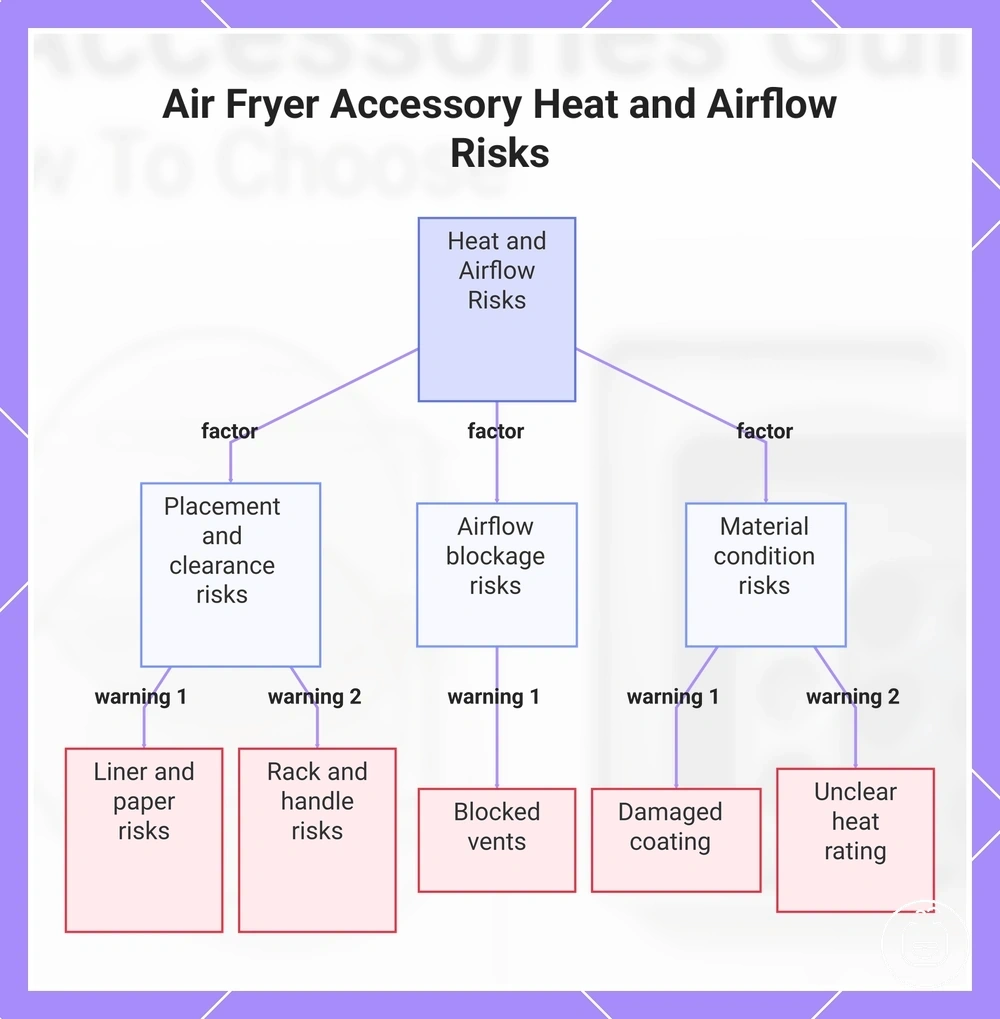
Items and placements that can create heat or airflow risk
Accessory risk usually comes from placement, weight, clearance, or material condition rather than from the accessory category alone. A useful liner, rack, or tool can become unsuitable if it moves toward the heating element, blocks circulation, or crowds the basket. The safer approach is to check how the item sits in use, especially around heat exposure and airflow.
The following placements can create heat or airflow risk, so each warning stays practical rather than fear-based:
- Loose paper — paper without enough food weight may shift toward the heating element; keep paper liners weighted by food and positioned away from heating areas.
- Oversized liner — a liner that covers too much basket surface may block vents or reduce circulation; choose coverage that leaves airflow space.
- Tall rack — a rack with limited clearance may lift food too close to heating areas; compare rack height with available basket height before use.
- Blocked vents — covered openings can create airflow risk and uneven cooking; leave vents and circulation paths open.
- Handles near heating areas — handles that sit too high or too close to heat may be unsuitable; check handle position during placement.
- Damaged coating — scratches, peeling, or heavy wear can become a replacement signal; avoid using accessories when the coating condition is poor.
- Unclear heat rating — materials without a clear heat rating may not match cooking conditions; use only when material guidance supports the intended placement.
This chart shows the main factors that create heat or airflow risk from air fryer accessories, with specific placement and material warnings.
Accessories worth buying for everyday use
Accessories worth buying for everyday use are the ones that solve a frequent cooking, cleanup, handling, or fit problem for the reader’s air fryer. A useful accessory should match the basket, support safe use, and avoid duplicating tools already owned. Worthwhile accessories solve frequent problems rather than adding unused pieces to storage.
Accessories worth buying for everyday use are easier to judge when value is tied to use frequency, compatibility, safety, storage, and overlap with existing tools. The table below compares common everyday decisions by practical value criteria.
| Accessory decision | When it is useful | Trade-off | Buy separately or in a set |
|---|---|---|---|
| Everyday cleanup | When liners, mats, or brushes reduce frequent residue problems | May add storage or need fit checks | Buy separately if cleanup is the main need |
| Handling | When tongs or similar tools make hot food easier to move | May duplicate utensils already owned | Buy separately if existing tools are unsuitable |
| Baking or grilling | When a pan, tray, or mold supports a repeated recipe type | Requires compatibility and material checks | Buy separately for a specific cooking need |
| Layered cooking | When a rack supports food spacing in a compatible basket | May reduce airflow or usable food space | Choose a set only if the rack and other pieces will be used |
| Cleaning support | When a cleaning brush reaches residue on the basket surface | Brush material should suit the surface | Buy separately if maintenance is the frequent problem |
Essential accessories are usually the ones that support repeated tasks such as cleanup, handling, or a common cooking style. Optional add-ons are more useful when they match a specific recipe, basket shape, or storage plan. Beginners often get more value from simple cleanup and handling tools before specialty pans or layered cooking pieces. For a tighter starter decision, compare the role of essential air fryer accessories.
When someone is considering an accessory set or kit, the useful question is how many included pieces solve real problems. A kit may make sense when several pieces fit the basket, support frequent use cases, and do not overlap with tools already owned. Individual pieces may offer better value when the user only needs one liner type, one rack, or one cleaning tool. The trade-off is convenience versus unused storage burden.
Before choosing, check whether the accessory solves a frequent problem, fits the basket, uses suitable material, stores easily, and avoids duplicating existing tools. Product examples should only illustrate those criteria after the decision logic is clear. For a final pre-purchase review, use the air fryer accessories buying checklist.
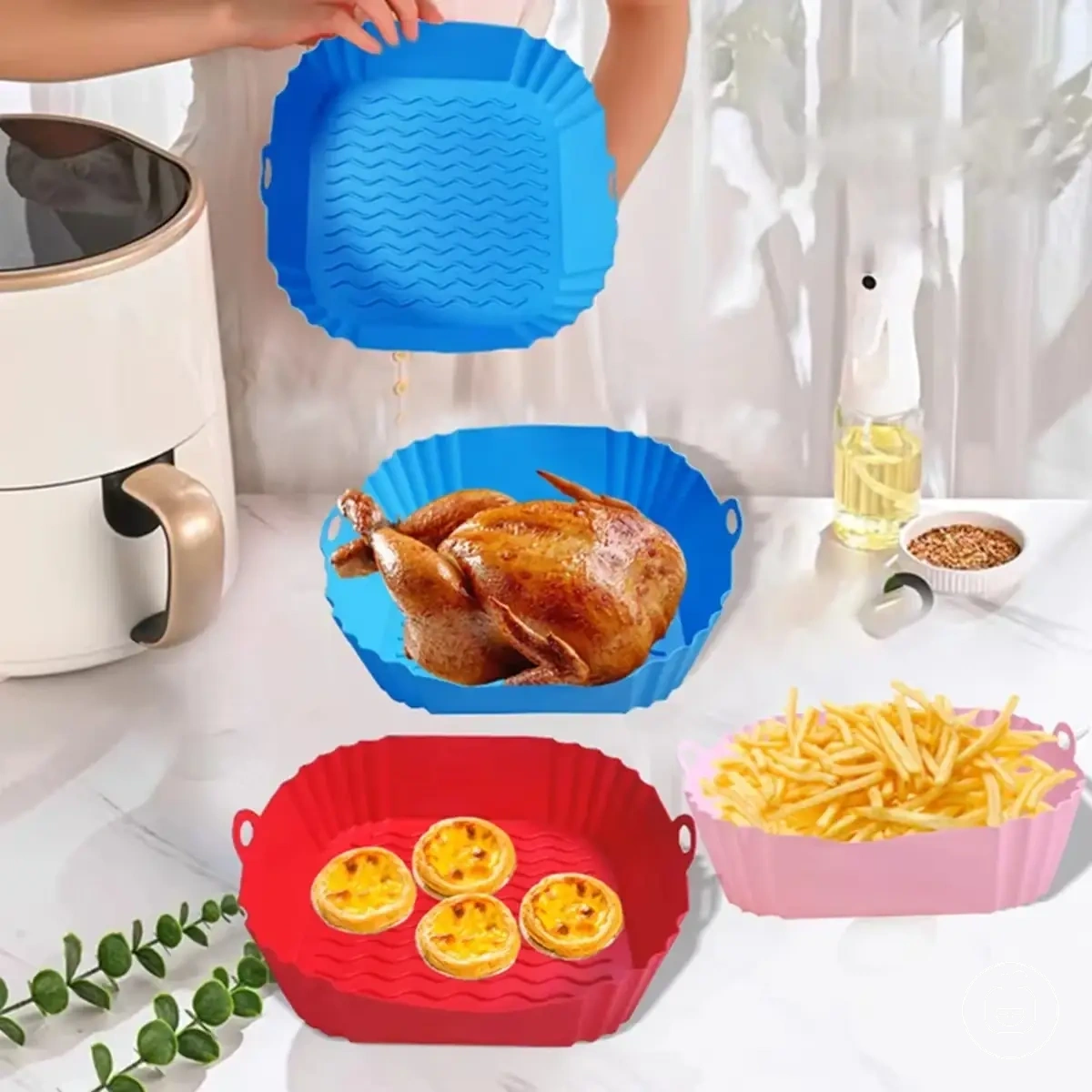
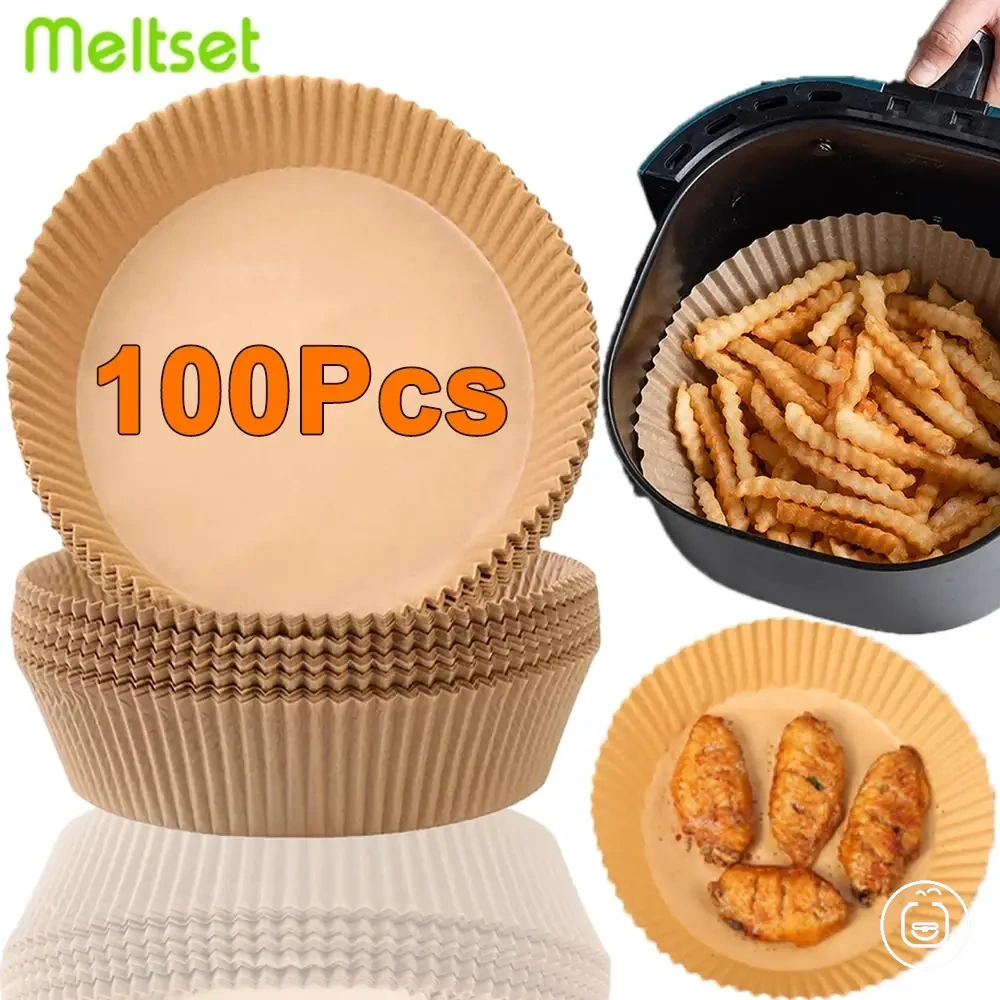
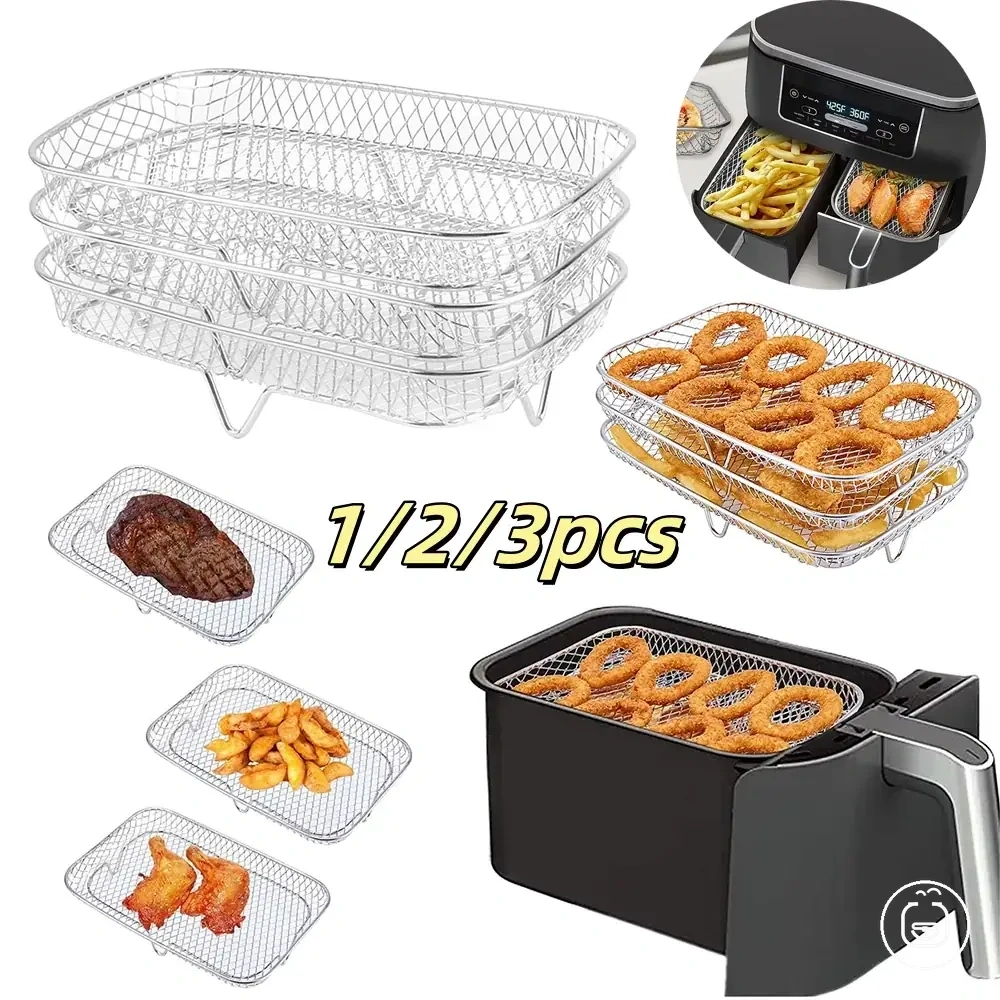
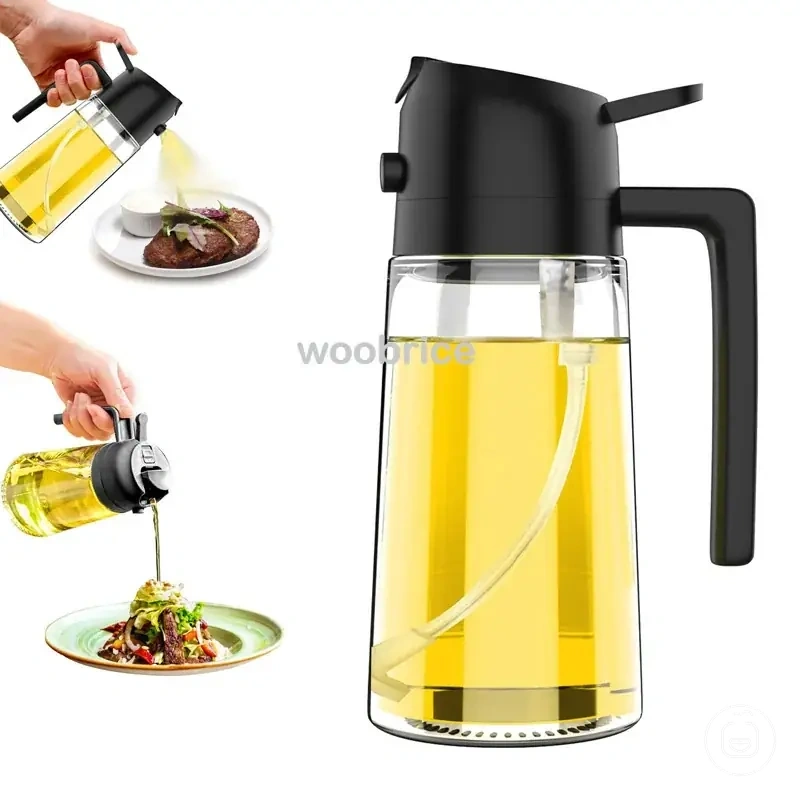
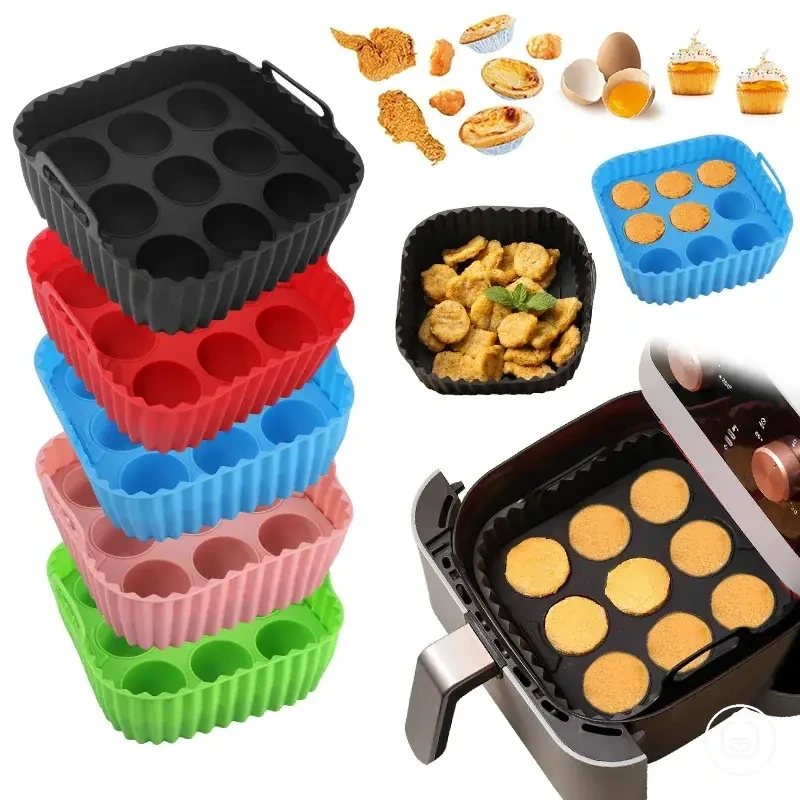
Here are product examples that may make comparison easier. Before buying, always review the compatibility criteria, essential features, and product details.
Essential accessories vs optional add-ons
Essential accessories are the items used often enough to solve a repeated cooking, cleanup, handling, or storage problem. Optional add-ons are more useful for occasional recipes, specialty cooking styles, or extra convenience when space allows. The difference depends on cooking routine, cleanup tolerance, and frequency of use rather than on a full set.
Essential accessories vs optional add-ons should be checked through everyday use, storage space, and overlap with existing kitchen tools. The checklist below verifies whether an accessory belongs in a frequent-use group or a specialty-use group. High-frequency tools such as tongs, liners, or a cleaning brush usually serve daily handling or cleanup needs, while baking molds and specialty racks are more often tied to specific cooking tasks.
- Check frequency of use: choose essential accessories for tasks repeated often, not for rare recipes.
- Check cleanup tolerance: liners or a cleaning brush may be more useful when basket residue is a frequent problem.
- Check safety handling: tongs may matter more when hot food is difficult to turn or remove safely.
- Check storage space: optional add-ons can lose value if they create storage burden.
- Check cooking style: baking molds or specialty racks are useful when that cooking style is repeated.
- Check existing tools: avoid duplicating utensils or containers that already work for the same task.
Accessory sets and kits vs individual pieces
Accessory sets and kits vs individual pieces depends on how many included items will actually be used, fit the basket, and justify the storage space they require. More pieces do not automatically mean better value because usefulness depends on fit certainty, material quality, and everyday cooking needs. The trade-off is between broader coverage from an accessory set and more targeted selection through individual pieces.
The comparison below shows how bundled value depends on useful pieces, fit certainty, material quality, and storage.
| Choice | Best when | Main risk | Decision signal |
|---|---|---|---|
| Sets or kits | When most useful pieces match the cooking routine and basket size | Duplicate items, unused accessories, storage burden, or uncertain pan size and rack size | Consider a kit when multiple included pieces are likely to be used regularly |
| Individual pieces | When there is a targeted need such as a liner, rack, pan, or cleaning tool | May require separate compatibility checks and comparisons | Buying one or two separate pieces may be safer when fit certainty is unclear |
An accessory set may include useful pieces, but duplicate items can reduce practical value when existing kitchen tools already cover the same tasks. Kit contents should be checked for pan size, rack size, material claims, heat rating information, and storage requirements before assuming that a multi-piece option is more useful. Unused accessories can increase storage needs without improving everyday cooking, while individual pieces can provide less waste and better cost control for a targeted need. When material quality, fit certainty, or return risk is unclear, selecting one or two separate accessories is often the safer decision.
Use limits that protect airflow and cooking results
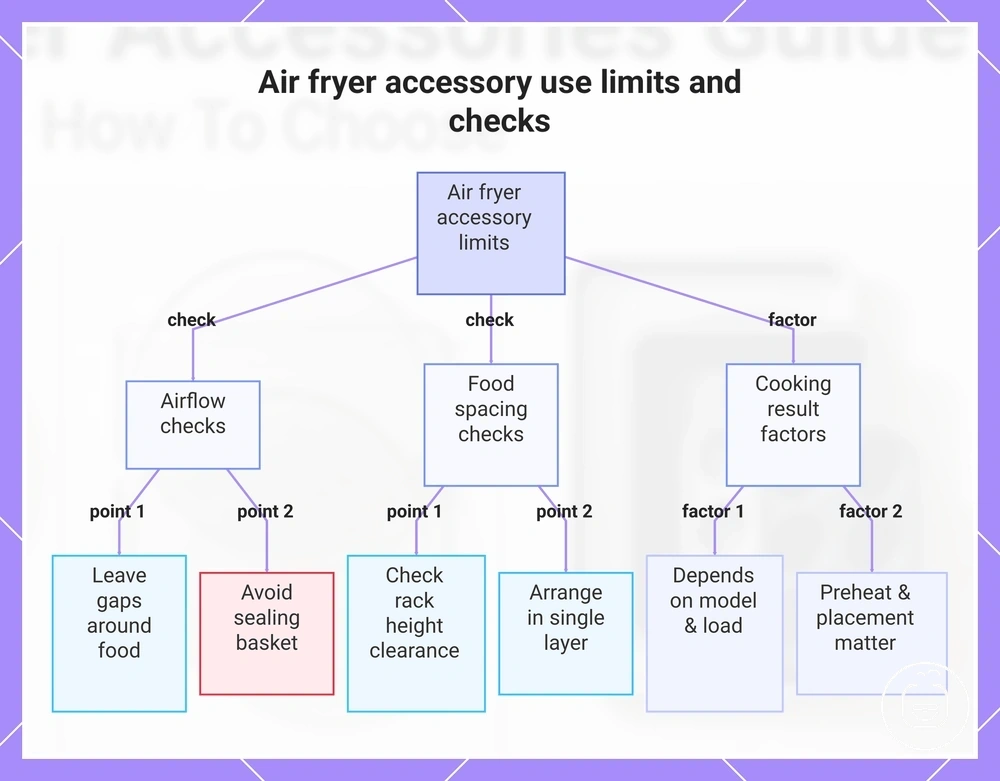
Use accessories in ways that support cooking without crowding food, sealing the basket, or blocking hot-air circulation. Air fryer accessories can help with cleanup, support, or food arrangement, but cooking results may change when placement, food load, or accessory design restricts airflow. The most important use limits focus on airflow and food spacing.
Use limits that protect airflow and cooking results are easier to follow when airflow, food contact, and placement are checked before cooking. The checklist below verifies common placement conditions that can affect cooking results and highlights key placement checks.
- Leave gaps around food to maintain airflow and reduce crowding.
- Avoid sealing the basket with liners, trays, or accessories that cover excessive basket surface area.
- Use sufficient liner weight from food when using a perforated liner or paper liner so it remains properly positioned.
- Check rack height and clearance to reduce the chance of food sitting too close to heated areas.
- Arrange food in a single layer when spacing becomes limited and circulation is needed around each piece.
- Turn or shake food when crowding or food arrangement may reduce exposure to circulating air.
- Remove residue and perform cleaning after use to help maintain the accessory surface and support maintenance.
When food is arranged with adequate spacing, a rack or perforated liner may support airflow around the food. When the same accessory is used with a heavier food load, crowding can reduce circulation and may weaken cooking results. A perforated liner can help with cleanup while still allowing airflow, but excessive basket coverage may limit circulation. Rack height, food arrangement, turning, and shaking can influence how evenly food is exposed to circulating air, making the same accessory helpful in one condition and less effective in another.
These limits are usage boundaries rather than guarantees because cooking results depend on appliance model, accessory design, food amount, and placement. Preheating limits, food load, and accessory position should be considered together when results vary. For broader usage guidance, see how to use air fryer accessories.
This chart shows the main checks for protecting airflow and food spacing, and factors that influence cooking results.