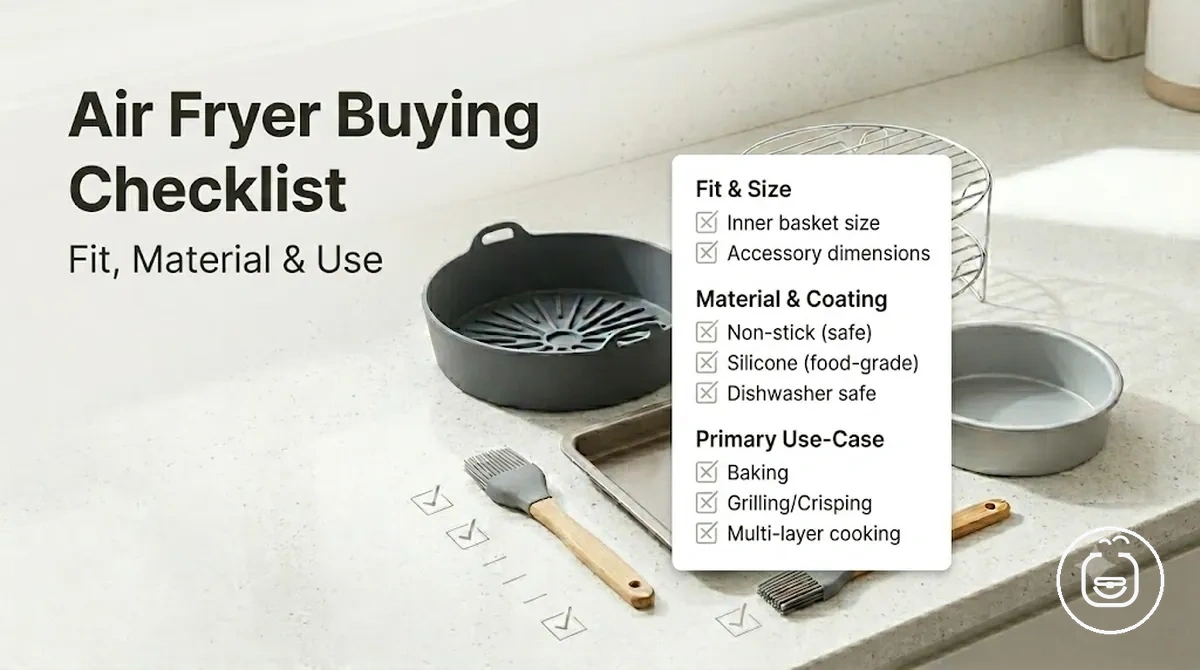
Air Fryer Accessories Buying Checklist
An air fryer accessories buying checklist is a structured decision filter for selecting accessories before considering price, bundle size, or popularity signals. It helps organize choices based on need, fit, material, value, and safe use so the decision stays grounded in actual cooking requirements. This approach reduces uncertainty when comparing different add-ons and keeps attention on practical usage instead of marketing influence. It also helps clarify whether an accessory aligns with real cooking behavior rather than assumptions.
Many SERP results for air fryer accessories mix kits, liners, racks, pans, and tongs in ways that can create purchase noise. This often leads to confusion between what looks complete and what actually fits a specific cooking setup. Fit and safety depend on the air fryer model and accessory material, so assumptions based on general listings may not hold in practice. Without clear criteria, mismatches in size or material can affect usability.
The air fryer accessories buying checklist also applies directly to everyday cooking patterns such as crisping, baking, batch cooking, and cleanup routines. It helps connect cooking needs with the right accessory type so decisions stay aligned with actual usage. For example, liners may support cleanup, while racks may support airflow depending on design and placement conditions. This structured evaluation also reduces unnecessary purchases that do not match repeated cooking tasks. It provides a clear contextual border between general browsing and focused selection through the air fryer accessories hub.
Before reviewing individual filters, the Air Fryer Accessories Buying Checklist organizes the decision by purchase risk rather than product appearance or bundle size. It separates essential evaluation points so each accessory can be assessed consistently across different use cases. The following checklist summarizes the key decision filters that guide selection.
Air Fryer Accessories Buying Checklist Summary
- Need — determines whether the accessory solves a repeated cooking or cleanup task before any purchase consideration.
- Fit — checks size, basket shape, and clearance to avoid mismatch with the air fryer model.
- Material — evaluates heat resistance, coating condition, and food-contact suitability for safe use.
- Value — compares usefulness of included pieces against actual cooking frequency and avoids low-use additions.
- Airflow — ensures the accessory does not block circulation and affect cooking consistency.
- Cooking needs — aligns accessories with specific outcomes like baking, crisping, or batch cooking patterns.
- Red flags — identifies unclear claims, missing size details, or weak material information before selection.
Accessory necessity and cooking-use fit
Accessory necessity depends on whether an air fryer accessories item solves a repeated cooking, handling, or cleanup need. An accessory is worth considering only when it clearly supports a repeated cooking task or reduces friction in everyday use. This shifts evaluation toward cooking-use fit instead of accessory count or appearance, and it leads directly into a structured mini-check focused on necessity.
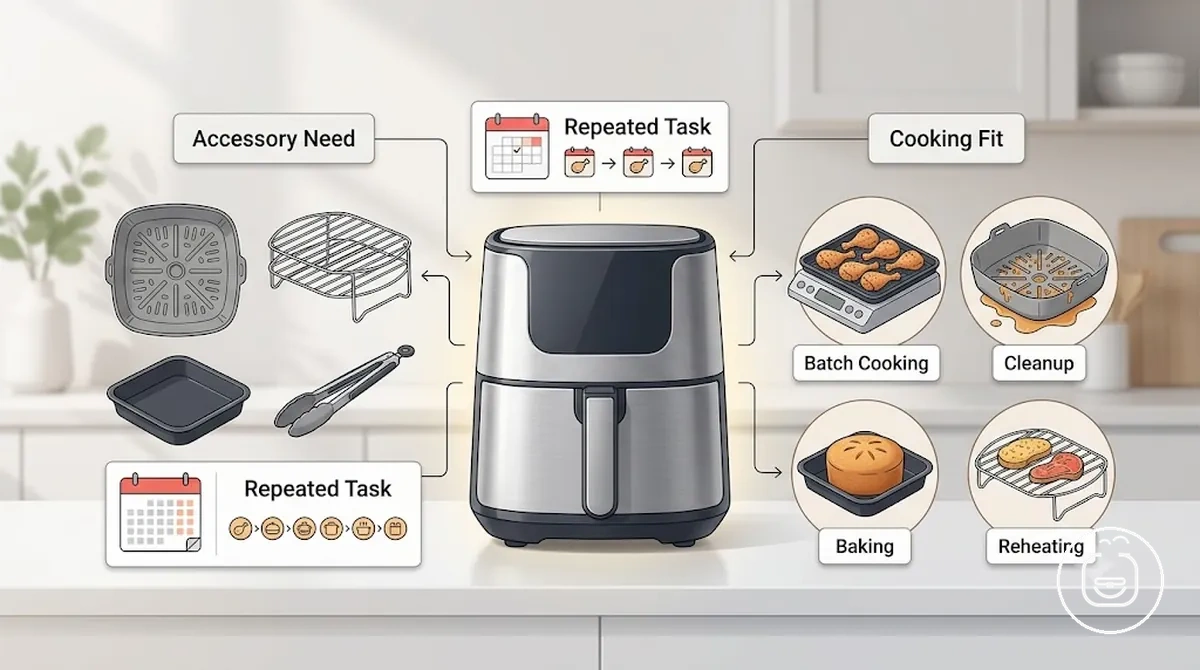
Cooking-use fit changes across different usage patterns such as occasional cooking, batch cooking, baking, grilling, reheating, and cleanup-focused preparation. Occasional use may not justify adding items like liners, racks, pans, or tongs unless a clear handling need exists. Batch cooking often increases the usefulness of racks for space and airflow, while baking and grilling may depend more on pan fit and heat resistance. Reheating usually benefits from simple handling tools, and cleanup-heavy use may increase the relevance of liners. The selection cue depends on which pattern repeats most often.
Accessory count and bundle appeal can distract from actual function because accessory sets often combine liners, racks, pans, and tongs without reflecting real cooking-use fit. This can shift attention away from whether each accessory supports a repeated cooking task or solves a specific handling or cleanup problem. When frequency and problem solved are not evaluated, unused accessories become more likely despite apparent value in the set.
Accessory necessity should be reviewed through repeated use patterns rather than bundle size or accessory variety. A liner may only be relevant when cleanup is frequent, while a rack becomes useful when airflow and batch cooking are consistent needs. For broader selection context, refer to the essential accessories list.
Necessary, useful, and optional accessory signals
Necessary, useful, and optional accessory signals depend on repeated use and the specific problem an accessory solves in everyday cooking. These signals classify how strongly an air fryer accessories item should be considered before purchase decisions. The three tiers are necessary accessory, useful accessory, and optional accessory.
A necessary accessory signal appears when a repeated cooking task depends on it, such as consistent handling or cleanup needs. A useful accessory signal appears when it improves a recurring cooking-use fit but is not strictly required for basic cooking. An optional accessory signal appears when the task is rare or does not significantly change outcomes.
The three decision tiers can be understood visually as a simple classification of accessory priority based on repeated cooking use and problem-solving strength. This visual helps separate necessity from convenience before comparing accessories.
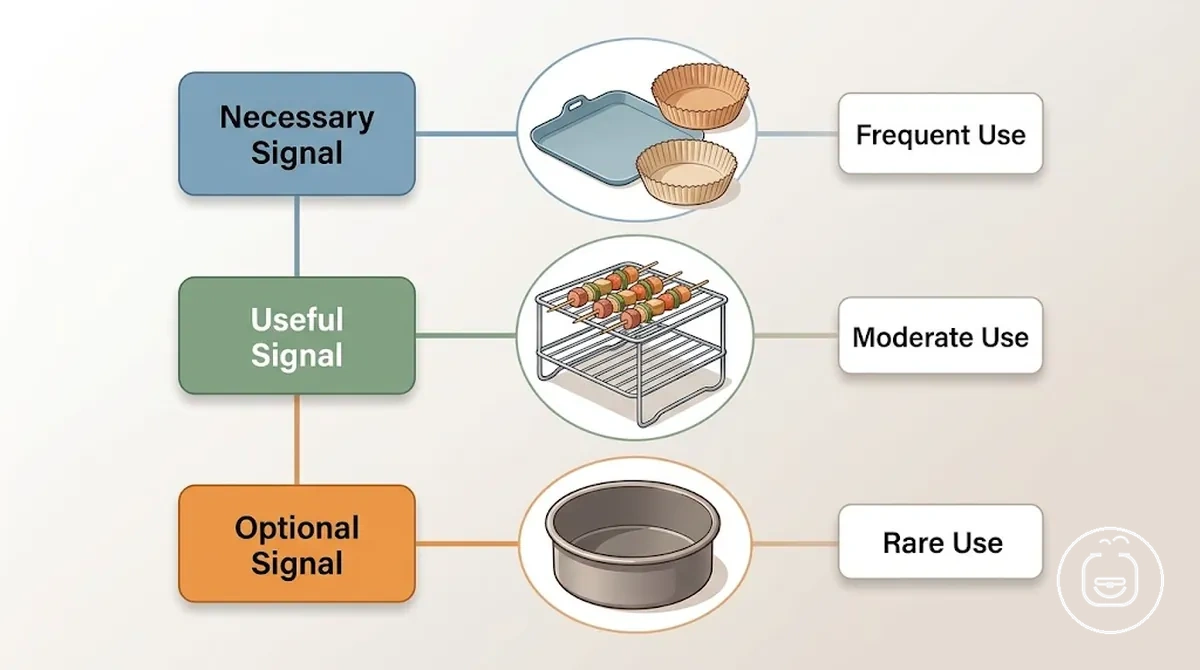
Necessary, useful, and optional accessory signals classify priority levels rather than product quality or appearance. These signals help separate purchase decisions based on how often a cooking task repeats and how strongly an accessory supports that task.
The classification works as follows before moving to detailed selection:
- Necessary accessory signal — repeated use with a clear problem solved → condition: frequent cooking task dependence → action: buy when the accessory consistently supports essential handling or cleanup needs.
- Useful accessory signal — moderate frequency with improved cooking-use fit → condition: enhances workflow without being required → action: buy if the task occurs regularly, otherwise delay until need becomes clearer.
- Optional accessory signal — rare or single-use scenarios → condition: limited repetition or low functional impact → action: skip when it does not contribute to repeated cooking tasks.
Cooking needs the accessory must support
Cooking need matching starts with the cooking outcome the user repeats most often. The accessory must support a clear cooking need to be relevant for use. This includes outcomes like crisping, baking, grilling, reheating, and cleanup.
Different food types and cooking methods create different cooking needs, which changes accessory function inside the air fryer. For example, crisping depends on airflow, baking depends on stable heat support, grilling depends on surface contact, and cleanup depends on mess control. This relationship helps connect food type and cooking method to the right accessory function.
The mapping between cooking needs and accessory function can be summarized in the table below. This helps avoid choosing an accessory that supports the wrong cooking outcome. To refine selection further, users can match accessories to cooking needs based on their repeated usage pattern.
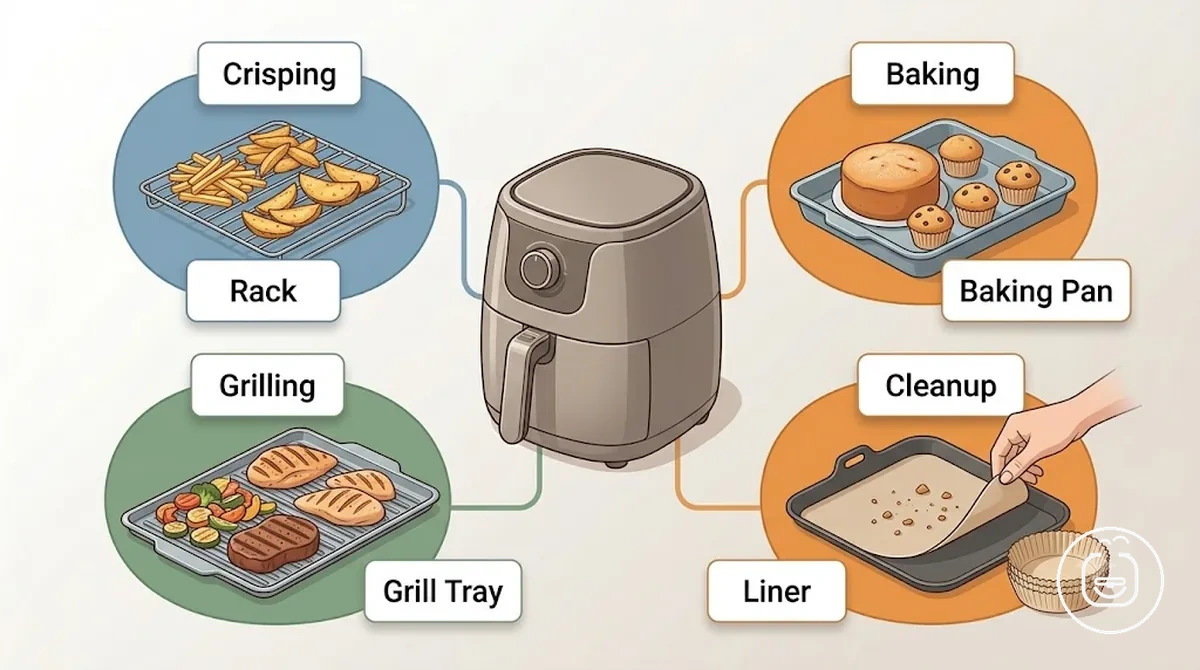
| Cooking need | Accessory function | Required condition | Expected benefit or limitation |
|---|---|---|---|
| Crisping | Rack for airflow | Needs spacing for circulation | Better crisping but may limit batch size |
| Baking | Baking pan support | Requires stable heat retention | More even baking but depends on size fit |
| Grilling | Grill tray or surface | Needs direct surface contact | Improved browning but depends on basket fit |
| Cleanup | Liner for mess control | Used when residue is frequent | Easier cleanup but may affect airflow |
Size, shape, and basket-fit checks
Basket fit depends on usable internal space, not accessory labels alone. Size, shape, clearance, and basket style must be checked to confirm physical compatibility.
When size, shape, or clearance does not match the air fryer basket, issues such as blocked airflow, unstable placement, or difficulty closing the drawer or lid may occur. These conditions can also increase return risk when the accessory does not align with internal dimensions or accessory height limits. Fit remains conditional and varies by model, so universal fit assumptions are not reliable.
Fit checking starts with measuring usable internal space before selecting any accessory. This includes evaluating size, shape, clearance, and basket fit as part of a structured compatibility check. A proper measure size and fit step helps reduce errors caused by quart size variation and differences in internal dimensions.
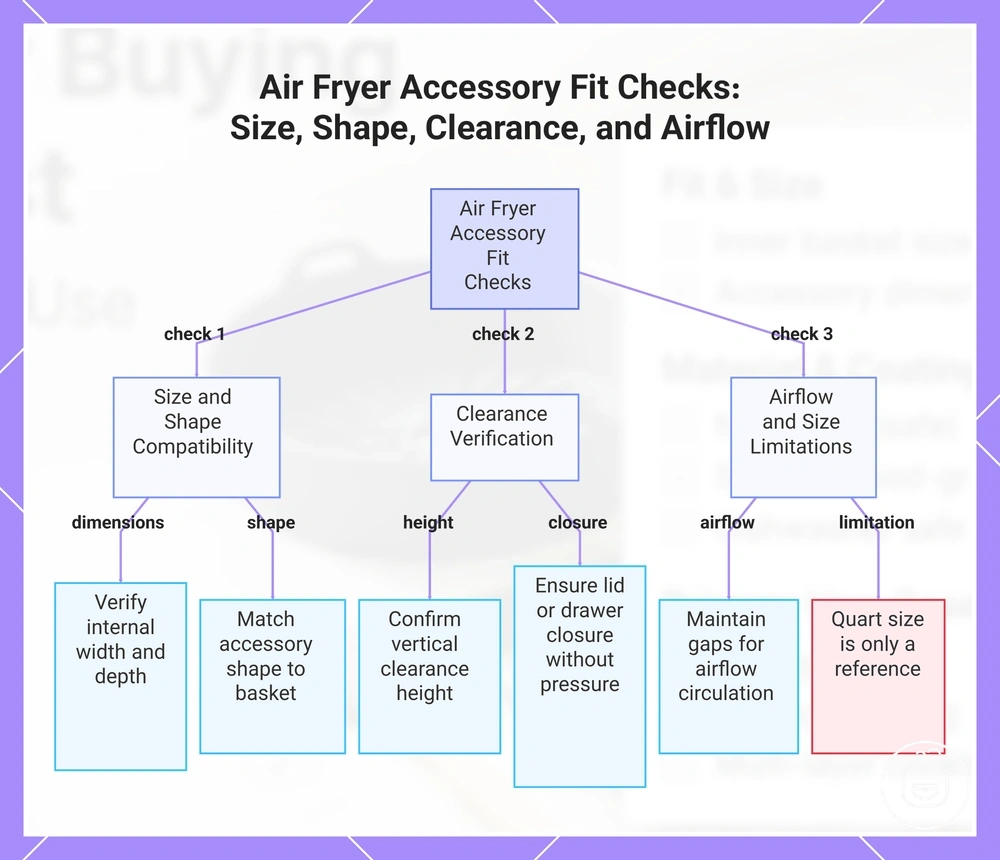
Round, square, basket-style, and oven-style air fryers each create different fit conditions based on airflow paths and internal structure. These differences affect how accessory height and shape interact with available space. The checklist below summarizes key physical checks before purchase.
- Internal dimensions — verify usable width and depth to match accessory size.
- Shape match — ensure accessory shape aligns with basket design to avoid edge obstruction.
- Clearance height — confirm vertical space supports accessory height and airflow.
- Accessory height vs closure — ensure lid or drawer can close without pressure.
- Airflow space — maintain gaps for circulation to avoid performance restriction.
- Quart size limitation — treat quart size as reference only, since usable space may differ.
- Model variation — confirm compatibility differences across similar-looking models.
This chart shows the key physical compatibility checks for air fryer accessories, helping to identify fit issues before purchase.
Basket clearance and accessory dimensions
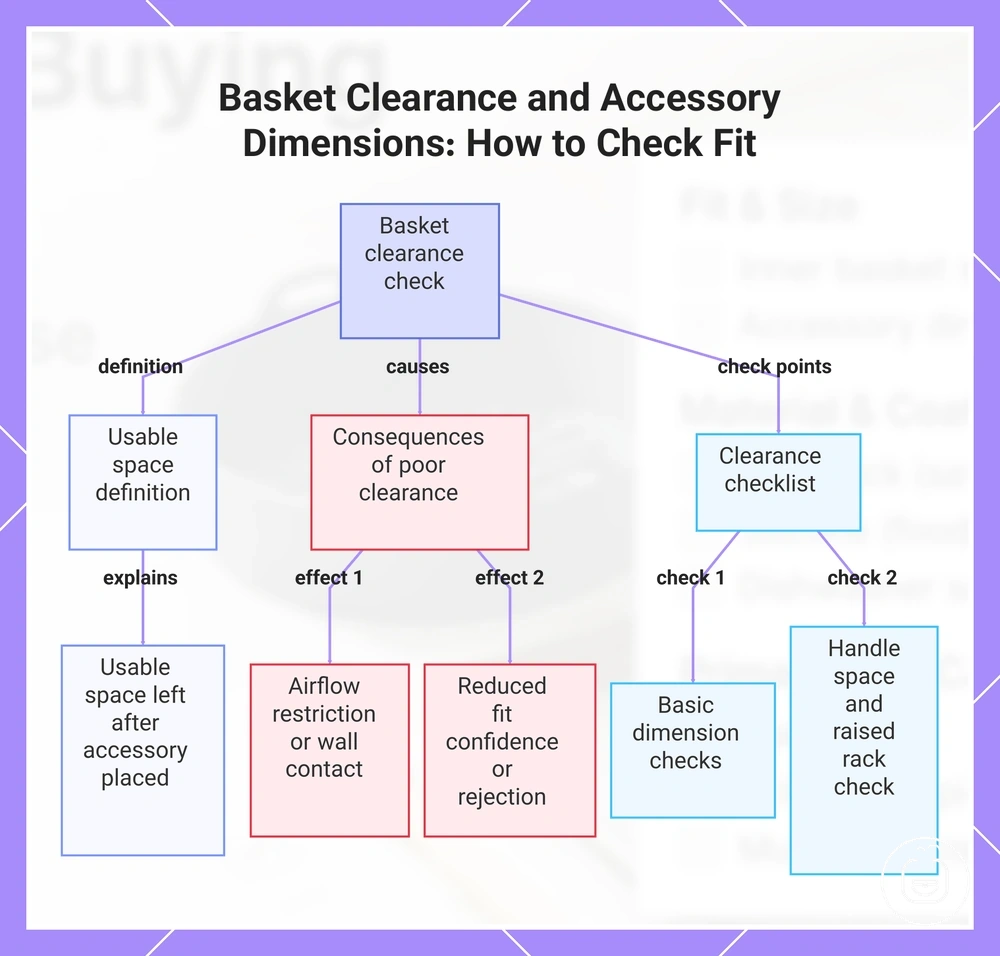
Basket clearance is the usable space left inside the basket after an accessory is placed. It determines how much width, depth, height, and handle space remains for safe basket fit.
When accessory dimensions exceed usable space, airflow may be restricted and contact with basket walls or lid areas can occur. Raised rack height, liner wall structure, or pan handle extension can reduce effective clearance and affect placement stability. These conditions may reduce fit confidence or lead to rejection depending on the model and airflow needs.
Clearance checking focuses on comparing basket clearance with accessory dimensions before selection. This includes evaluating size, shape, and height to understand how space is used inside the basket. Measured usable space is more reliable than relying only on external size labels.
Different accessory structures change how clearance behaves in practice. A raised rack reduces vertical space, a liner with walls reduces usable width, and a pan with handles affects safe insertion and removal space. These factors must be considered before final selection.
The mini-checklist below helps structure the clearance check before purchase:
- Width check — confirm accessory width fits within usable basket space without wall contact.
- Depth check — ensure front-to-back space allows full placement without blocking airflow paths.
- Height check — verify vertical clearance remains after adding racks or pans.
- Handle space check — ensure handles do not obstruct closure or safe removal.
- Raised rack impact — confirm added height does not significantly restrict airflow circulation.
This chart explains what basket clearance is, why it matters, and the key checks for verifying accessory fit.
Brand-specific fit and universal-fit claims
Universal fit claims suggest broad compatibility, but they still depend on measured basket dimensions and accessory size alignment. These claims cannot confirm fit without checking actual measured basket space, including width, depth, and height, along with model range compatibility. Claim wording alone does not guarantee correct basket fit.
Brand-specific fit claims can narrow compatibility by pointing to a compatible model range, but they still require verification against measured basket space and accessory dimensions. These claims are useful when they define model range boundaries, but mismatch risk remains if internal basket dimensions differ. The comparison below explains how each claim type should be evaluated before selection.
| Claim type | What it indicates | Required verification | Mismatch risk condition |
|---|---|---|---|
| Universal fit | Broad compatibility across multiple models | Measured basket dimensions and accessory dimensions | Higher when basket size or shape differs from assumed space |
| Brand-specific fit | Compatibility within a defined model range | Model range confirmation plus measured basket check | Occurs when internal basket design varies within same brand |
Material, coating, and quality checks
Material suitability depends on heat tolerance, food-contact claim, coating condition, and cleaning method. These factors determine whether an air fryer accessory can handle repeated cooking use without degrading performance. Common materials include silicone, stainless steel, parchment, and nonstick coating.
Material labels must be checked against stated heat tolerance and cleaning conditions before use. A dishwasher safe claim does not always confirm heat resistance, so both claims need separate verification. Coating condition and food-contact claims should also be reviewed together to understand durability and performance limits under repeated cycles.
Reusable and disposable material decisions change how durability and cleaning method are evaluated. Silicone and stainless steel are typically reusable and depend more on heat tolerance and surface condition over time. Parchment is generally disposable and focuses on single-use heat handling rather than durability. Nonstick coating may improve usability but can vary in condition depending on wear and coating quality.
Material, coating, and quality checks should always be validated against measured use conditions before selection. For deeper criteria on evaluating material safety and claims, users should check safe materials based on accessory type and usage context.
| Material | Heat tolerance | Food-contact claim | Coating / quality condition | Decision signal |
|---|---|---|---|---|
| Silicone | Typically used for moderate to high heat use cases | Must confirm direct food-contact suitability | Flexible structure; check for wear over time | Reusable when heat and condition remain stable |
| Stainless steel | Generally supports high heat applications | Food-contact depends on surface finish | Durable; resistant to warping under repeated use | Preferred for repeated use when structure is stable |
| Parchment | Used for limited heat exposure scenarios | Indirect food-contact barrier material | Disposable; no long-term coating condition | Single-use when cleanup or sticking control is needed |
| Nonstick coating | Varies by coating type and condition | Depends on surface integrity | Can degrade or change with wear over time | Use conditionally when coating remains intact |
Food-contact material and coating claims
Food-contact claim and coating condition must be checked before hot-air use. The decision depends on label clarity and coating integrity. Silicone, nonstick surfaces, and disposable liners may behave differently based on heat limit and stated use conditions.
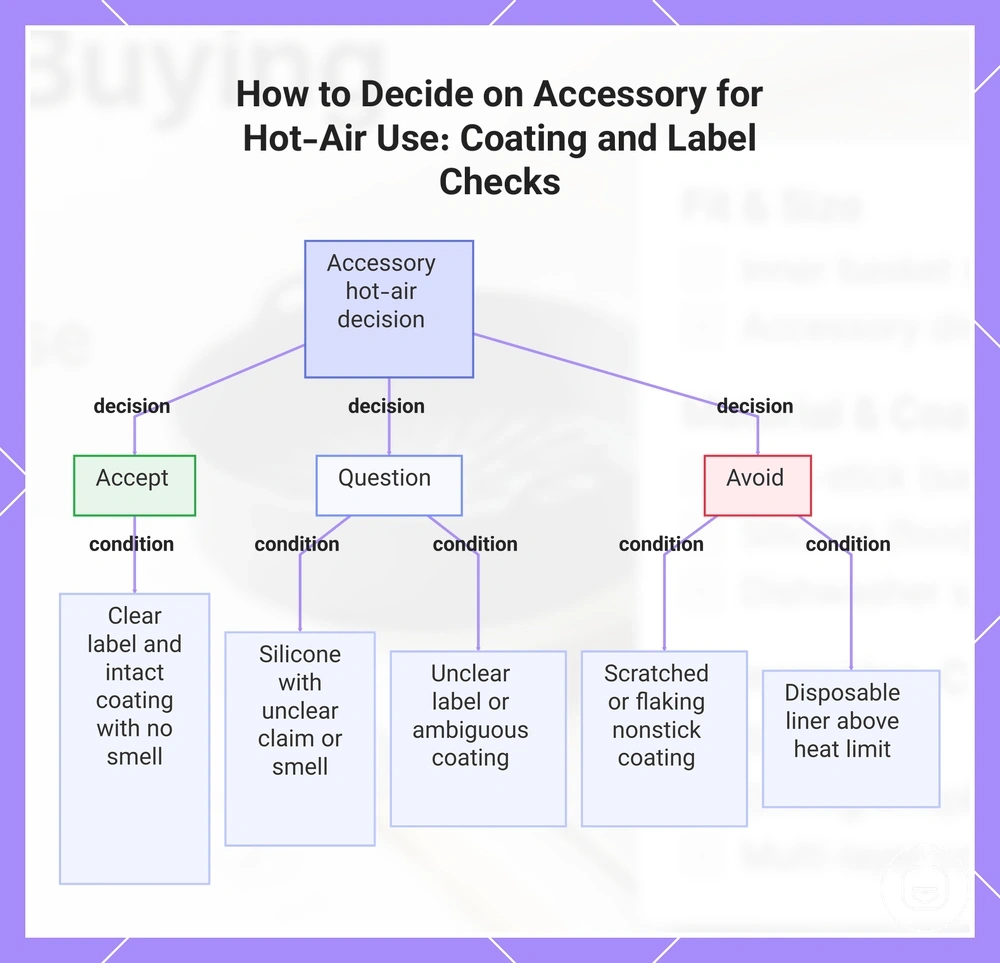
Unclear material labels, smell, scratched surfaces, or flaking coating change how the accessory should be treated before use. A damaged nonstick surface or weak food-contact claim may indicate reduced reliability under repeated heating. These conditions should be assessed before deciding accept, question, or avoid.
Food-contact and coating claims should be checked together before the accessory touches food or hot air. The decision depends on visible surface condition and label clarity. Use the checks below to guide handling of uncertain cases.
- Clear food-contact label + intact coating + no smell → accept when surface condition remains stable under heat use
- Scratched or flaking nonstick coating → avoid due to coating integrity loss and surface wear
- Silicone with unclear claim or unusual smell → question and verify before use within heat limit conditions
- Disposable liner exceeding stated heat limit → avoid due to risk of material breakdown under hot air exposure
- Unclear label or ambiguous coating condition → question until label clarity and integrity are confirmed
This decision tree helps determine whether to accept, question, or avoid using an accessory in hot air based on its food-contact label and coating condition.
Heat resistance and dishwasher-safe claims
Heat resistance and dishwasher safe are separate conditions that answer different material questions. Heat resistance relates to heat exposure during cooking, while dishwasher safe relates to cleaning exposure after use.
These claims should not be interpreted as interchangeable. Heat exposure depends on cooking conditions, while cleaning exposure depends on repeated cleaning cycles, coating condition, seams, and manufacturer condition. Treating them as the same can lead to incorrect assumptions about safe use.
| Condition | Heat exposure (heat resistance) | Cleaning exposure (dishwasher safe) |
|---|---|---|
| Silicone accessory | May handle cooking heat depending on stated heat resistance | May be dishwasher safe depending on manufacturer condition |
| Nonstick coated surface | Heat tolerance depends on coating type and stability | Repeated cleaning may affect coating condition over time |
| Metal / stainless steel part | Generally stable under heat exposure | Dishwasher use depends on seams and finish condition |
| Disposable liner | Limited heat exposure based on heat limit | Not designed for repeated cleaning exposure |
Repeated dishwasher cycles, weak seams, or degraded coating conditions can influence durability over time. Heat resistance does not guarantee cleaning durability, and dishwasher safe does not guarantee heat performance under cooking conditions.
Set, bundle, and individual accessory value checks
Value depends on usable pieces, fit confidence, and likely frequency, not piece count. An accessory set or bundle only creates real value when included pieces match actual cooking needs and basket fit conditions. When usable pieces are limited, overall value drops even if the purchase format looks complete.
Large bundles often include duplicate pieces or low-use items that do not match repeated cooking habits. This reduces usable value because part of the bundle remains unused in real cooking situations. The comparison table below shows how purchase formats differ based on included pieces, usable pieces, fit confidence, and frequency signals.
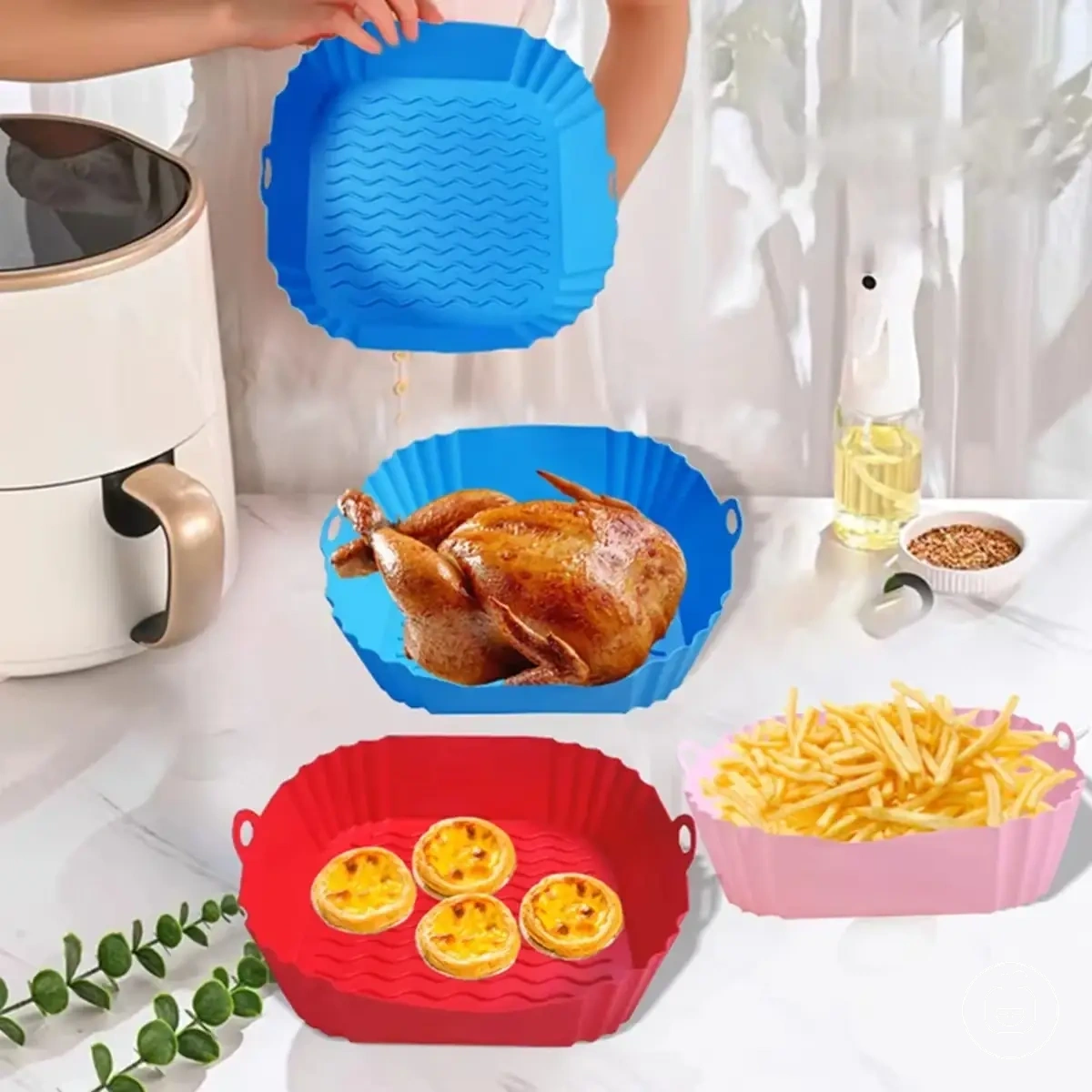
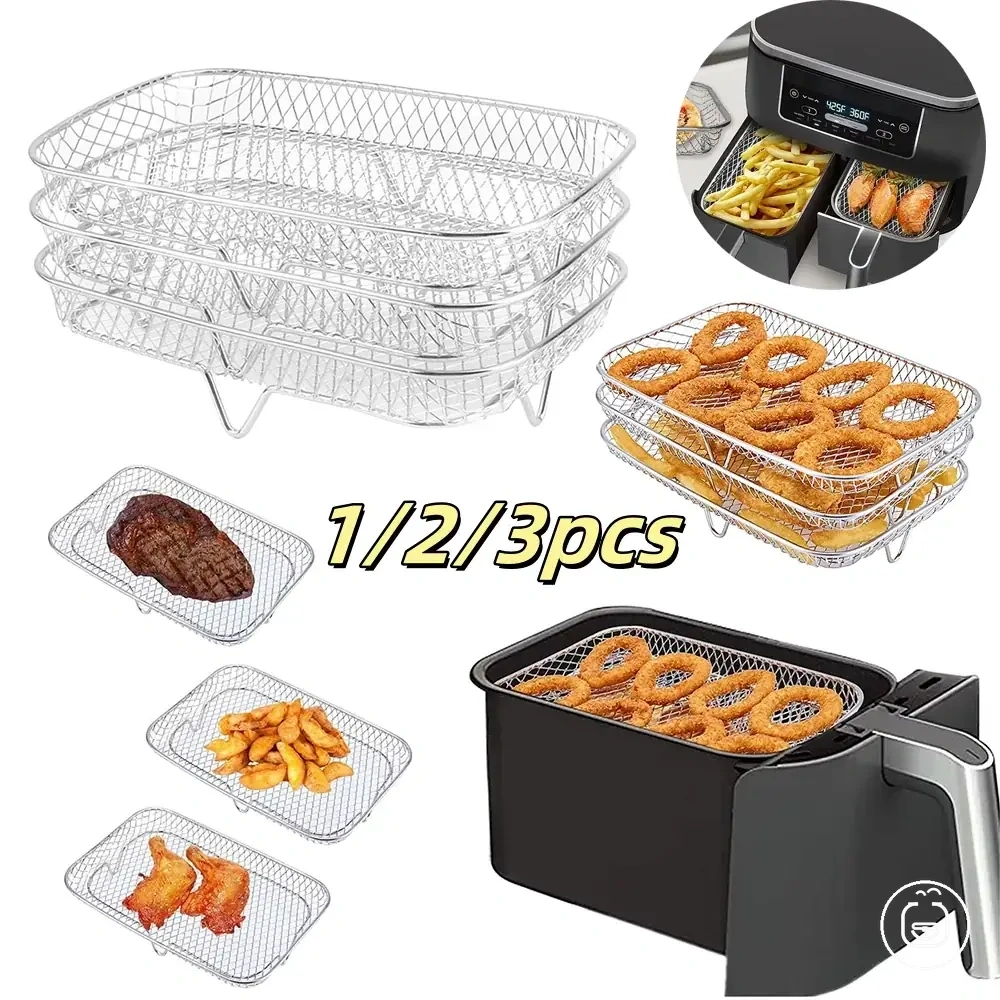
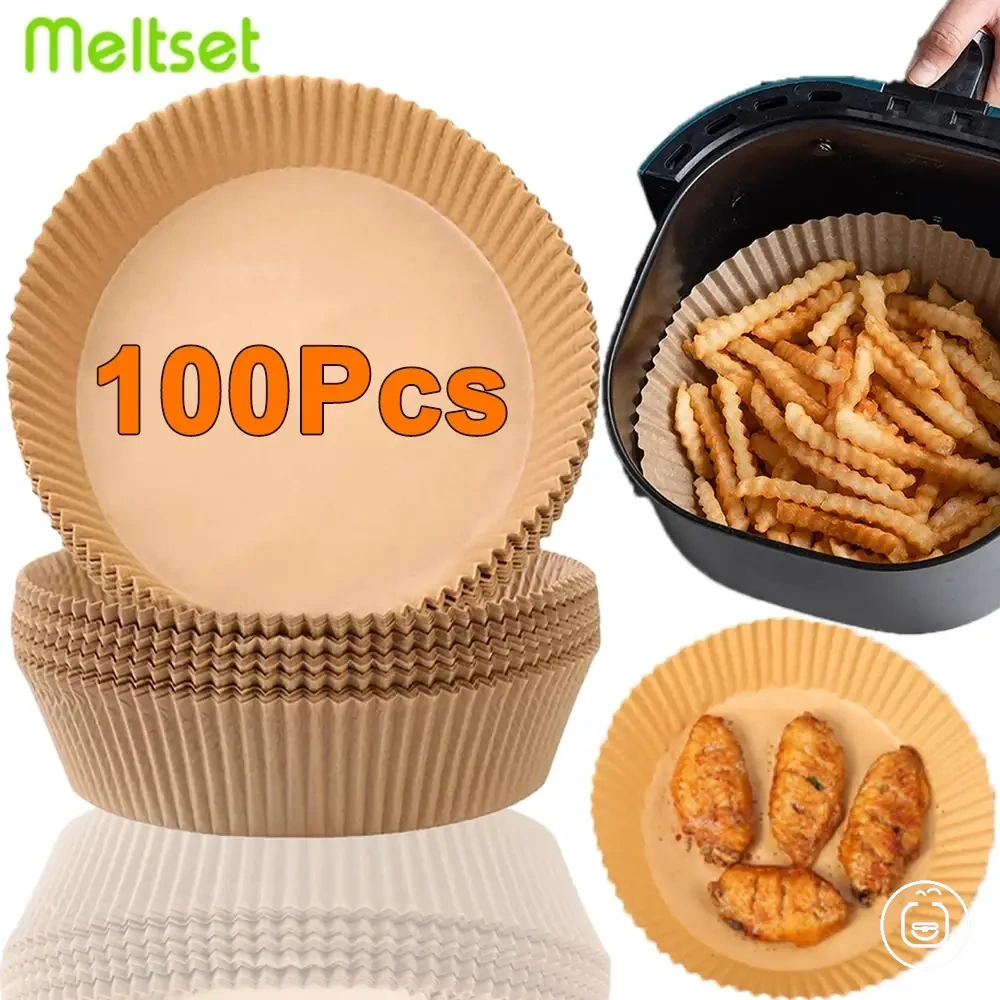
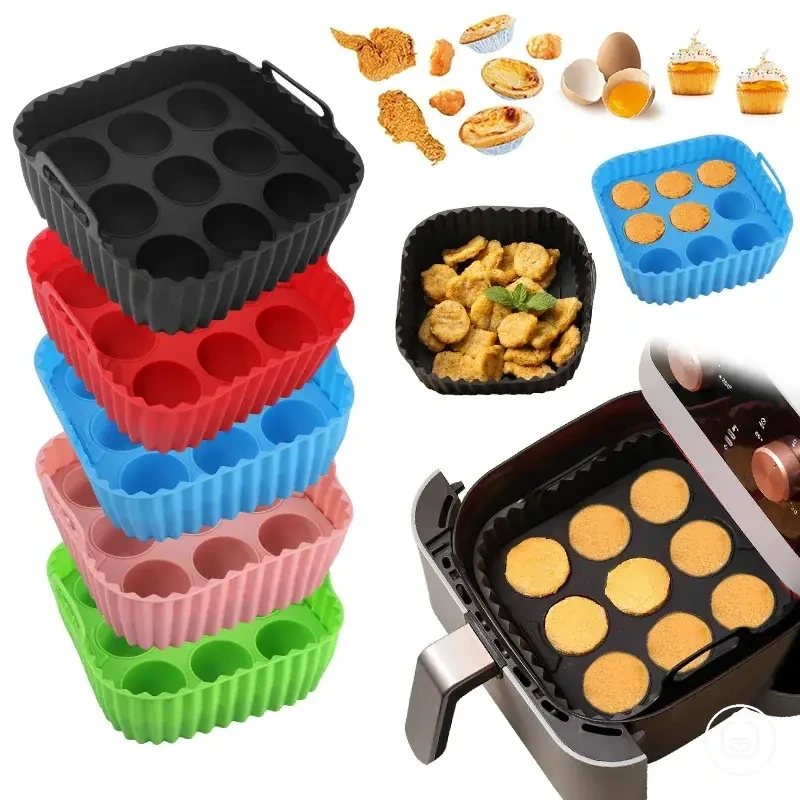
A liner and rack set may offer stronger value when both items match repeated cooking needs, while a broader bundle can include mixed accessories with uneven fit confidence. An individual accessory is often more suitable when only one function is missing. You can evaluate accessory sets to compare purchase formats based on usage and fit.
Buy decisions depend on matching format to actual use. Choose a bundle when most included pieces are usable, choose an individual accessory when a single need exists, and skip when duplicate pieces or low-use items reduce practical value. The goal is to align purchase format with frequency and fit rather than item count.
The products below are useful examples for comparing available options. Before buying, check that the compatibility criteria, key features, and product details match your needs.
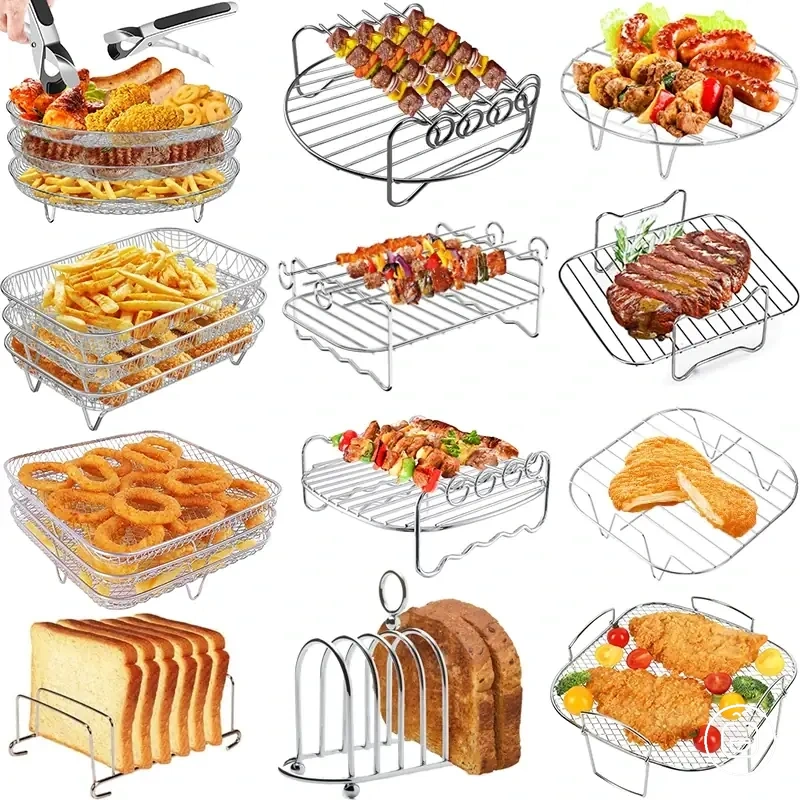
| Purchase format | Included pieces | Usable pieces | Fit confidence | Likely frequency → decision |
|---|---|---|---|---|
| Liner and rack set | Paired essential tools | High when cooking needs match | Medium to high depending on basket compatibility | Frequent use → consider set if both functions are needed |
| Broader bundle | Multiple mixed accessories | Variable due to duplicates or low-use items | Medium depending on model fit | Occasional use → skip if many items remain unused |
| Individual accessory | Single targeted item | High when addressing one clear need | High when size and fit are confirmed | Specific need → buy when one function is missing |
Duplicate pieces, unused items, and bundle fit
Bundle fit weakens when duplicate pieces, unused items, or poor overlap reduce real usefulness. Bundle value depends on how many items match actual cooking needs and basket compatibility. When overlap is high or fit status is uncertain, frequency drops and practical value decreases.
Keep, ignore, or reject decisions depend on overlap, fit status, and expected frequency. A liner that fits basket shape and supports repeated use can be kept. A duplicate pan already available should be ignored due to low added value. A mold with rare use or uncertain fit should be rejected. The compact comparison block below shows how bundle items are evaluated.
| Bundle item pattern | Overlap / fit status / frequency | Decision |
|---|---|---|
| Liner matching basket shape | Low overlap, good fit status, medium-to-high frequency | Keep (supports repeated use) |
| Duplicate pan already owned | High overlap, valid fit but redundant, low frequency | Ignore (no added value) |
| Specialty mold with rare usage | Low overlap, uncertain fit status, low frequency | Reject (limited practical use) |
| Extra rack with similar function | High overlap, partial redundancy, medium frequency | Ignore or reject (depends on need overlap) |
| Low-use accessory with unclear function | Medium overlap, unclear fit status, very low frequency | Reject (unused item risk) |
Airflow, handling, and cooking-result checks
Accessory use should preserve airflow, handling space, and cooking consistency during use. Airflow must remain open, handling must stay safe, and cooking result stability should not be disrupted by accessory placement.
Racks, liners, pans, trays, and tongs affect airflow and handling in different ways. A rack changes air circulation through elevation and spacing, while a liner can reduce airflow if perforations are blocked. A pan or tray changes food contact and heat exposure patterns, and tongs mainly support grip and safe removal. These differences determine whether accessory placement supports or risks cooking consistency. The mini-checklist below organizes practical-use checks.
Caution signs include blocked perforations, awkward removal paths, and uneven exposure caused by poor accessory placement. These conditions can reduce airflow, affect handling space, or disrupt cooking consistency depending on load and design. Checking these risks before use helps maintain safer operation and more stable results.
The products below are useful examples for comparing available options. Before buying, check that the compatibility criteria, key features, and product details match your needs.
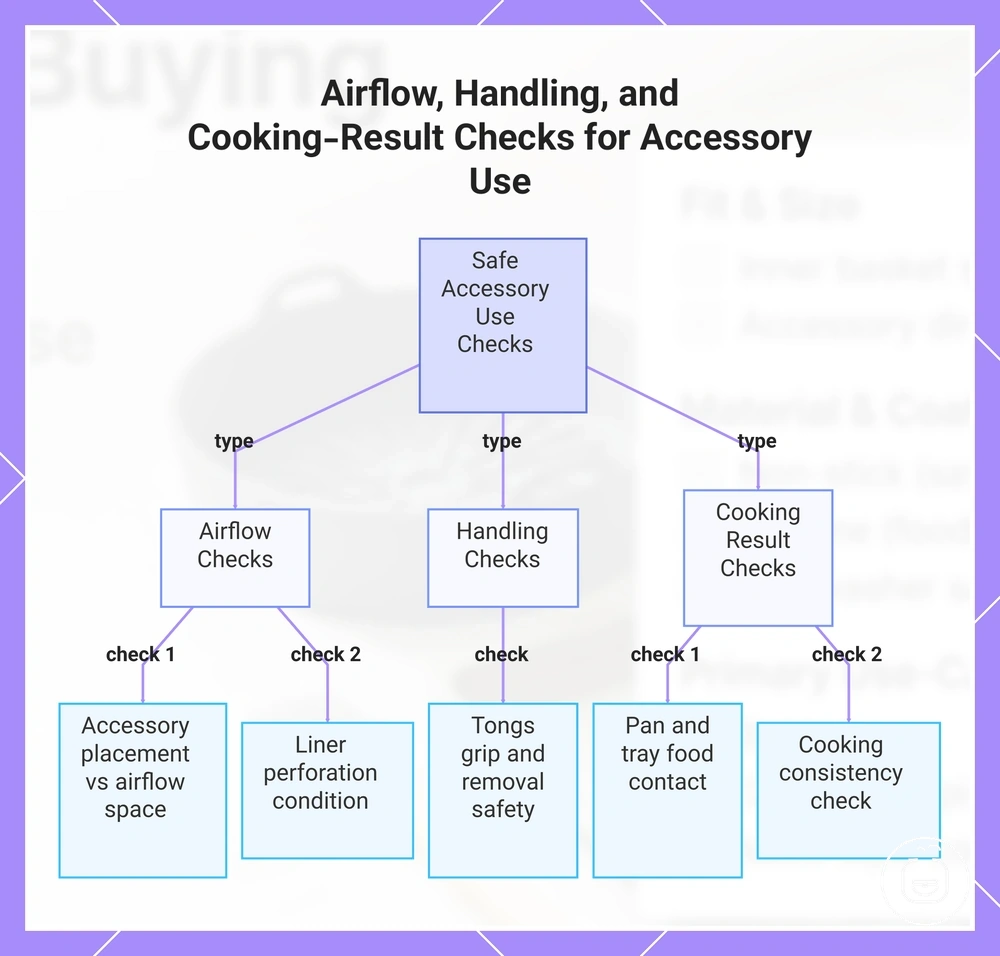
Airflow, handling, and cooking-result checks are structured below to evaluate safe use conditions:
- Accessory placement vs airflow space — ensure racks or trays do not block air circulation inside the basket
- Liner perforation condition — verify airflow openings remain clear to avoid restricted circulation
- Rack spacing effect — confirm elevation supports air movement without overcrowding food
- Pan and tray food contact — check stable placement without disrupting heat exposure zones
- Tongs grip and removal safety — ensure safe handling without disturbing hot contents
- Cooking consistency check — confirm setup avoids uneven exposure during use
This chart organizes the three categories of checks for safe accessory placement: airflow, handling, and cooking consistency.
Buying mistakes and accessory red flags
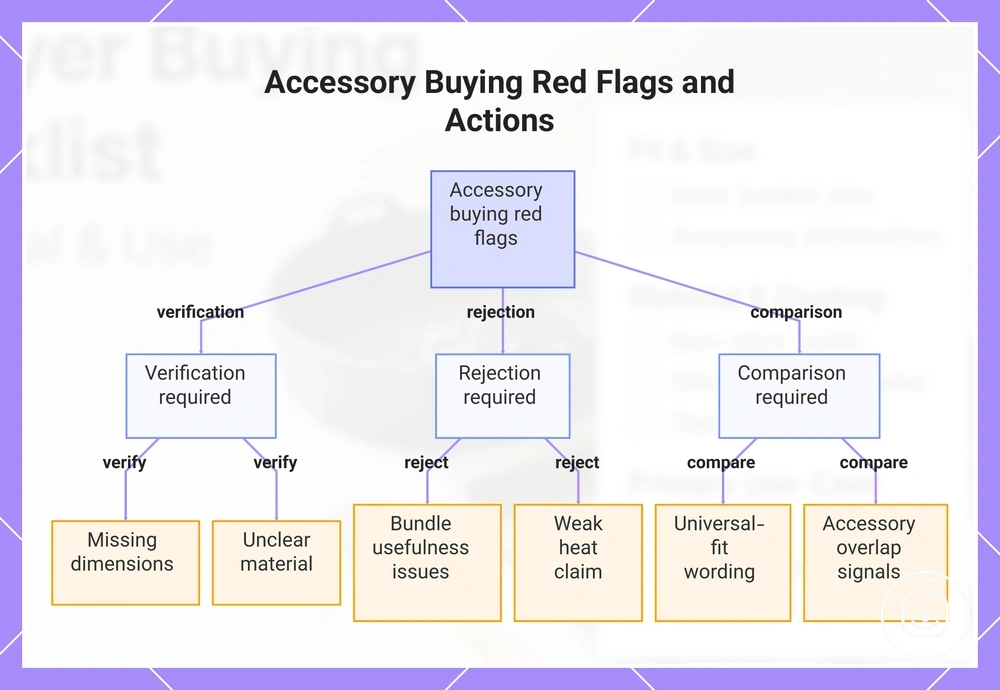
Buying mistakes and red flags are missing details or weak claims that signal you should pause before choosing an accessory. These signals usually relate to fit, material, value, and airflow risk, and they indicate where a purchase may need verification before moving forward.
Missing dimensions, unclear material descriptions, weak heat claims, and bundles with many low-use pieces create decision risk. Universal-fit wording without measurements, dishwasher-safe wording without heat context, and poor bundle usefulness can increase uncertainty. In these cases, the correct action is to pause, verify details, or reject based on unresolved risk and airflow risk conditions.
Red flags should be grouped into clear actions before final selection. Some signals require verification when details are incomplete, others require rejection when risk remains unresolved, and some require comparison again when overlap is unclear. The checklist below organizes these buying mistakes into final stop signals for decision control.
- Missing dimensions — creates fit uncertainty → pause and verify exact basket and accessory size before decision
- Unclear material — limits understanding of durability and safety → pause and verify material composition and heat context
- Weak heat claim — reduces reliability of temperature suitability → verify heat limits or reject if unsupported
- Universal-fit wording — may hide fit mismatch risk → verify measurements or compare again before selection
- Dishwasher-safe wording without heat context — separates cleaning claim from cooking safety → pause and verify both conditions
- Bundle usefulness issues — includes many low-use items → reject when overlap and frequency do not match needs
- Airflow risk from design — blocked or restricted circulation → verify placement compatibility or reject unsafe configuration
- Accessory overlap signals — duplicate tools reduce value → compare again and avoid unnecessary redundancy
This chart organizes accessory buying red flags into three action categories to help you decide whether to verify, reject, or compare before purchasing.